
Government Policy and Incentives Shaping Automotive & Mobility
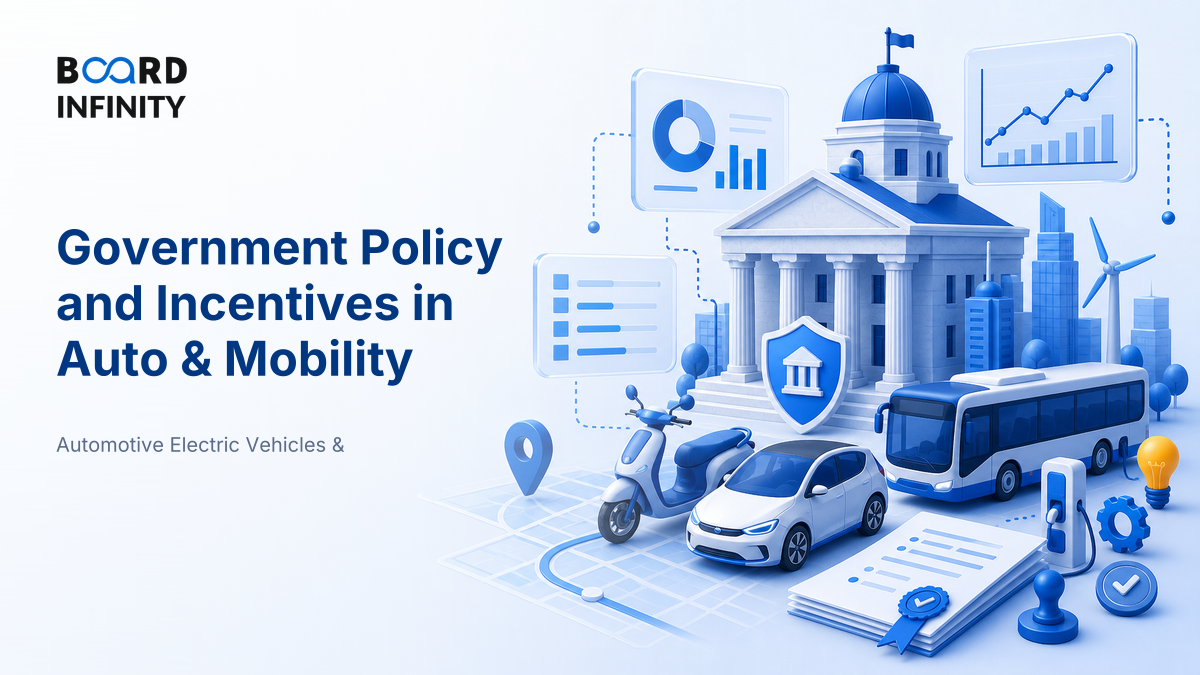
In India, an electric scooter’s price tag can change because of a government notification, not because the company changed the motor, battery or design. That is the power of policy in automotive and mobility - it quietly decides which technologies scale, where factories are built, how fleets are financed, and which players survive a subsidy shock.
- Policy shapes auto demand, supply and compliance - not just subsidies. Think incentives, standards, taxes, localisation and infrastructure.
- Demand incentives lower upfront prices for buyers; supply incentives improve manufacturing economics for firms.
- Regulation is a strategy variable: safety norms, emission rules, battery rules and scrappage policy can reshape product portfolios.
- Do not say “EV growth is because of subsidy.” The stronger answer combines TCO, charging, financing, localisation and regulation.
- Track policy impact with metrics: EV penetration, subsidy dependence, localisation ratio, TCO parity gap, charger uptime and compliance cost per vehicle.
- Interview answer structure: classify the policy, identify who it affects, trace the business impact, quantify with metrics, then discuss risks.
Big Picture - Policy Is the Invisible Hand in Auto Strategy
Automotive is one of the most policy-sensitive sectors because it touches fuel imports, jobs, safety, pollution, manufacturing investment and urban congestion. A good candidate sees policy as a market-shaping system, not as a paragraph on “government support.”
Core Explanation - The Five Ways Policy Shapes Automotive and Mobility
Government policy affects automotive and mobility through five major levers. Use this as your mental checklist whenever you discuss EVs, shared mobility, charging, scrappage, localisation or vehicle safety.
1. Demand Incentives - Making Adoption Cheaper
Demand incentives reduce the buyer’s effective cost. In EVs, this can mean purchase subsidies, registration-fee relief, road-tax concessions or preferential access for certain vehicle categories. India’s central EV demand support has included programmes such as FAME India Phase II and the newer PM E-DRIVE scheme.
The business implication is direct: when upfront price falls, adoption improves, especially in price-sensitive segments such as two-wheelers, three-wheelers and fleet vehicles. But smart firms do not build a model that collapses if the subsidy falls.
2. Supply Incentives - Making Local Production Attractive
Supply-side policy improves the economics of manufacturing. Production-linked incentives, localisation conditions, import-duty structures and state industrial policies influence where companies build plants, source batteries, localise components and choose vendors. India approved a production-linked incentive scheme for the automobile and auto-component industry in 2021 (Press Information Bureau, Government of India).
For companies, the strategic question becomes: “Can we redesign the value chain to qualify for incentives without hurting quality, cost or speed?”
3. Standards and Regulation - Changing What Can Be Sold
Regulation can force product transitions. Emission norms push cleaner powertrains. Safety standards raise minimum engineering requirements. Battery rules affect design, traceability and recycling. India’s Battery Waste Management Rules place extended producer responsibility obligations on battery producers, recyclers and refurbishers.
This is why policy is not external noise. It changes the product roadmap itself.
4. Public Infrastructure - Making New Mobility Usable
Mobility adoption depends on systems beyond the vehicle. Charging stations, road quality, digital tolling, urban parking rules, bus electrification, battery-swapping standards and city-level transport policy all affect usage. A great EV product with poor charging access will still face adoption friction.
5. Lifecycle Policy - What Happens After the Vehicle Is Sold
Scrappage, recycling, end-of-life compliance and resale-value norms influence replacement demand and circular-economy models. India’s voluntary vehicle scrappage framework is part of this lifecycle shift (Ministry of Road Transport and Highways).
The Interview Matrix - Classify Any Policy in 20 Seconds
Most candidates describe policies one by one. Strong candidates classify them. This 2x2 helps you sound structured immediately.
Use this matrix like this: identify the quadrant, then explain the channel. For example, an EV purchase incentive is direct demand support; a battery-manufacturing incentive is direct supply support; safety norms indirectly reshape supply because firms must redesign products; public charging indirectly stimulates demand by reducing range anxiety.
Definitions You Should Be Able to Say Cleanly
- Government policy: A public rule, priority or programme that guides market behaviour through law, funding, standards or permissions.
- Incentive: A financial or regulatory benefit designed to make a preferred behaviour more attractive.
- Demand incentive: A benefit that reduces buyer cost or adoption friction.
- Supply incentive: A benefit that improves producer economics, capacity creation or localisation.
- Homologation: Official approval that a vehicle meets required safety, emission and technical standards.
- Total cost of ownership: Purchase price plus operating, financing, maintenance and resale costs over the vehicle’s life.
Metrics to Track Policy Impact in Automotive and Mobility
Policy discussion becomes interview-grade when you attach metrics. Use these measures to connect a scheme or regulation to business outcomes.
For India-specific data, candidates often triangulate registrations from the VAHAN dashboard and then combine it with company disclosures. If you need a quick method for regulator discovery, revise locating the regulator and what it controls.
Mini Case Study - BluSmart and Policy-Aligned Electric Mobility
BluSmart built an all-electric ride-hailing model where policy tailwinds helped, but operating discipline determined whether the model could work.
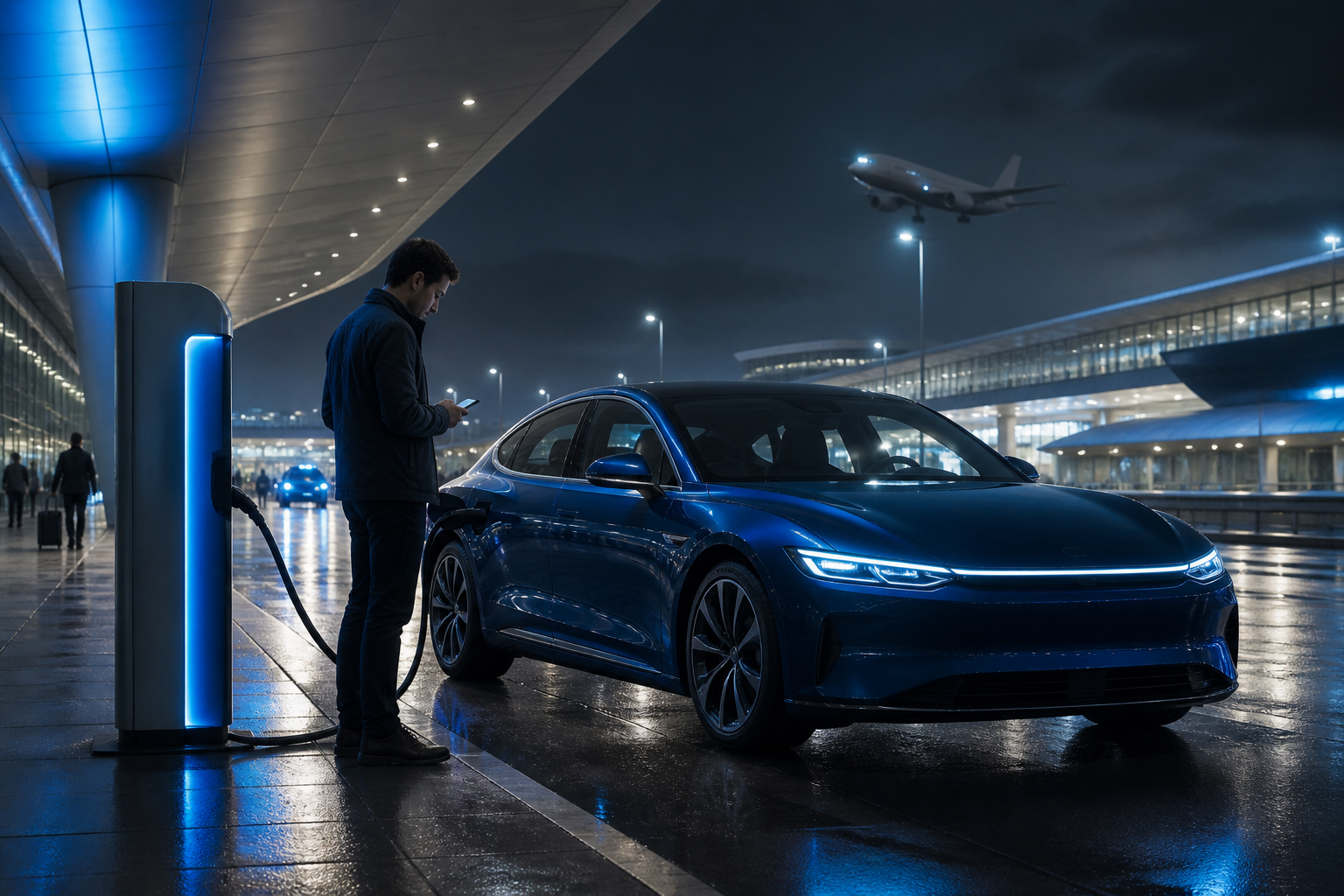
BluSmart is a useful case because it is not simply an EV manufacturer story. It sits at the intersection of EV policy, urban mobility, charging infrastructure and fleet economics. The company positions itself as an all-electric ride-hailing service on its own platform (BluSmart), which means its economics are shaped by vehicle costs, charging access, driver productivity and city demand patterns.
Situation: Urban ride-hailing had two pressures: customer demand for reliable mobility and policy pressure to reduce emissions. EVs looked attractive for fleets because high utilisation can make operating-cost savings more meaningful than for private owners.
The move: BluSmart aligned its model with the policy direction toward clean mobility, but the primary driver was not “subsidy.” The primary driver was fleet-level total cost of ownership. Supporting drivers included controlled charging access, airport and urban demand corridors, predictable fleet operations, and the ability to manage vehicles as assets rather than only as marketplace supply.
Outcome and lesson: The strategic lesson is that mobility firms win when policy support matches a real operating model. Incentives can lower the launch barrier, but the moat comes from utilisation, charging reliability, customer experience and unit economics.
How AI Changes Government Policy and Incentives Shaping Automotive & Mobility
AI is changing how companies monitor, interpret and respond to auto policy. The advantage is not “AI knows policy.” The advantage is faster scenario thinking with human verification.
Student workflow: Load a company annual report, one policy document and recent official notifications into NotebookLM. Ask: “Identify the top five policy risks and opportunities for this company’s automotive or mobility strategy, and show the source line for each.” Then verify every claim manually. For safer prompting habits, revise using AI to research a sector without importing its errors.
Interview Relevance
“How do government policies and incentives shape the automotive and mobility sector in India? Give an example.”
If the interviewer asks about one policy, do not stop at describing it. Say who pays, who benefits, which company capability becomes more valuable, and what happens if the policy is withdrawn.
Common Mistake
The mistake: Saying “government subsidy drives EV growth” as if that is the whole story. Why it costs candidates: it sounds shallow and ignores TCO, charging, financing, battery costs, localisation, safety norms and fleet utilisation. One-line fix: say “subsidy can accelerate adoption, but sustainable growth comes from TCO parity plus infrastructure, regulation, financing and execution.”