
Hunter vs Farmer: Two Sales Role Types
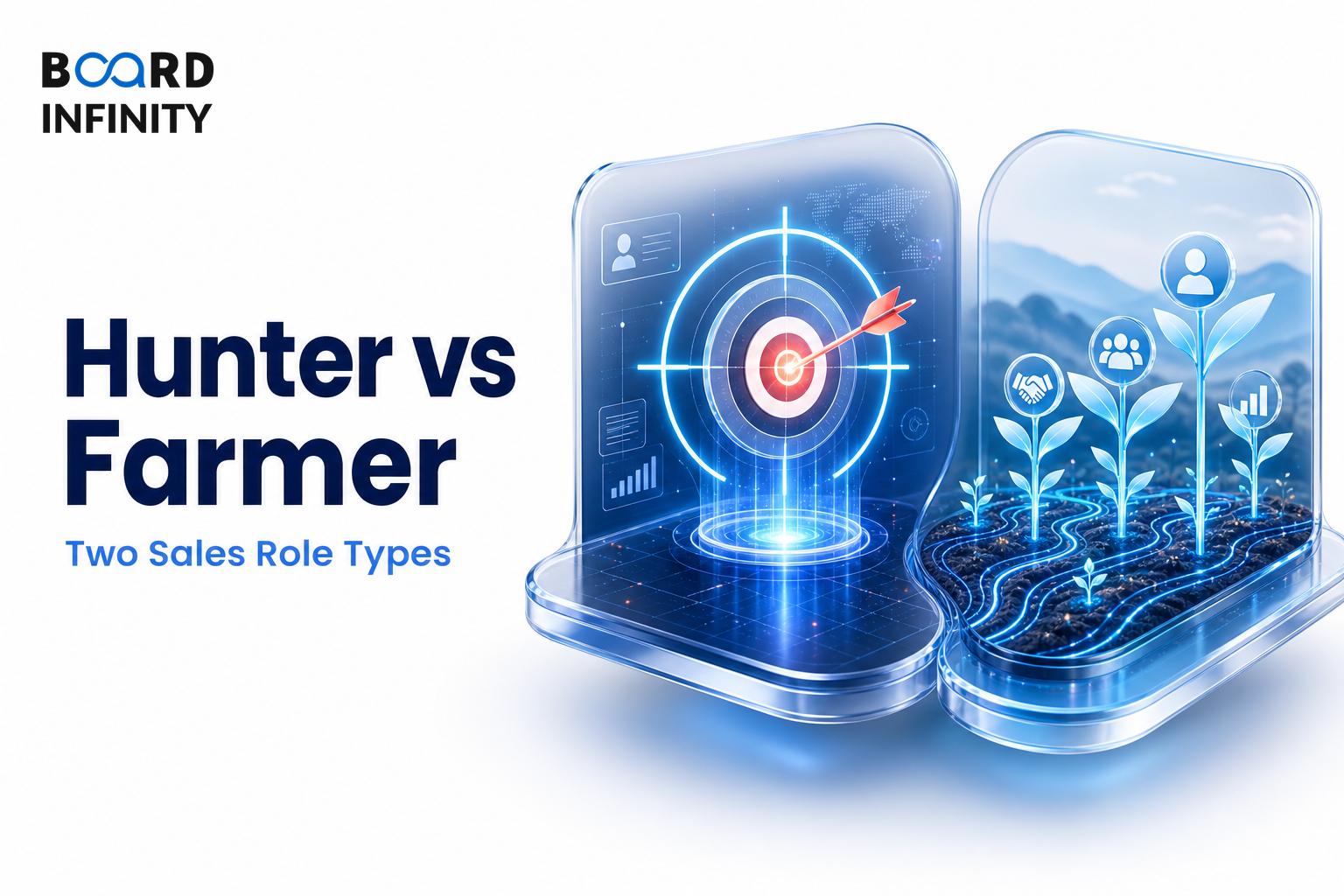
After MEDDPICC: The B2B Sales Qualification Framework, the next practical question is how sales teams divide responsibility once opportunities enter the funnel. Hunter vs Farmer answers that by separating acquisition-focused selling from relationship-led account growth. In interviews, this matters because it shows whether you understand how sales roles, activities, metrics, and handoffs differ across the customer journey.
- Sales teams are commonly structured around two archetypes based on their primary function: Hunter and Farmer.
- A Hunter's primary role is to acquire new clients.
- A Farmer's primary role is to grow existing accounts.
- Hunter activities include cold outreach, business development, and new logos.
- Farmer activities include upsell, cross-sell, renewals, and relationship mgmt.
- Hunter metrics include new logos, pipeline generation, and new MRR, while Farmer metrics include Net Revenue Retention, expansion MRR, and NPS.
- In practice, many organisations use a hybrid model where Account Executives act as hunters during new business acquisition and transition accounts to Customer Success Managers post-sale.
Hunter-Farmer Model Overview
Sales teams are commonly structured around two archetypes based on their primary function. The Hunter role is centred on acquiring new clients, while the Farmer role is centred on growing existing accounts.
Hunter Sales Role
Hunter refers to the sales role focused on new business acquisition. The primary role is to acquire new clients, and the core activities are cold outreach, business development, and new logos.
The Hunter mindset is aggressive, deal-focused, and high energy. The metrics used to evaluate this role are new logos, pipeline generation, and new MRR. MRR means monthly recurring revenue, so new MRR tracks recurring revenue added from new clients.
Farmer Sales Role
Farmer refers to the sales role focused on existing account growth. The primary role is to grow existing accounts, and the core activities are upsell, cross-sell, renewals, and relationship mgmt.
The Farmer mindset is patient, relationship-focused, and strategic. The metrics used to evaluate this role are Net Revenue Retention, expansion MRR, and NPS. NPS means Net Promoter Score, and it appears here as a relationship and account-health metric.
How the Sales Cycle Differs
For Hunters, the sales cycle is longer because they are building from scratch. For Farmers, the sales cycle is shorter because trust is already established.
This distinction is the practical reason the model is useful. New client acquisition requires creating interest, building credibility, and developing pipeline, while existing account growth starts from an already-established relationship.
Hybrid AE-to-CSM Handoff Model
In practice, many organisations use a hybrid model. Account Executives (AEs) act as hunters during new business acquisition and transition accounts to Customer Success Managers (CSMs, farmers) post-sale.
This hybrid model keeps the acquisition motion and the relationship-growth motion connected without treating them as the same job. The AE owns the new business acquisition motion, while the Customer Success Manager takes over the post-sale farming motion.
Structuring a Hunter vs Farmer Interview Answer
"How would you explain the Hunter vs Farmer model in a sales team?"
Do not stop at personality labels like aggressive versus patient. A strong answer connects primary role, activities, metrics, sales cycle, and the AE-to-CSM handoff model.
The most frequent error is treating Hunter and Farmer as interchangeable sales labels. The model separates primary function: acquire new clients versus grow existing accounts, and that difference changes activities, mindset, metrics, and sales cycle.
Conclusion
Hunter vs Farmer is a simple way to explain how sales teams divide new business acquisition from existing account growth. In interviews, use the model to show the contrast between roles, metrics, sales cycles, and the practical AE-to-CSM handoff used in many organisations.