
The Sales Funnel: Stages Explained
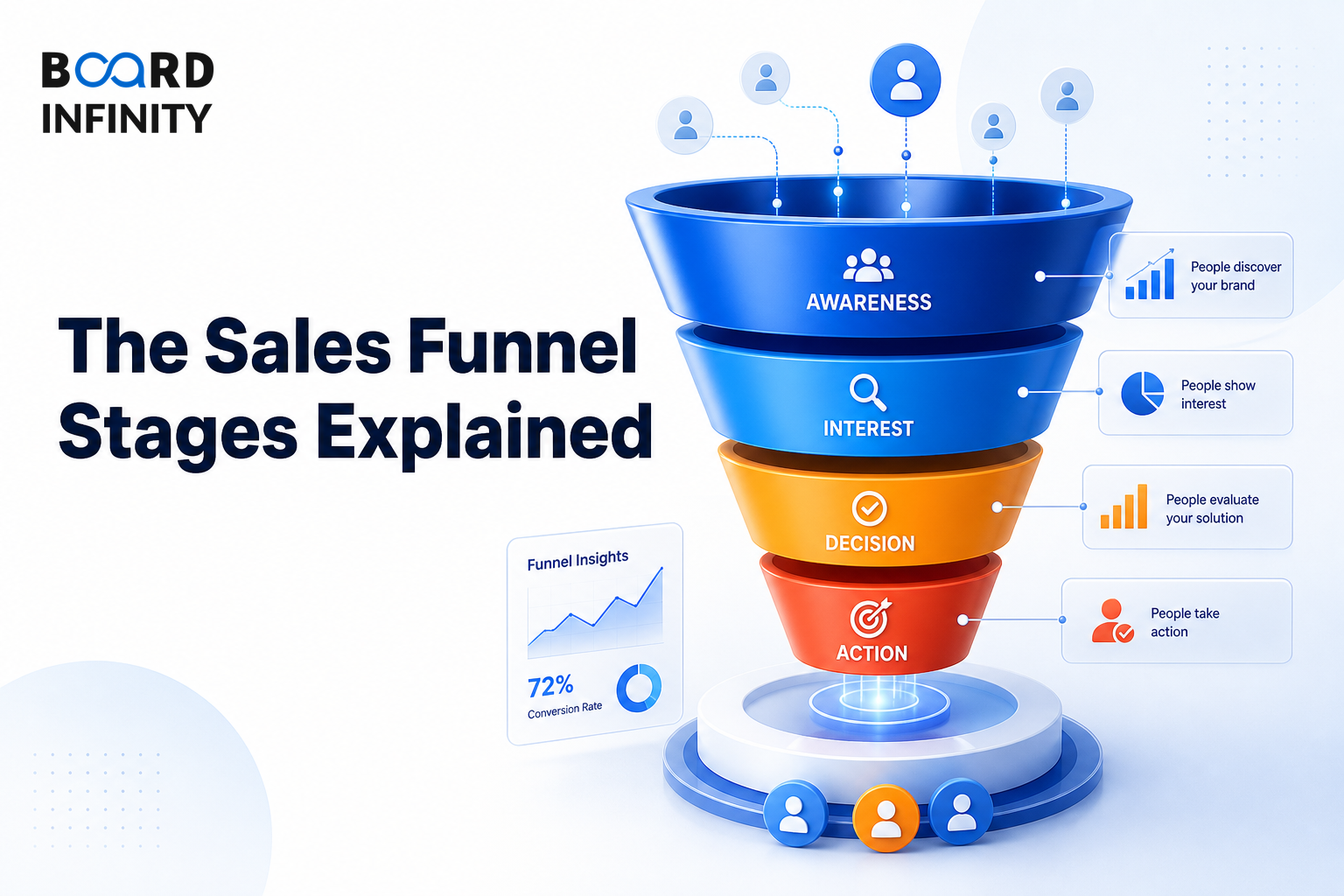
The sales funnel is a practical way to understand how prospects move from first awareness to final purchase. In sales interviews, it matters because it shows whether you can track prospect movement, identify drop-off points, and connect conversion rates to qualification quality.
- The sales funnel maps the buyer's journey from first awareness to final purchase.
- Each stage narrows the pool of prospects, reflecting increasing qualification and commitment.
- Understanding the funnel helps sales teams allocate effort and identify drop-off points.
- The core stages are Awareness (TOFU), Interest, Consideration, Intent, Evaluation, and Purchase.
- Modern sales funnels are non-linear - prospects may skip stages, revisit earlier stages, or enter mid-funnel.
- The key metric at each stage is the conversion rate to the next stage.
Big Picture Overview
The sales funnel maps the buyer's journey from first awareness to final purchase. Each stage narrows the pool of prospects, reflecting increasing qualification and commitment.
The key metric at each stage is the conversion rate to the next stage.
Why the Sales Funnel Matters
Understanding the funnel helps sales teams allocate effort and identify drop-off points. When the pool narrows from Lead to Marketing Qualified Lead (MQL), Sales Qualified Lead (SQL), Opportunity, and Closed Won, the movement reflects increasing qualification and commitment.
The funnel is useful because it does not only show final purchase. It shows where prospects are entering, where they are progressing, and where they are dropping off before commitment becomes strong enough to close.
How to Read the Funnel Percentages
The funnel snapshot begins with Lead at 100%, then moves to MQL at 25%, SQL at 15%, Opportunity at 10%, and Closed Won at 3%. These numbers show how each stage narrows the pool of prospects.
For interview use, the important point is not only the final Closed Won figure. The bigger insight is that conversion rate to the next stage helps identify drop-off points and reveals whether prospects are becoming more qualified as they move forward.
Modern Funnels Are Non-Linear
Modern sales funnels are non-linear - prospects may skip stages, revisit earlier stages, or enter mid-funnel. This means the funnel should be used as a tracking model, not as a rigid assumption that every buyer follows the same path in the same order.
The practical implication is simple: sales teams should still measure conversion rate at each stage, but they should expect movement to vary depending on how the prospect discovers the brand, engages with outreach, evaluates alternatives, and signals buying intent.
Structuring a The Sales Funnel Interview Answer
"How would you explain the sales funnel and use it to identify drop-off points?"
Do not describe the funnel only as a list of stages. Connect it to allocation of effort, increasing qualification and commitment, drop-off points, and conversion rate to the next stage.
The most frequent error is treating the sales funnel as a fixed linear path. Modern sales funnels are non-linear - prospects may skip stages, revisit earlier stages, or enter mid-funnel, so interview answers should focus on tracking conversion and identifying drop-off points.
Conclusion
The sales funnel maps how prospects move from awareness to purchase, while each stage narrows the pool through increasing qualification and commitment. Use it to allocate sales effort, monitor conversion rates, and diagnose where prospects drop off before becoming Closed Won.