
Java Roadmap for Spring Boot Developers: What to Learn Before Writing Your First Spring App
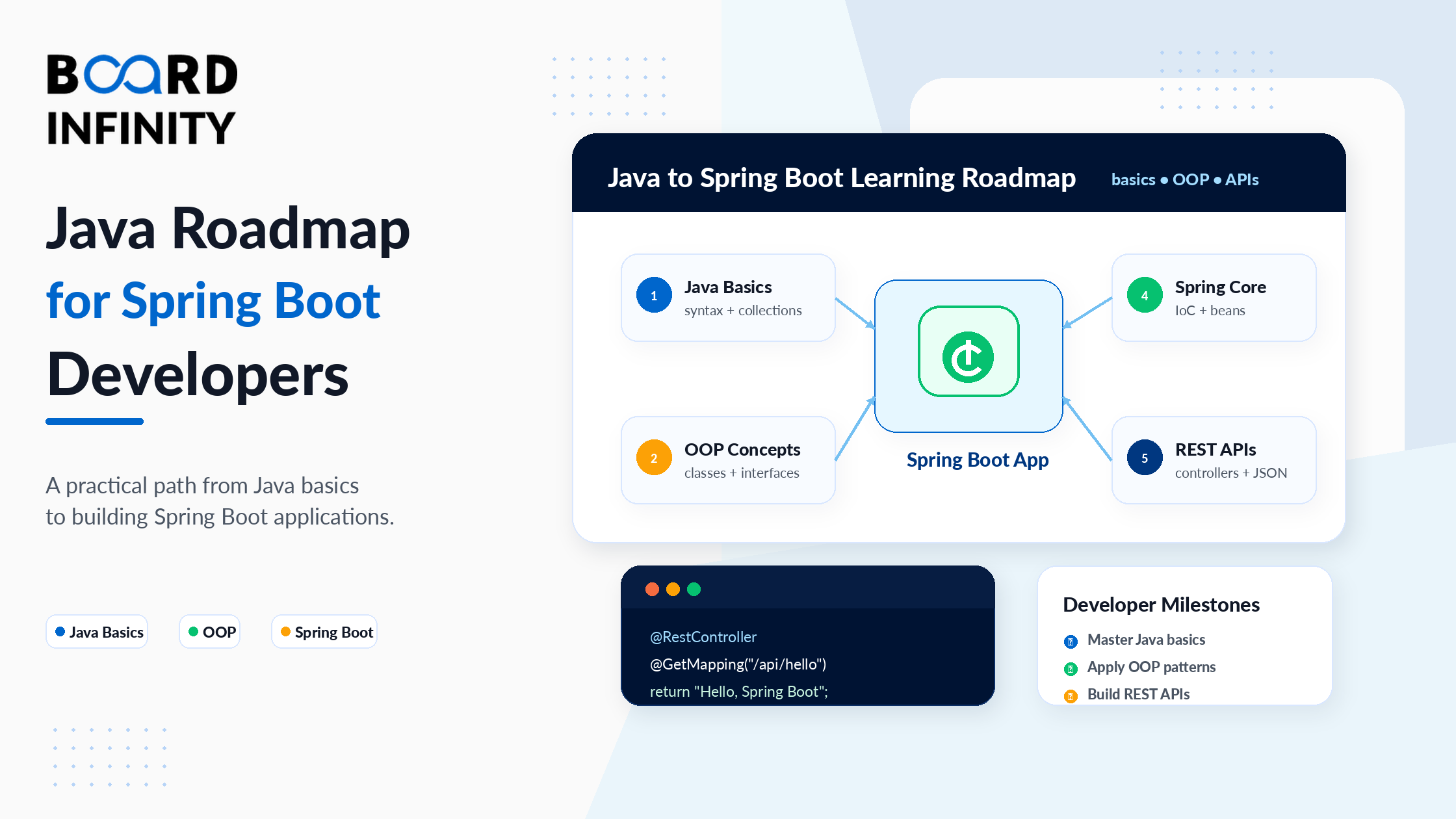
Every week, thousands of developers open a Spring Boot tutorial, get through the "Hello World" app, and then completely freeze when they encounter @Autowired, Optional<T>, or a List<UserDto>. The tutorial didn't fail them. Their Java did.
There's a persistent myth in developer communities: "Spring Boot is so beginner-friendly, you can learn Java and Spring Boot simultaneously." That advice has wasted months of learning time for thousands of developers. The framework doesn't cause the confusion - shaky Java foundations do.
Spring Boot is not a standalone framework. It is deeply Java-native. Every annotation is powered by Java reflection. Every dependency injection relies on interfaces. Every data layer uses generics. When you skip Java fundamentals and jump straight to Spring Boot, you are not learning Spring - you are copying code you do not understand. Board Infinity's Core Java Concepts and Syntax guide is a great companion read alongside this article.
Who This Is For
Java Platform Basics: JDK, JVM, JRE - What Actually Matters
Before writing a single line of code, you need to understand what happens when that code runs. Spring Boot applications compile to bytecode, load into a JVM, and execute in a managed runtime environment. Understanding this architecture helps you diagnose real production errors - not just copy-paste fixes from Stack Overflow. Board Infinity's guide on how the JVM works in Java covers this in depth.
java -version in your terminal right now. Still on Java 8 or 11? Upgrade to Eclipse Temurin JDK 21 LTS — it is free and production-ready. Use IntelliJ IDEA Community Edition as your IDE.
OOP Concepts That Spring Is Literally Built On
Object-Oriented Programming is not optional background knowledge for Spring developers — it is the mechanism through which Spring works. When you annotate a class with @Service, Spring uses OOP to instantiate it, manage its lifecycle, and inject its dependencies. A solid understanding of Java OOP concepts is non-negotiable before touching Spring.
1. Classes and Objects — The Blueprint of Every Spring Component
In Spring Boot, every component is a class. Controllers, services, repositories — all are regular Java classes and objects that Spring manages as beans.
2. Encapsulation — How Spring Entities Protect Their Data
Encapsulation keeps a class's internal data private and exposes only what is needed via getters and setters. This is why every Spring @Entity uses private fields. Read Board Infinity's post on Abstraction vs Encapsulation in Java for a deeper look.
3. Interfaces — The Backbone of Spring's Architecture
Spring's entire architecture depends on interfaces. The JpaRepository you extend is an interface. UserDetails in Spring Security is an interface. ApplicationContext is an interface. Understanding how interfaces enable multiple inheritance in Java is understanding how Spring works under the hood.
Java Collections: The Data Structures Spring Uses Constantly
Every Spring Boot application manages data — user lists, role sets, configuration maps, error responses. The Java Collections Framework is how you store, retrieve, and process all of it. Start with Board Infinity's post on Java List and then explore HashSet in Java for the Set side.
List and Map — those angle brackets are Java Generics. Without understanding generics, Spring's type system will constantly confuse you. Also study Wrapper Classes and autoboxing — they appear everywhere collections meet primitive values.
Exception Handling: How Every Spring Service Stays Alive
A Spring Boot API that crashes on unexpected input is a broken API. Exception handling separates professional applications from hobby projects. You will use it in every service method, every repository call, every controller. Board Infinity's guide on throw and throws in Java is essential reading here.
Modern Java Features: Lambdas, Streams & Optional
Java 8 introduced features that Spring Boot now relies on throughout its codebase. Lambda expressions, Streams, and Optional appear in Spring's official documentation, in every modern Spring tutorial, and in every real codebase you will work on. Board Infinity's post on Map Stream in Java is the perfect companion to this section.
opt.get() without checking isPresent() first, you will get a NoSuchElementException. Always use orElseThrow(), orElse(), or map() instead — they are safer and more readable.
Annotations & Reflection: The Magic Behind @Autowired
When you add @Component to a class, Spring automatically creates an instance and manages it. When you add @Autowired, Spring automatically injects the right dependency. This feels like magic — but it is powered by two concrete Java features: annotations and reflection.
At startup, Spring scans your classes using Java Reflection. It finds @Component, @Service, and @Repository annotations, creates instances, and registers them in the application context. Every @Autowired call uses reflection to find the matching bean and inject it.
Your Complete Pre-Spring Boot Java Checklist
Before you open a Spring Boot tutorial, make sure you can do everything on this list confidently.
The 4-Week Learning Roadmap to Spring-Ready Java
Further Reading
Board Infinity Guides:
- Core Java Concepts and Syntax
- OOP Concepts in Java
- Generics in Java
- Map Stream in Java
- Back-End Development Essentials
External Resources:
- Spring Boot Official Reference Docs
- Spring Boot Developer Roadmap — roadmap.sh
- Download JDK 21 LTS Free — Eclipse Temurin
Conclusion
Spring Boot is not hard. Spring Boot with weak Java foundations is hard. The developers who pick it up in weeks instead of months are the ones who arrived with solid Java — not the ones who skipped it hoping the framework would fill the gaps.
The Java that Spring Boot actually uses is a specific, learnable set: OOP, Collections, Exception Handling, Lambdas, Streams, and Annotations with Reflection. None of these topics require months to learn — but all of them require deliberate practice before you open your first Spring project.
Master these concepts and Spring Boot becomes exactly what it was designed to be: a productivity multiplier, not a source of confusion. Start with Module 1, follow the 4-week roadmap, and you will be writing real Spring Boot applications — not copying them.
