
Modes of Transportation in India: Freight Mix, Costs and DFC Shift
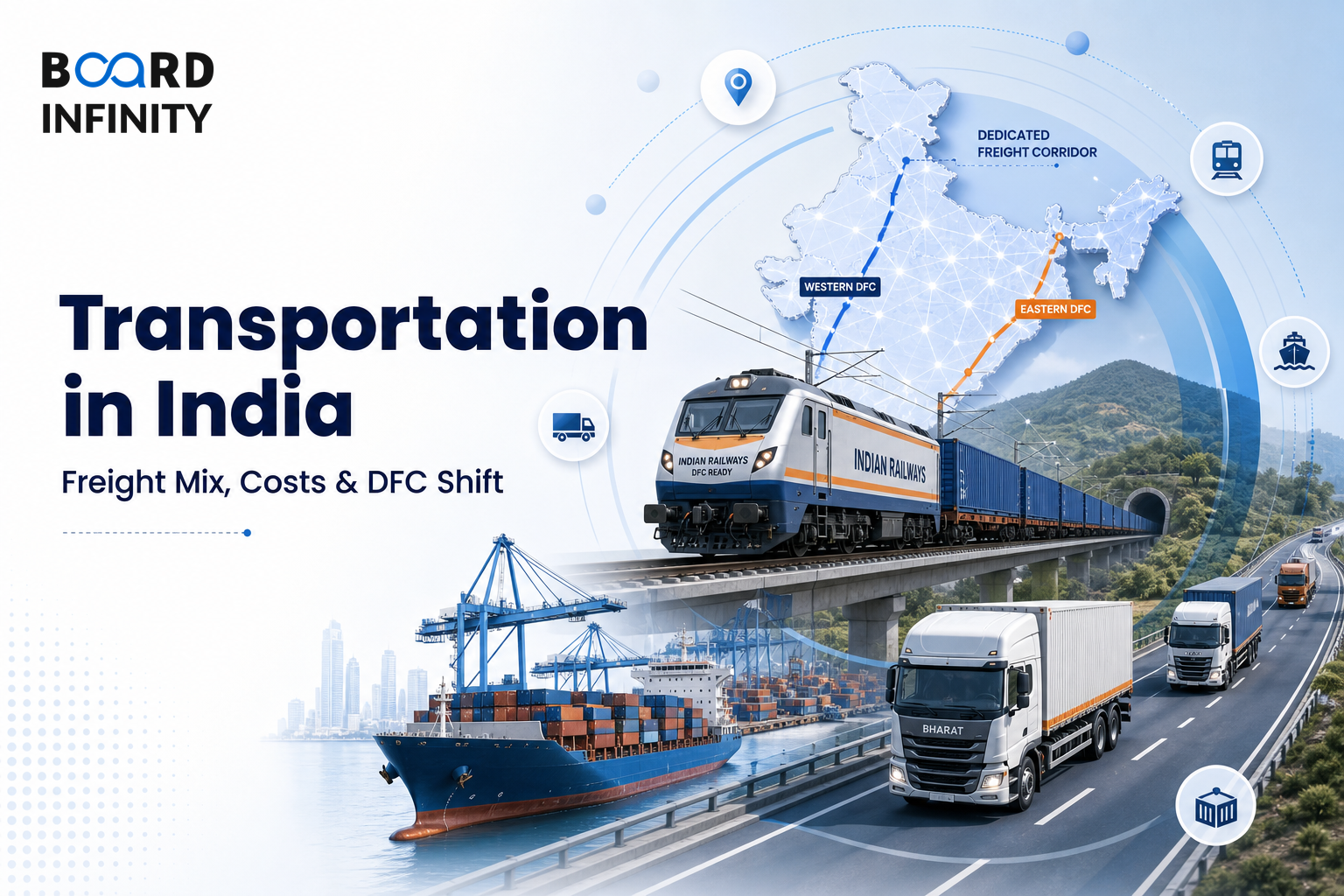
In India, freight mode choice is not just a transport question; it is a trade-off across cost per tonne-km, speed, capacity, flexibility, India share, and key infrastructure. Interviewers use this topic to test whether you can connect the freight mix to high logistics costs and the role of Dedicated Freight Corridors.
- Road has Medium cost/Ton-km, Medium speed, Low-Medium capacity, Highest flexibility, and ~65% India share.
- Rail has Low cost/Ton-km, Medium speed, Very High capacity, Low flexibility because of fixed routes, and ~27% India share.
- Air has Very High cost/Ton-km, Fastest speed, Low capacity, Moderate flexibility, and ~2% India share.
- Sea/Waterway has Lowest cost/Ton-km, Slowest speed, Highest capacity, Very Low flexibility, and ~6% India share.
- Pipeline has Very Low cost/Ton-km, Continuous speed, High capacity for liquids/gas, None flexibility, and ~1% India share.
- India's over-dependence on road transport (65%) compared to developed nations, where rail handles 40%+ of freight, is a key reason for high logistics costs.
- The Dedicated Freight Corridors aim to shift 20%+ freight from road to rail by 2030.
Big Picture: India’s Freight Mode Trade-off
The India freight mix is best read as a comparison of cost per tonne-km, speed, capacity, flexibility, India share, and the infrastructure supporting each mode. Road dominates because it has the Highest flexibility, while rail and sea/waterway offer stronger capacity advantages with lower flexibility.
Frame India’s freight mix as a trade-off between cost/Ton-km, speed, capacity, flexibility, India share, and key infrastructure.
Road Transport in India
Road has Medium cost/Ton-km, Medium speed, Low-Medium capacity, and the Highest flexibility. Its India share is ~65%, supported by NH: 1,50,000+ km, with Expressways growing.
The core nuance is that road’s flexibility explains its dominance, but India’s over-dependence on road transport (65%) compared to developed nations, where rail handles 40%+ of freight, is a key reason for high logistics costs.
Rail Transport in India
Rail has Low cost/Ton-km, Medium speed, Very High capacity, and Low flexibility because of fixed routes. Its India share is ~27%, with DFC: Eastern + Western corridors as the key infrastructure.
The Dedicated Freight Corridors aim to shift 20%+ freight from road to rail by 2030. This makes rail the major corrective shift in the India freight mix.
Air Transport in India
Air has Very High cost/Ton-km, the Fastest speed, Low capacity, and Moderate flexibility. Its India share is ~2%, with cargo hubs at Delhi, Mumbai, and Bengaluru.
In a mode comparison answer, air should be positioned through speed first, while also noting its Very High cost/Ton-km and Low capacity.
Sea and Waterway Transport in India
Sea/Waterway has the Lowest cost/Ton-km, the Slowest speed, the Highest capacity, and Very Low flexibility. Its India share is ~6%, supported by 12 major ports and the Sagarmala programme.
This mode is the clearest contrast to air: it wins on cost and capacity, while losing on speed and flexibility.
Pipeline Transport in India
Pipeline has Very Low cost/Ton-km, Continuous speed, and High capacity for liquids/gas. Its flexibility is None, its India share is ~1%, and its key infrastructure is oil, gas, and water pipelines.
Pipeline is therefore not a general freight mode; it is relevant where the shipment category matches liquids/gas or water pipeline movement.
Why India’s Freight Mix Matters
India's over-dependence on road transport (65%) compared to developed nations, where rail handles 40%+ of freight, is a key reason for high logistics costs. The Dedicated Freight Corridors aim to shift 20%+ freight from road to rail by 2030.
This is the central interview linkage: road dominance creates flexibility, but the corrective shift is toward rail capacity through Dedicated Freight Corridors.
Structuring a Modes of Transportation Interview Answer
"Why is India’s over-dependence on road transport a key reason for high logistics costs, and how can Dedicated Freight Corridors change the freight mix?"
Do not recommend a transportation mode only on speed. A strong answer compares cost/Ton-km, speed, capacity, flexibility, India share, and key infrastructure before linking road dependence to high logistics costs.
The most frequent error is saying road is the best mode because it has the Highest flexibility. That misses the bigger India context: road over-dependence is a key reason for high logistics costs, and Dedicated Freight Corridors are meant to shift 20%+ freight from road to rail by 2030.
Conclusion
India’s freight mix is a trade-off between cost, speed, capacity, flexibility, and infrastructure. The final takeaway is simple: road dominates today, but rail corridors are positioned as the major corrective shift for India’s high logistics cost problem.