
Multimodal Logistics and Dedicated Freight Corridors Explained
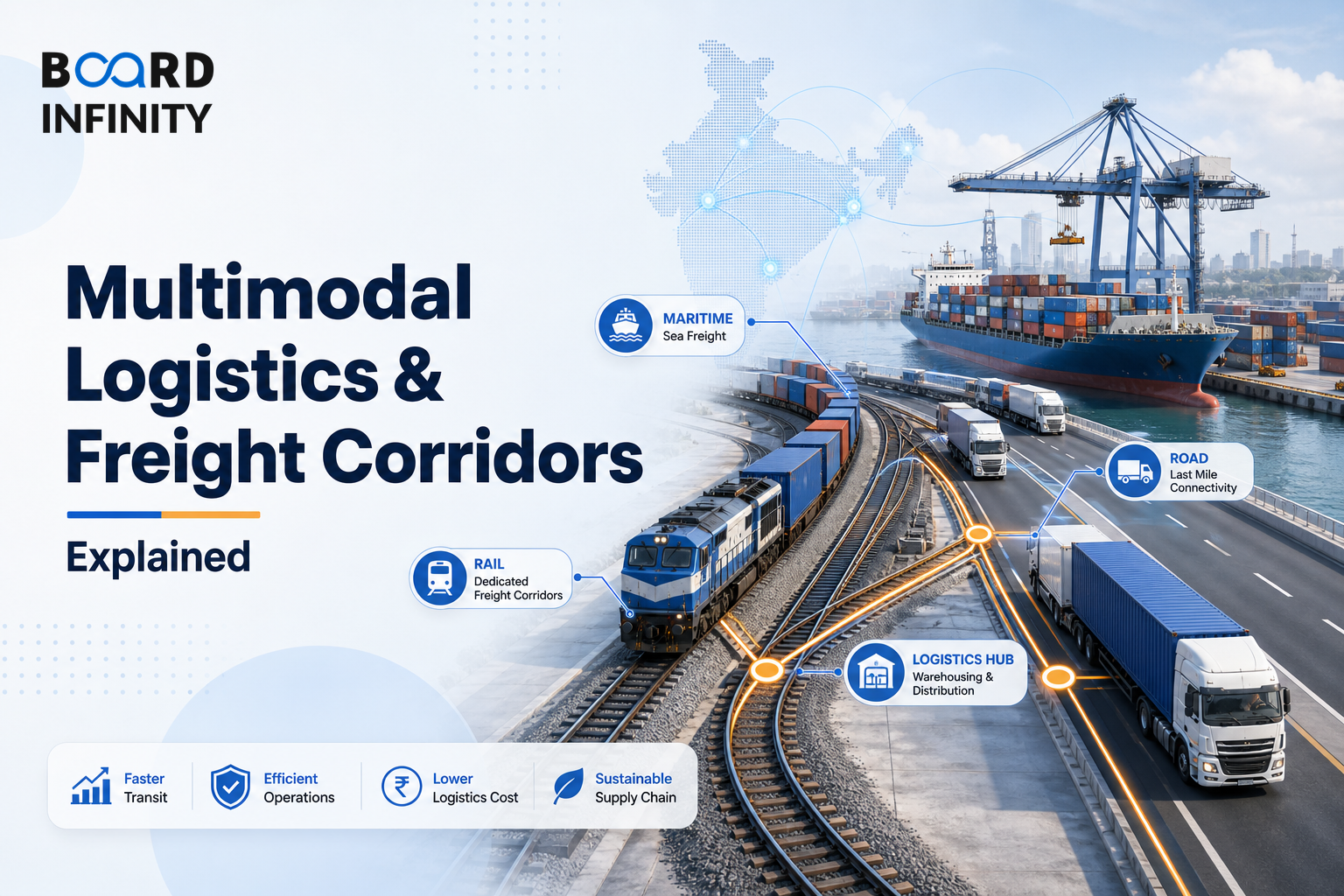
Last-mile delivery models explain how orders reach the customer through own fleets, 3PL delivery, crowd-sourced delivery, hyperlocal delivery, quick commerce, and locker/PUDO models. The bigger operations question is how freight reaches those fulfilment and delivery networks in the first place. Multimodal Logistics and Dedicated Freight Corridors explain India’s freight infrastructure map - how rail corridors, logistics parks, port modernization, and economic corridors reduce transit time and connect ports, industrial clusters, borders, and hinterland markets.
- Dedicated Freight Corridors are focused on improving freight movement through Eastern DFC and Western DFC routes.
- Eastern DFC runs Ludhiana → Sonnagar → Dankuni (1,875 km), is Operational (Phase 1), and supports coal, steel, containers - 3x freight speed.
- Western DFC runs JNPT (Mumbai) → Dadri (Delhi) (1,504 km), is Operational (Phase 1), and supports container traffic - connects ports to hinterland.
- Multi-Modal Logistics Parks cover 35 locations identified under Bharatmala and are under development as integrated road-rail-air cargo nodes.
- Sagarmala aims to modernise 12 major + 200 minor ports and reduce port turnaround time, coastal shipping boost.
- Bharatmala Pariyojana covers 34,800 km of economic corridors, with Phase 1 ongoing, to connect industrial clusters to ports & borders.
Big Picture: India’s Freight Infrastructure Map
The operational map is simple: Dedicated Freight Corridors focus on high-speed freight rail, Multi-Modal Logistics Parks create integrated road-rail-air cargo nodes, Sagarmala focuses on ports, and Bharatmala Pariyojana builds economic corridors. Together, these initiatives connect ports to hinterland, reduce port turnaround time, support coastal shipping, and connect industrial clusters to ports & borders.
Why Dedicated Freight Corridors Matter
India's over-dependence on road transport (65%) compared to developed nations (where rail handles 40%+ of freight) is a key reason for high logistics costs. The Dedicated Freight Corridors aim to shift 20%+ freight from road to rail by 2030.
Dedicated Freight Corridors, or DFCs, are dedicated freight lanes for high-volume rail movement. EDFC/WDFC allow dedicated freight lanes at 100 km/h vs current 25 km/h, supporting faster and more reliable freight movement for bulk commodities and containers.
India's Dedicated Freight Corridors (EDFC + WDFC, total ₹81,000 Cr investment) will allow freight trains at 100 km/h vs the current 25 km/h average, and double freight capacity on these routes. When complete, they represent the largest logistics infrastructure investment in Indian history.
Eastern DFC: Coal, Steel, and Containers
Eastern DFC runs Ludhiana → Sonnagar → Dankuni (1,875 km). Its status is Operational (Phase 1), and its impact on operations is coal, steel, containers - 3x freight speed.
For interview answers, Eastern DFC is useful when discussing heavy freight, bulk commodities, and industrial movement where speed and dedicated freight capacity directly affect logistics performance.
Western DFC: Port-to-Hinterland Container Movement
Western DFC runs JNPT (Mumbai) → Dadri (Delhi) (1,504 km). Its status is Operational (Phase 1), and its impact on operations is container traffic - connects ports to hinterland.
This is the clearest example for explaining how freight corridors connect ports to inland demand and production centres. In operations terms, Western DFC links container traffic with hinterland markets through a dedicated rail corridor.
Multi-Modal Logistics Parks
Multi-Modal Logistics Parks have 35 locations identified under Bharatmala. Their status is under development, and their impact on operations is integrated road-rail-air cargo nodes.
Multimodal logistics means freight movement planned across more than one transport mode. In this context, Multi-Modal Logistics Parks support integrated cargo handling across road, rail, and air, rather than treating each mode as a separate network.
Sagarmala: Port Modernization
Sagarmala focuses on modernising 12 major + 200 minor ports. Its status is ongoing, and its impact on operations is to reduce port turnaround time, coastal shipping boost.
For logistics and transportation management, Sagarmala is the port-led part of the freight infrastructure map. It matters because port turnaround time and coastal shipping affect how quickly cargo can move through sea and waterway-linked networks.
Bharatmala Pariyojana: Economic Corridors
Bharatmala Pariyojana covers 34,800 km of economic corridors. Phase 1 is ongoing, and its impact on operations is to connect industrial clusters to ports & borders.
In an interview, Bharatmala Pariyojana should be positioned as the road and corridor layer of the freight network. It supports the movement of goods between industrial clusters, ports, and borders.
How the Initiatives Fit Together Operationally
These projects should not be read as isolated infrastructure schemes. Dedicated Freight Corridors improve freight rail speed and capacity, Multi-Modal Logistics Parks act as integrated road-rail-air cargo nodes, Sagarmala improves port-linked movement, and Bharatmala Pariyojana connects industrial clusters to ports & borders.
The combined operations logic is multimodal integration: freight can move from industrial clusters through economic corridors, connect into rail freight corridors, pass through integrated cargo nodes, and link with ports and hinterland markets.
Structuring a Multimodal Logistics & Dedicated Freight Corridors Explained Interview Answer
"How do Dedicated Freight Corridors, Multi-Modal Logistics Parks, Sagarmala, and Bharatmala improve logistics operations in India?"
Do not list project names without their operational impact. Anchor every initiative to route/scope, status, and impact on operations - for example, 3x freight speed, integrated road-rail-air cargo nodes, reduced port turnaround time, or connection between industrial clusters, ports, and borders.
The most frequent error is treating DFCs, logistics parks, Sagarmala, and Bharatmala as separate facts to memorize. That loses interview points because the real operations story is how these initiatives work together to reduce transit time and connect ports, industrial clusters, borders, and hinterland markets.
Conclusion
Multimodal Logistics and Dedicated Freight Corridors are an operational map of India’s freight infrastructure. The core idea is to connect road, rail, air, ports, industrial clusters, borders, and hinterland markets so freight moves faster, with better integration across the network.