
Reverse Logistics & Returns Management Explained
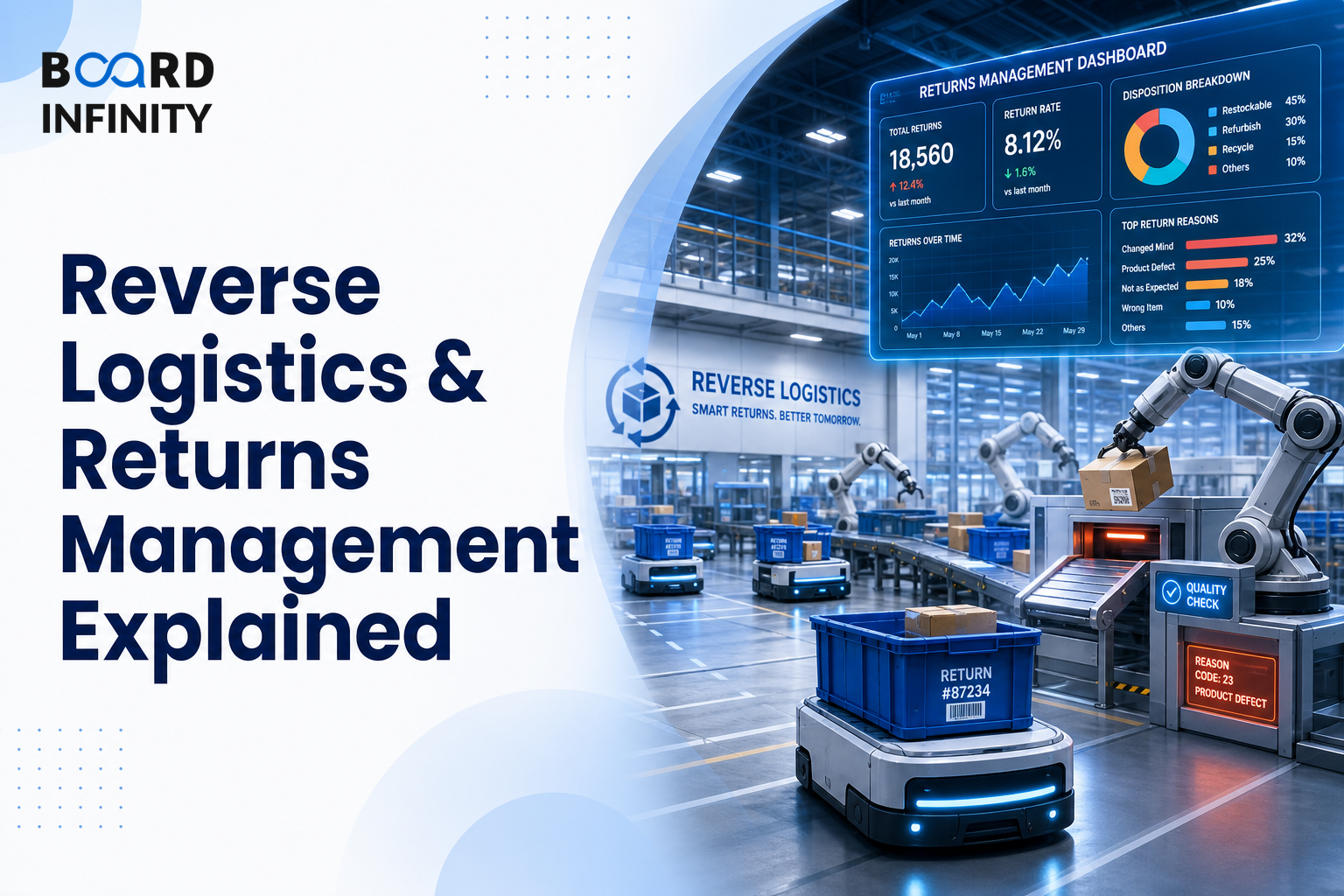
After Multimodal Logistics & Dedicated Freight Corridors explained how goods move efficiently toward customers, reverse logistics asks what happens when products move back from customer to company. In interviews, this matters because e-commerce returns are highly unpredictable, costly, and directly linked to customer satisfaction, cash recovery, resale value, and sustainability gains.
- Reverse logistics moves in the direction Customer → Company, unlike forward logistics where the direction is Supplier → Customer.
- The core flow is Customer Return Request & Pickup → Collection Hub → Inspection & Grading → Refurbish or Recycle → Re-sell or Dispose.
- Forecasting is highly unpredictable because companies do not know when returns will happen or what condition products will arrive in.
- Quality is variable - unknown condition until inspection, so A/B/C Grading becomes a critical operating step.
- Fast processing = customer satisfaction + cash recovery, while forward logistics focuses on fast delivery as a competitive advantage.
- Indian e-commerce returns are significant: fashion e-commerce sees 25-30% return rates, costing ₹200-400 per return.
- Companies like Flipkart and Amazon have built dedicated returns processing centres, and reverse logistics is now a ₹10,000 Cr+ market in India.
Big Picture: The Post-Purchase Supply Chain
Reverse logistics is the post-purchase supply chain that turns a customer return into a decision: repair, repack, dispose, re-sell, or recycle. The process is not just pickup in reverse; it is a full operating system for aggregation, inspection, grading, value recovery, and waste handling.
Forward Logistics vs Reverse Logistics
The easiest way to understand reverse logistics is to compare it with forward logistics. Forward logistics is optimised for predictable movement from supplier to customer, while reverse logistics deals with fragmented, uncertain returns from customer to company.
Why Reverse Logistics Matters in Indian E-commerce
Indian E-commerce Returns: Fashion e-commerce sees 25-30% return rates, costing ₹200-400 per return. Companies like Flipkart and Amazon have built dedicated returns processing centres.
Reverse logistics is now a ₹10,000 Cr+ market in India and a growing career opportunity. The strategic importance is clear: fast processing improves customer satisfaction, supports cash recovery, and creates an opportunity around e-waste, packaging waste, and the circular economy.
Indian E-commerce Returns: Fashion e-commerce sees 25-30% return rates, costing ₹200-400 per return. Companies like Flipkart and Amazon have built dedicated returns processing centres. Reverse logistics is now a ₹10,000 Cr+ market in India and a growing career opportunity.
Structuring a Reverse Logistics & Returns Management Explained Interview Answer
"A customer returns 25% of fashion orders. How do you reduce this?"
Do not treat returns as just reverse delivery. A strong answer moves through inspection & grading, repair, repack, or dispose, and secondary market or recycling.
The common mistake is treating reverse logistics like forward logistics in the opposite direction. That misses that forecasting is highly unpredictable, quality is variable until inspection, and fast processing drives customer satisfaction + cash recovery.
Conclusion
Reverse logistics and returns management convert unpredictable customer returns into a structured flow for grading, recovery, resale, disposal, and recycling. For interviews, the key is to show how the post-purchase supply chain improves customer satisfaction, cash recovery, and sustainability outcomes.