
Three-Statement Modelling: How the Statements Link
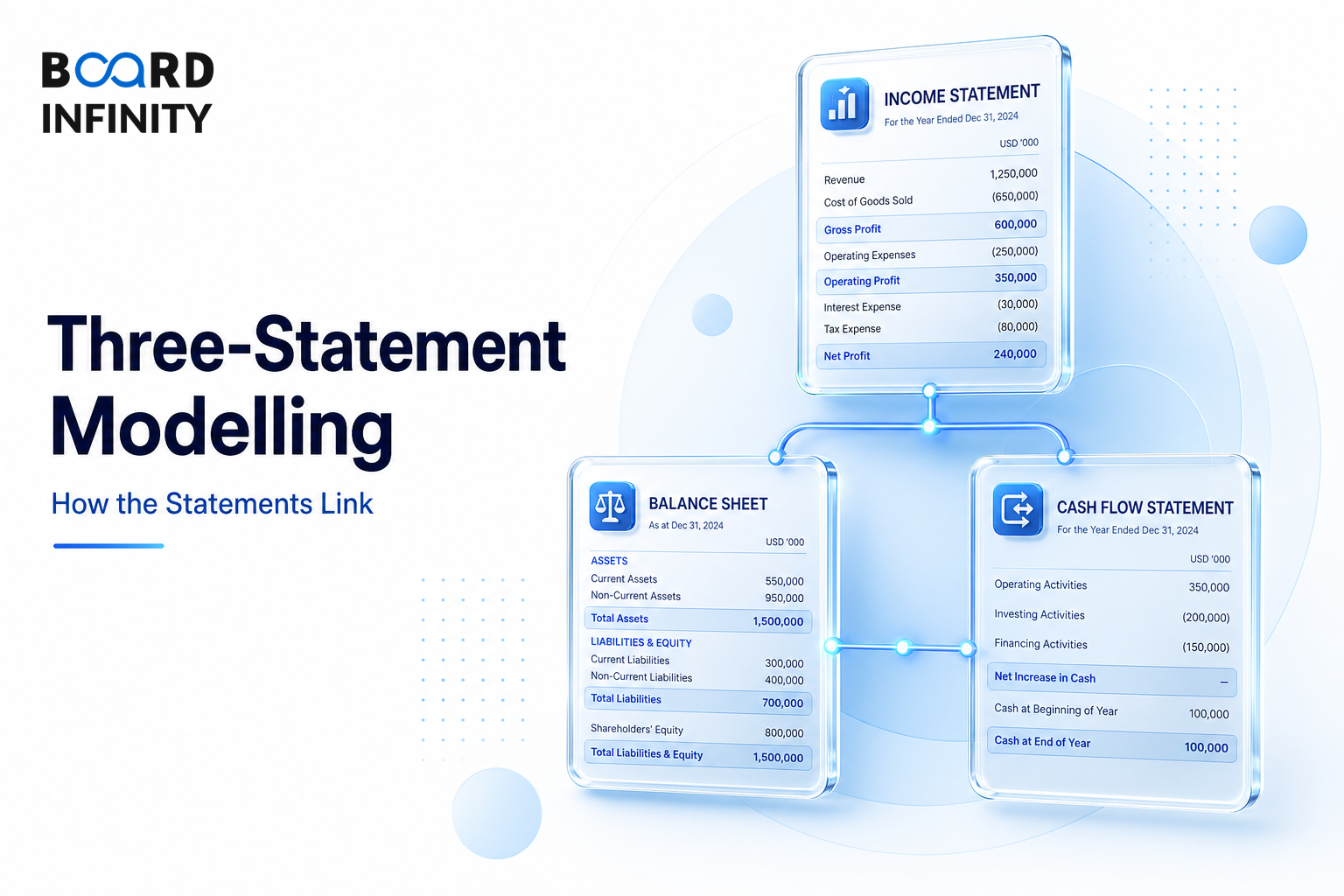
After red flags like CFO vs Net Profit divergence, the next interview stress test is whether you can trace a business event through all three financial statements. This is the single most frequently asked technical question in IB, PE, and corporate finance interviews: "Walk me through the impact of X on all three financial statements." The key is not memorising isolated answers, but following the same logic chain every time.
- Every answer follows the same logic chain: Income Statement first, Balance Sheet second, Cash Flow Statement last.
- Depreciation is a non-cash expense - it reduces profit but does NOT reduce cash.
- When depreciation increases by ₹10 Cr at a 25% tax rate, Net Income falls by ₹7.5 Cr and Cash increases by ₹2.5 Cr.
- When inventory increases by ₹10 Cr with no sale yet, the Income Statement has zero impact because inventory is not yet expensed.
- When a company issues ₹100 Cr of long-term debt, the issuance itself has no P&L impact - only future interest payments will.
- Cash Flow Statement is often the most useful statement because a company can manipulate accruals, but cash is harder to fake.
The Big Picture: Follow the Statement Chain
Every answer follows the same logic chain: Income Statement first - Balance Sheet second - Cash Flow Statement last. The interview question changes the scenario, but the structure remains the same.
"Walk me through the impact of X on all three financial statements." The answer should trace the impact through the Income Statement, Balance Sheet, and Cash Flow Statement in that order.
Depreciation Increase and the Tax Shield
This is the single most common 3-statement question. The key insight: depreciation is a non-cash expense - it reduces profit but does NOT reduce cash. The only cash benefit is the tax shield.
Impact Flow for Depreciation
The same answer can be compressed into a clean interview flow. Start from operating expense, move to net income, prove the Balance Sheet balances, and then explain the cash flow add-back.
* Depreciation is non-cash → adds back to Cash Flow | Net cash effect: +₹2.5 (tax shield) | Most asked IB question
- Net Income falls by ₹7.5 Cr (after-tax effect = ₹10 × (1 - 25%))
- PP&E on Balance Sheet falls by ₹10 Cr (full depreciation amount)
- Cash INCREASES by ₹2.5 Cr (the tax shield - the only real cash benefit)
- Operating Cash Flow increases by ₹2.5 Cr (add-back exceeds NI reduction)
- The Balance Sheet balances: Asset drop of ₹7.5 net = Equity drop of ₹7.5
Inventory Build with No Sale Yet
A company purchases ₹10 Cr of additional raw material inventory, paying cash. This is a pure balance sheet transaction - no revenue, no expense, no profit impact.
- Income Statement: ZERO impact - inventory not yet expensed (COGS only when sold)
- Balance Sheet: Cash -₹10, Inventory +₹10 → net zero change, equation balanced
- Cash Flow Statement: Operating CF falls by ₹10 (working capital consumed cash)
- Watch for: Rising inventory + flat revenue = potential demand problem or channel stuffing
Long-Term Debt Issuance
A company raises ₹100 Cr by issuing bonds at 9% annual coupon. The issuance itself has no P&L impact - only future interest payments will.
Live Interview Drill: Common Follow-Up Questions
Q: "What if inventory is sold the NEXT year?" → Then COGS increases, gross profit falls, net income falls, inventory clears from Balance Sheet, CFO improves (inventory consumed = WC release). Cash from sale hits CFO.
Q: "If you had to choose one statement, which tells you most?" → Cash Flow Statement. A company can manipulate accruals (revenue recognition, expense deferral) but cash is harder to fake. CFO is the acid test of earnings quality.
Q: "PP&E increases by ₹50 Cr - walk through all 3 statements." → No IS impact at purchase (capex ≠ expense). BS: PP&E +₹50, Cash -₹50. CFS: Capex in CFI section = -₹50. Then each future year: depreciation hits IS and adds back in CFO.
Structuring a Three Interview Answer
"Walk me through the impact of X on all three financial statements."
For depreciation, do not say cash falls by the depreciation amount. Depreciation is non-cash - the only cash benefit is the tax shield.
Conclusion
Three-statement modelling interview answers work when you trace the same chain every time: Income Statement first, Balance Sheet second, Cash Flow Statement last. The strongest answers prove both the accounting impact and the cash impact, especially in common cases like depreciation, inventory build, and debt issuance.
The single most frequent error is treating depreciation as a cash outflow. Depreciation reduces Net Income by the after-tax amount, but because it is non-cash, it is added back on the Cash Flow Statement; the net cash effect is the tax shield.