offers via TCS NQT - one campus, phase two
From 60–80 placed a year before the partnership.

Program 05 · BTech · Non-CS branches
Core-branch cohorts get pushed into IT-services prep because that is what training partners know how to deliver. This program does the opposite: seven disciplines, thirty-five branch-specific bootcamps, each mapped to real target roles and the industries that hire for them.
Disciplines
7 branchesMechanical to bioengineeringBootcamps
35Five per discipline, tool-anchoredRoles
40+ namedEach bootcamp states its job titlesMode
On campus70–100 hours per bootcampSeven branches, one method
01 Who this is for
A civil department with a 40% placement rate is not a training problem to solve with DSA. It is a different problem, and it has a different answer.
Head of Department
Bootcamps built around what your industry actually hires for - Primavera and quantity surveying for civil, not a generic coding bootcamp.
T&P Officer
Batches that fit the timetable, with RAG dashboards naming exactly who needs intervention.
Student
You finish knowing the job title you are targeting, the tools that title requires, and the kind of company that hires for it.
Trusted by the institutions that answer for placements




Among 120+ partner institutions - including 12 IIMs, 2 IITs and 45 of the NIRF-100.
02 The map
The complete branch-to-role-to-industry map our delivery team works from.
| Discipline | Specialised bootcamps | Target roles | Industries & recruiters |
|---|---|---|---|
| Mechanical Engineering | Smart Manufacturing & Industry 4.0 · CAD, CAE & Product Design · EV Systems & Automotive Technology · Robotics & Industrial Automation · Supply Chain & Operations Excellence | GET, Production Engineer, Design Engineer, CAD Engineer, EV Engineer, Automation Engineer, PLC Engineer, Supply Chain Analyst | Tata Motors, Force Motors, automotive OEMs, product engineering firms, factory automation companies, manufacturing SMEs |
| Civil Engineering | Smart Infrastructure & Construction Tech · Quantity Surveying & Estimation · Primavera & Project Management · Sustainable Construction & Green Buildings · GIS & Surveying Technology | Site Engineer, Planning Engineer, Quantity Surveyor, Billing Engineer, GIS Analyst, Project Coordinator | EPC companies, infrastructure firms, construction companies, surveying and analytics firms |
| Chemical Engineering | Process Plant Operations · Industrial Safety & HSE · Oil, Gas & Refinery Operations · Pharma Manufacturing & Quality · Data Analytics for Process Industries | Process Engineer, Plant Operations Engineer, HSE Officer, QA/QC Associate, Production Associate, Process Data Analyst | Chemical plants, refineries, pharma and biotech companies, manufacturing industries |
| Petroleum Engineering | Upstream Oil & Gas Operations · Energy Transition & Renewable Fuels · Oilfield Safety & HSE · Petroleum Data Analytics · Refinery & Petrochemical Operations | Drilling Engineer, Reservoir Operations Associate, Energy Analyst, HSE Engineer, Refinery Operations Engineer | Oil and gas service companies, energy-tech companies, refineries, petrochemical firms |
| Renewable Energy Engineering | Solar PV Design & Installation · Wind Energy Systems · Energy Auditing & Sustainability · Battery Storage & EV Infrastructure · Smart Grid & Energy Management | Solar Design Engineer, Wind Operations Associate, Energy Auditor, Sustainability Analyst, Smart Grid Engineer | Solar EPC companies, renewable energy firms, ESG consulting firms, power and utility companies |
| Material Science & Advanced Manufacturing | Advanced Materials & Composites · Additive Manufacturing & 3D Printing · Quality Engineering & Six Sigma · Semiconductor Materials & Fabrication · Industrial Metallurgy & Failure Analysis | Materials Engineer, Additive Manufacturing Engineer, Quality Engineer, Semiconductor Process Associate, Metallurgy Engineer | Aerospace, manufacturing, the semiconductor ecosystem, heavy engineering companies |
| Bioengineering | Medical Devices & Healthcare Technology · Bioinformatics & Data Analytics · Pharma & Biotech Industry Readiness · AI in Healthcare · Clinical Research & Regulatory Affairs | Biomedical Engineer, Bioinformatics Analyst, Biotech Associate, Clinical Research Associate, Regulatory Affairs Executive, Healthcare Data Analyst | Medical device manufacturers, pharma and biotech companies, hospital networks, CROs, health-tech firms |
← scroll the table sideways →
Every branch program also carries the shared employability layer - aptitude, communication, resume, interviews and placement tracking - because core-branch recruiters screen on those too.
03 Measurement
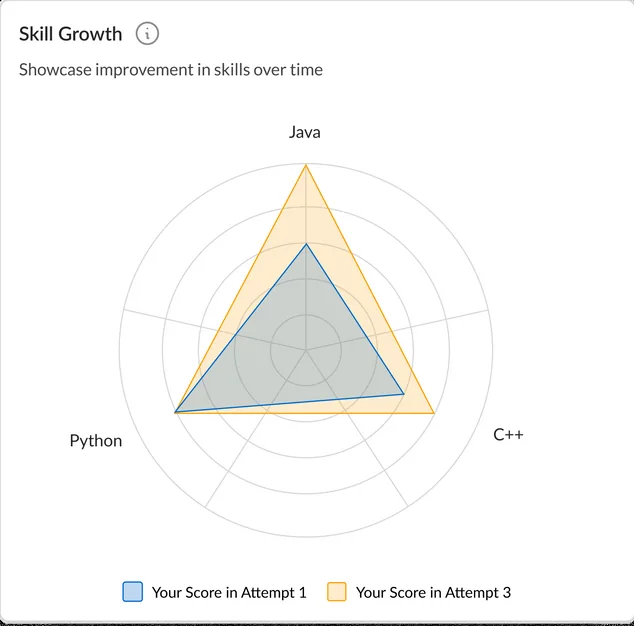
Core-branch training usually ends with an attendance sheet. It ends here with a skill profile per student, tracked across attempts, so a head of department can show a board what moved.
Each axis is a skill the target role actually screens for.
The gap between the two shaded areas is the program’s contribution, stated visually.
The same axes every semester, so year-on-year comparison is honest.
04 How a branch program is built
Each bootcamp is anchored on the software and standards the role uses daily - CAD and CAE suites, Primavera, GIS platforms, process simulation, Six Sigma method, energy-audit protocols. Students finish with artefacts, not notes.
Every bootcamp states the job titles it prepares for. That single discipline changes how students research companies and how they answer “what role are you looking for?” in an interview.
Process data analytics, petroleum data analytics, GIS analysis, bioinformatics, healthcare data. Core-branch roles increasingly sit next to a dashboard, and the students who can read it get promoted first.
HSE for chemical, petroleum and oilfield roles; regulatory affairs for bio; green-building and sustainability standards for civil and energy. These are hiring filters in those industries, not electives.
Bootcamps are delivered by practitioners from the relevant industry, drawn from the wider expert network - the same model as our software and analytics tracks.
05 Outcome proof
From 60–80 placed a year before the partnership.
157 offers at ₹9.5 LPA after HackWithInfy preparation.
Including 12 IIMs, 2 IITs and 45 of the NIRF-100.
06 How it’s delivered
Bootcamps run on campus, typically 70–100 hours each, sequenced against the department’s academic load. Where a branch has a small cohort, we combine adjacent disciplines for shared modules - aptitude, communication, data literacy - and keep the tool-specific bootcamps separate.
Career Discovery Test, diagnostics, AI baseline.
Coach-led + self-paced across 40+ careers.
Company-specific prep, GD-PI, mocks.
Employer outreach and placement management.
Live RAG and skill-gap dashboards.
Every engagement runs on the InfyLearn suite - white-labelled LMS, AI-proctored assessments, placement management, AI resume builder and AI video mock interviews - so training, testing and placement data sit in one place your team can audit.
07 Endorsements
The difference was specificity: company-wise test patterns, DSA depth, and weekly dashboards. Our placement numbers didn’t inch up - they tripled.
08 Questions deans ask
∞ Keep exploring
Talk to our academic team about what an outcome-accountable partnership looks like for your campus.
We’ll be in touch within 48 hours.