
Where AI Is Landing in E-Commerce & Quick Commerce
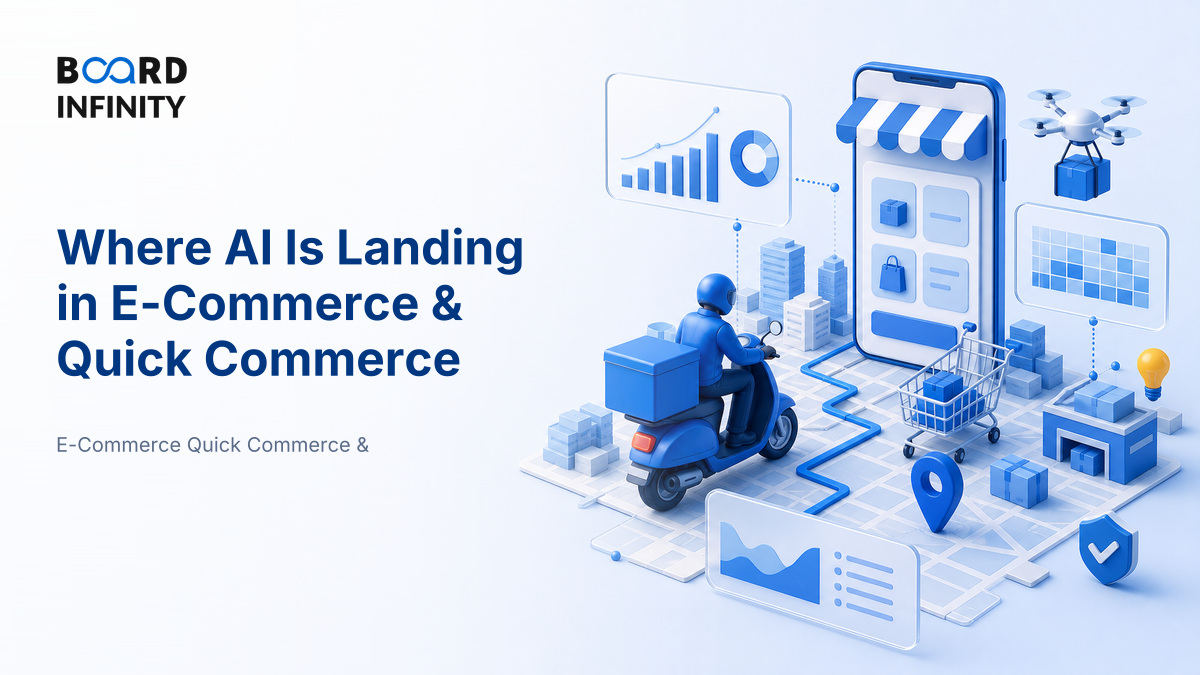
A packet of milk, a bunch of coriander and a phone charger look like three small orders. To a quick-commerce AI system, they are three predictions: what will be needed nearby, where it should sit before demand appears, and which rider route will keep the promise without destroying margin.
- AI lands where decisions repeat at scale - search, recommendations, demand forecasting, assortment, pricing, fraud, routing and support.
- E-commerce AI mainly improves discovery and conversion; quick-commerce AI also has to protect inventory availability and delivery reliability.
- The core loop is: sense demand - predict - decide - execute - learn.
- The best interview answer links AI to business metrics: conversion, average order value, stock-out rate, picking accuracy, delivery SLA and contribution margin.
- In quick commerce, AI is not a feature. It is the operating layer connecting customer demand, dark-store inventory and last-mile capacity.
- The trap is saying “AI personalizes everything” without explaining the trade-off between speed, availability and margin.
Big Picture: AI Lands Where Decisions Repeat
AI creates value in e-commerce and quick commerce wherever a company has large volumes of repeated decisions, fast feedback and enough data to learn from. The mental model is simple: AI converts messy signals into sharper operating decisions.
For a marketplace, the hard question is “What should this customer see next?” For quick commerce, the harder question is “What should be stocked nearby before the customer even opens the app?” That difference is why quick commerce is such an AI-heavy business: the promise is operational, not just digital.
The Five AI Landing Zones in E-Commerce and Quick Commerce
Think of AI landing in five connected zones. Each zone improves one commercial decision, and the strongest companies stitch these zones into a single operating system.
Core Explanation: E-Commerce AI Versus Quick-Commerce AI
E-commerce is digital buying and selling through websites, apps or marketplaces. Its AI emphasis is usually on discovery, conversion, pricing, reviews, seller quality and post-purchase service.
Quick commerce is e-commerce with a hyperlocal, time-compressed fulfilment promise. Its AI emphasis is more operational: local demand prediction, dark-store replenishment, substitution logic, picking sequence, batching, rider allocation and estimated time of arrival.
This is the interview distinction that makes you sound sharp: e-commerce AI can tolerate some delay between prediction and execution, but quick-commerce AI works under a much tighter clock. A wrong recommendation may lose a click. A wrong quick-commerce forecast creates stock-outs, substitutions, rider idle time and margin leakage.
The AI Stack: From Customer Signal to Operating Action
Do not describe AI as “one model.” In real businesses, AI sits across a stack - data, models, decision rules and human processes. A recommendation model that cannot influence inventory, pricing or fulfilment will remain a nice front-end feature, not a business advantage.
The base is data: searches, clicks, carts, orders, refunds, delivery times, inventory positions and customer complaints. Models then estimate intent, demand, risk or route time. The decision layer converts those predictions into actions - for example, rank this product higher, replenish this SKU, batch these orders, or flag this payment. The top of the pyramid is the only thing management cares about: better conversion, reliability and margin.
Where AI Creates Business Value: Metrics to Track
AI should be judged by business lift, not by model glamour. A good answer names the metric, gives the formula and explains what “good” means in context.
A simple way to test an AI initiative: ask whether it improves at least one customer metric and one economics metric. For example, better recommendations should lift conversion, but the company should also check whether the lift came from excessive discounts or low-margin products.
Mini Worked Example: Why “Better ETA” Is Not Enough
Assume a quick-commerce company uses an AI routing model for 10,000 daily orders in one city. Before the model, 8,700 orders are delivered within the promised time. After the model, 9,100 orders are delivered within the promised time.
On-time delivery SLA improves from 87% to 91% because 8,700 ÷ 10,000 becomes 9,100 ÷ 10,000. But the model is only a business success if rider cost per order, cancellation rate and contribution margin do not worsen. This is the difference between an analytics answer and a management answer.
Definitions You Can Say in One Breath
- E-commerce: Buying, selling and servicing products or services through digital channels such as websites, apps and marketplaces.
- Quick commerce: Hyperlocal e-commerce designed for very fast fulfilment through nearby inventory nodes and last-mile delivery capacity.
- Recommendation engine: An AI system that ranks products by predicted customer relevance or purchase probability.
- Demand forecasting: Predicting future customer demand by product, time and location to guide inventory and operations.
- Dark store: A small fulfilment node built for picking online orders, not for walk-in shopping.
Case Study: BigBasket’s Quick-Commerce Shift
BigBasket is a useful Indian case because it shows how an online grocer can move from scheduled delivery logic toward faster, AI-enabled local fulfilment.

Situation: Grocery e-commerce has difficult economics. Demand is frequent but fragmented, baskets contain perishables and staples, substitutions can annoy customers, and availability matters as much as price. A customer may forgive a slower electronics order, but not a missing breakfast item.
The move: BigBasket’s quick-commerce proposition, such as BB Now, reflects a shift from broad online grocery fulfilment toward local, time-sensitive fulfilment. The AI logic is not only “recommend the right product.” It is to predict local demand, place the right assortment close to customers, reduce stock-outs, guide pickers, suggest acceptable substitutes and estimate delivery times realistically.
The result or lesson: The primary driver is demand-linked inventory placement near consumption pockets. Supporting drivers include a grocery catalogue with repeat-purchase behaviour, better replenishment discipline, picker workflows, substitution rules and delivery-capacity planning. The strategic lesson is clear: in quick commerce, AI wins only when front-end personalization and back-end operations improve together.
This case is especially useful in interviews because it avoids the shallow “AI equals recommendation engine” answer. It shows AI as a bridge between merchandising, supply chain and last-mile operations.
How AI Changes E-Commerce & Quick Commerce
AI is changing this sector in three concrete ways.
Practical student workflow: Use ChatGPT or Claude to build a sector map, then verify claims manually. A safe workflow is: ask for AI use cases in quick commerce, convert them into metrics, and then cross-check company-specific claims using annual reports, official blogs or credible news. If you use AI for preparation, first read how to research a sector with AI without importing its errors, because confident hallucinations are common in fast-moving sectors.
If you are building a two-page prep note for an e-commerce or quick-commerce company, use this AI map as one page and the company’s business model, competitors and metrics as the second. The method in building your own two-page sector brief fits this perfectly.
Interview Relevance
“Where exactly is AI creating value in e-commerce and quick commerce, and how would you measure whether it is working?”
If the interviewer asks for market sizing or growth potential, do not invent numbers. State the drivers and use a structured approach like sizing a sector when no number exists.
Common Mistake
The mistake is treating AI as a customer-facing chatbot or recommendation widget only. It costs candidates because quick commerce is won in the operating system - inventory, fulfilment, routing and unit economics. One-line fix: always map AI to a repeated decision and a measurable KPI.