
E-Commerce & Quick Commerce Interview Questions With Model Answers
Can a company lose money faster by delivering faster? That is the uncomfortable question behind quick commerce: speed excites customers, but every extra promise - 10-minute delivery, high availability, free returns - quietly attacks unit economics.
- E-commerce is digital buying and selling; quick commerce is e-commerce optimized for ultra-fast fulfilment of frequent, convenience-led purchases.
- Strong answers connect four levers: demand, assortment, fulfilment and unit economics.
- The interviewer is not testing whether you know brand names. They are testing whether you can explain why a model works or breaks.
- For quick commerce, always discuss density: enough orders in a small area make fast delivery economically possible.
- Key metrics: conversion rate, AOV, CAC, contribution margin per order, fill rate and on-time delivery.
- Best model answers use a structure: customer need - operating model - revenue model - cost drivers - risks - recommendation.
- The biggest trap is praising speed without explaining the cost of speed.
Big Picture: The One Model Behind Most Answers
For interview answers, treat e-commerce and quick commerce as a system, not as an app. The app creates demand, but the business wins only when fulfilment, assortment and economics hold together.
Core Explanation: How to Think Before You Answer
E-commerce is broader: fashion, electronics, grocery, beauty, medicines, food, B2B supplies and services can all be sold digitally. Quick commerce is narrower: it is built for urgent or habitual purchases where delivery speed itself becomes part of the value proposition.
The difference is not just “online versus faster online.” The difference is the operating model.
This 2x2 is useful because it prevents a shallow answer. A laptop, a sofa and a packet of milk may all be bought online, but they need very different promise, inventory and delivery models.
The E-Commerce and Quick Commerce Answer Framework
Use this whenever you get a “compare,” “evaluate,” “why,” or “what will happen” question.
Key Metrics Interviewers Expect You to Know
Do not throw metrics randomly. Use them to prove whether the model is healthy. A good candidate also says that “good” values vary by category, city density, basket size and maturity stage.
If you are asked to size the opportunity and no clean number is available, use a demand-side build-up. Start with households or target users, estimate order frequency, estimate basket size, then apply adoption. This is the same logic explained in sizing a sector when no number exists.
Definitions You Can Say in One Breath
The OECD defines an e-commerce transaction as “the sale or purchase of goods or services, conducted over computer networks by methods specifically designed for the purpose of receiving or placing of orders” (OECD).
Quick commerce is digital retail designed for very fast delivery of frequent, convenience-led purchases through hyperlocal inventory and dense last-mile operations.
Common Interview Questions With Model Answers
1. What is the difference between e-commerce and quick commerce?
Model answer: E-commerce is the broader digital buying and selling model, where value may come from assortment, price, convenience or discovery. Quick commerce is a specialized form of e-commerce where speed and local availability are central to the proposition. Operationally, e-commerce can use large fulfilment centres and longer delivery windows, while quick commerce needs hyperlocal inventory, dense demand clusters and tight last-mile execution. The key trade-off is that speed improves convenience but increases operating cost, so profitability depends on basket size, margins, delivery density and repeat usage.
2. Why do quick commerce companies use dark stores?
Model answer: Dark stores are small fulfilment points designed for picking and dispatching orders, not for walk-in customers. They help quick commerce firms place inventory close to demand, reduce travel time and improve delivery reliability. But they also create fixed costs such as rent, staff and inventory holding. So the model works best in dense micro-markets where order volume, SKU productivity and delivery routing can support those costs.
3. Is quick commerce sustainable in India?
Model answer: It can be sustainable in selected categories and micro-markets, but not everywhere. India has strong demand drivers: urban density, convenience-seeking consumers, digital payments and frequent grocery or top-up purchases. The challenge is unit economics because delivery, picking, discounts and inventory costs can eat margins. Sustainable players will likely win through high order density, better assortment curation, private labels, advertising income, supplier terms and operational discipline rather than speed alone.
4. How does an e-commerce marketplace make money?
Model answer: A marketplace usually earns through commissions, seller services, logistics fees, advertising, payment services and sometimes subscriptions. Its advantage is that it can scale assortment without owning all inventory. But it must solve trust, quality, delivery and seller experience. The strongest marketplaces create a flywheel: more sellers increase choice, better choice attracts customers, more customers attract sellers, and data improves pricing, discovery and fulfilment.
5. How would you improve profitability for a quick commerce player?
Model answer: I would start with unit economics by micro-market and category. First, increase AOV through bundles, subscriptions and occasion-based baskets. Second, improve gross margin through private labels, supplier terms and smarter assortment. Third, reduce delivery cost through batching, better routing and higher order density. Fourth, cut wastage and stock-outs using demand forecasting. Finally, I would reduce discount dependence and focus on cohorts with strong repeat behaviour.
6. What risks should an e-commerce company manage?
Model answer: The main risks are customer trust, delivery reliability, returns, fake or poor-quality sellers, data privacy, working capital and dependence on paid acquisition. In quick commerce, I would add inventory wastage, rider capacity, dark-store utilization and local regulatory constraints. A strong company manages these through seller governance, fulfilment standards, customer support, better forecasting, responsible data usage and disciplined expansion.
7. Compare inventory-led and marketplace models.
Model answer: In an inventory-led model, the company buys or controls stock, which gives better control over availability, quality and delivery promise but increases working capital and inventory risk. In a marketplace model, third-party sellers list products, which allows wider assortment and faster scale, but creates challenges in seller quality, fulfilment consistency and trust. Many players use hybrids because customer experience requires control in some categories while scale requires marketplace breadth.
Case Study: BigBasket and the Dual-Speed Grocery Model
BigBasket shows how an online grocery player can serve both planned monthly baskets and faster top-up missions without treating speed as the only strategy.
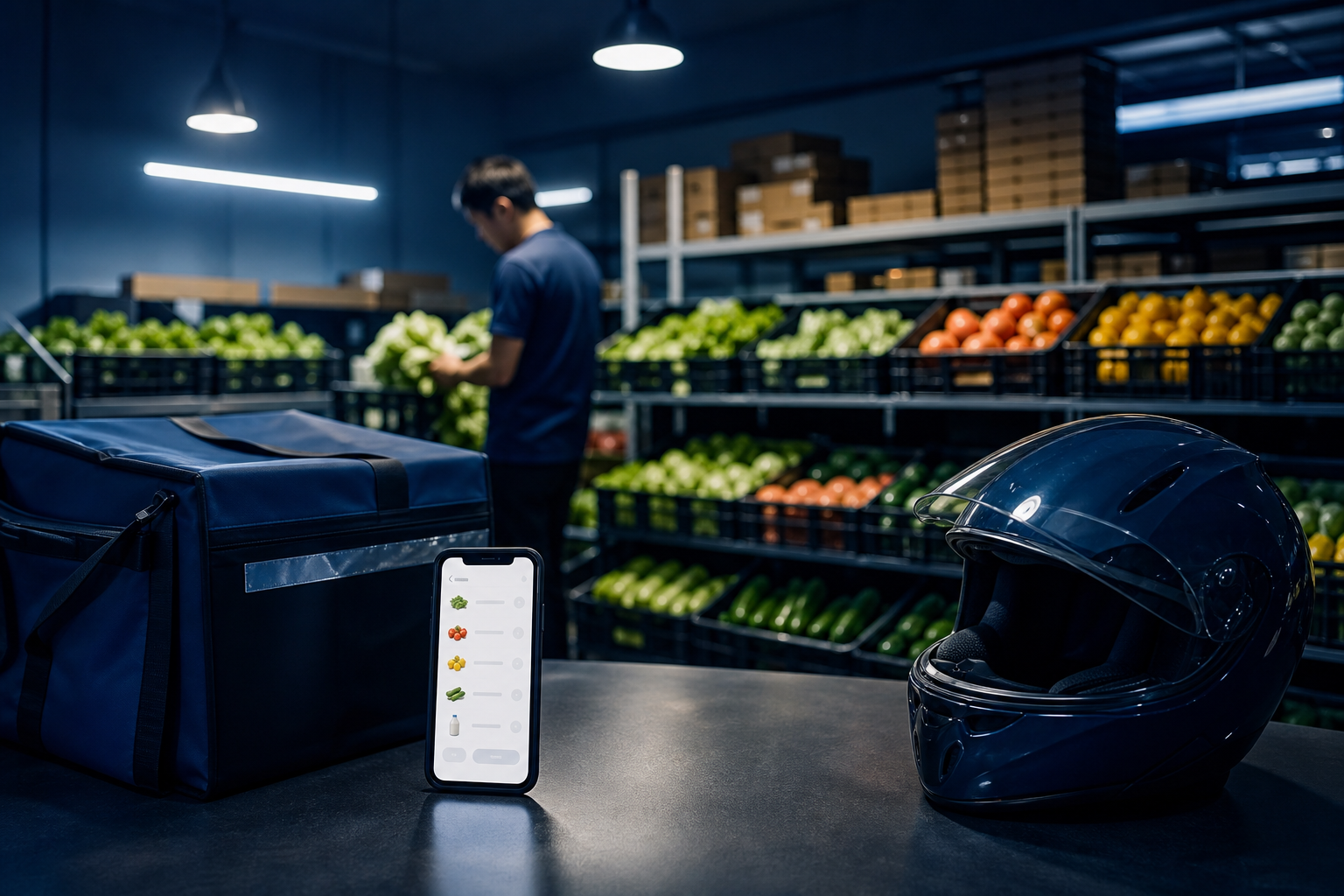
The situation: grocery is one of the hardest e-commerce categories. Customers buy often, but margins can be thin, freshness matters, substitutions irritate shoppers and delivery slots must match daily routines. Traditional e-grocery works well for planned baskets, but urban consumers also have sudden needs: milk, fruit, snacks, personal care, pet food or forgotten ingredients.
The move: BigBasket built a dual-speed logic. It continued serving larger planned grocery baskets while also offering faster delivery propositions for top-up needs in selected locations. The primary driver was mission separation: not every grocery order needs the same speed, basket size or assortment. Supporting drivers included curated SKUs, local fulfilment points, predictable replenishment, fresh-category handling and the ability to use grocery purchase data to understand repeat behaviour.
The lesson: quick commerce is not simply “make everything faster.” It is about matching the operating model to the customer mission. A monthly staples order, a fresh produce order and an emergency top-up order have different economics. The smartest answer in an interview is to show that the company must design separate promises for each.
So what: BigBasket is a useful interview case because it proves that grocery e-commerce is won through promise design, not only app design. The business has to align customer mission, assortment, fulfilment and margin.
How AI Changes E-Commerce & Quick Commerce Interview Questions
AI has changed what a “good answer” sounds like. You no longer get full marks by saying “personalization.” You need to know where AI enters the operating model.
- Demand forecasting and replenishment: AI models help predict SKU-level demand by location, time, weather, festivals and promotions. In quick commerce, this directly affects fill rate, wastage and dark-store productivity.
- Personalization and search: AI changes product discovery through personalized ranking, recommendation, conversational shopping and better search relevance. This affects conversion rate and basket building.
- Last-mile optimization: AI can improve rider allocation, batching, route sequencing and promised delivery times. The business value is not just speed; it is cost-to-serve reduction.
Use NotebookLM or Perplexity to build a company brief: upload or search for a company’s annual report, app pages, news releases and competitor notes, then ask: “Create 10 interview questions on this company’s e-commerce or quick commerce model, with answers using customer mission, operating model and unit economics.” Cross-check facts using trusted sources; this habit is covered in using AI to research a sector without importing its errors.
Interview Relevance
“Quick commerce companies promise very fast delivery. Is this a good business model, or just a discount-funded habit?”
If the question sounds opinion-based, answer it like a business analyst: “It depends on density, basket size, margin and repeat rate.” That one sentence makes you sound structured immediately.
Common Mistake
The mistake: saying “quick commerce wins because customers want speed.” That is only half the answer and it sounds naïve. The fix: always add, “Speed is valuable only if order density, basket economics, fill rate and delivery cost support it.”