
How the E-Commerce & Quick Commerce Value Chain Works
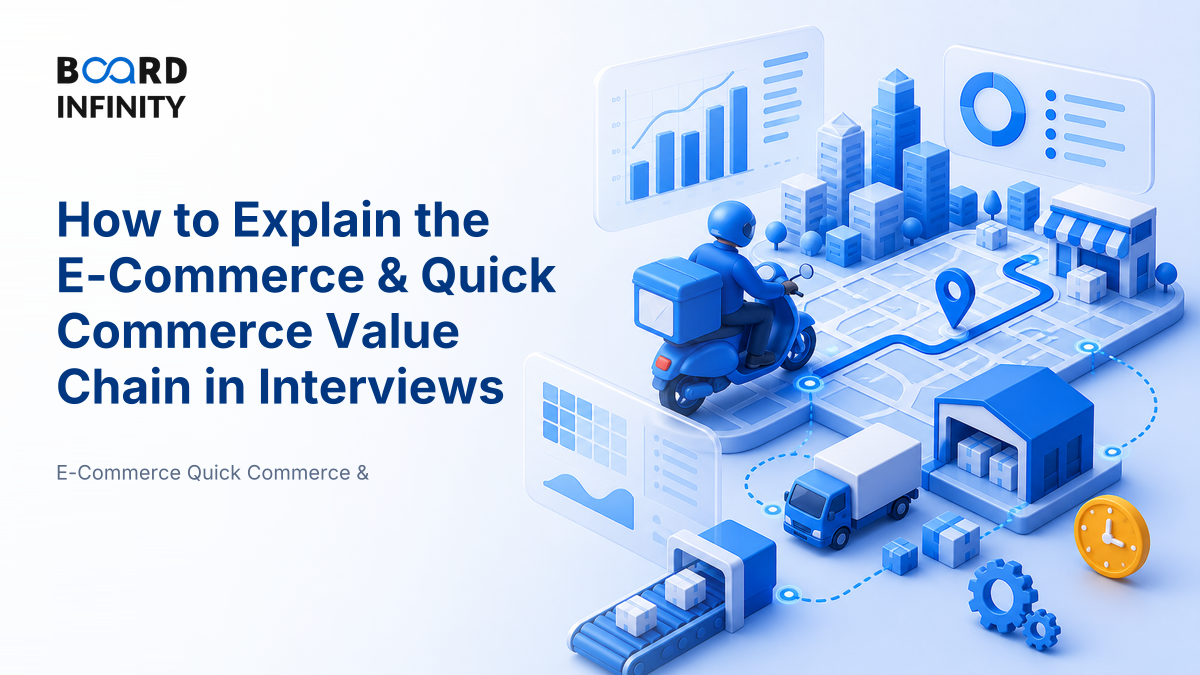
A customer taps “buy” at 10:42 p.m., but the real work started days earlier - demand forecasting, seller onboarding, inventory placement, picker routing, payment checks, and return design. In e-commerce, the order is only the visible tip; in quick commerce, every hidden step must happen close enough to the customer that minutes matter.
- E-commerce value chain means the sequence that creates demand, lists products, accepts orders, fulfils them, delivers them, and manages returns.
- Quick commerce is not just faster e-commerce; it is a density-led operating model built around nearby inventory, dark stores, rapid picking and short delivery radii.
- The core trade-off is selection versus speed versus cost-to-serve. Wider assortment improves choice but makes instant fulfilment harder.
- Marketplaces coordinate sellers, platforms and logistics; inventory-led models control stock directly and can offer tighter service levels.
- The five operational links are demand generation, catalog and pricing, order capture, fulfilment, last-mile and returns.
- Interview answers should separate front-end experience from back-end operations, then connect both to unit economics.
- The biggest mistake is saying “quick commerce is e-commerce with faster delivery” and ignoring dark-store density, replenishment and order batching.
Big Picture: The Value Chain Converts Attention Into Delivered Orders
Think of the e-commerce and quick commerce value chain as a controlled relay race. Marketing creates intent, the app converts that intent into an order, fulfilment turns the order into a packed shipment, and logistics completes the promise at the customer’s doorstep.
Core Explanation: How the E-Commerce and Quick Commerce Value Chain Works
The simplest way to understand the sector is to split it into two layers: the customer-facing layer that wins the order, and the operations layer that fulfils the promise profitably.
In normal e-commerce, the platform can often use central warehouses, seller inventory and scheduled logistics. In quick commerce, the platform needs inventory physically close to demand - usually in small fulfilment points called dark stores - because distance is the enemy of speed.
1. Demand Generation: Bringing the Customer Into the App
This includes performance marketing, search visibility, app notifications, influencer campaigns, loyalty programs and bank offers. The goal is not just traffic; it is qualified demand that converts without destroying margins through excessive discounting.
2. Catalog, Assortment and Pricing: Deciding What the Customer Sees
The catalog layer decides which products are listed, how they are described, how search ranks them and how prices or offers appear. In e-commerce, long-tail assortment is a strength. In quick commerce, assortment must be sharper because every SKU occupies scarce dark-store space.
3. Order Capture and Payment: Turning Intent Into a Transaction
This layer includes cart design, checkout, payment success, fraud controls, address accuracy and substitutions. In India, the flow must handle UPI, cards, wallets, cash-on-delivery in some categories, failed payments, gated-community instructions and high sensitivity to delivery fees.
4. Fulfilment: Where the Promise Becomes Operational
Fulfilment covers inventory availability, picking, packing, quality checks and handoff to logistics. This is where the biggest difference between e-commerce and quick commerce appears.
In quick commerce, a fast app is not enough. The platform needs dense demand pockets, nearby inventory, frequent replenishment, trained pickers, route assignment and delivery partner availability. If any of these is missing, the customer sees stockouts, substitutions or late delivery.
5. Last Mile and Returns: Completing the Experience
Last mile is the movement from fulfilment point to customer. For e-commerce, it may include sorting centres, delivery hubs and multiple delivery attempts. For quick commerce, it is a short-radius, high-frequency activity where batching, rider allocation and doorstep accuracy matter.
Returns are not an afterthought. They affect margin, inventory quality, customer trust and seller relationships. Categories like fashion face a very different return profile from groceries or medicines, so the reverse logistics design must match the category.
E-Commerce vs Quick Commerce: Same Customer, Different Operating Logic
Both models sell online, but they optimize different things. E-commerce optimizes breadth, price discovery and fulfilment scale. Quick commerce optimizes immediacy, local availability and repeat-use convenience.
The Four Value-Chain Archetypes You Should Recognize
Interviewers like this topic because it reveals whether you understand that “online selling” can hide very different business designs.
A strong answer compares these models on control, capital intensity, customer promise and margin risk. If you want a sharper way to structure sector comparisons, revise comparing two sectors on the same framework before your interview.
Key Metrics: How to Track Whether the Value Chain Is Working
Good operators do not only track GMV or order count. They track whether the chain is converting demand, fulfilling reliably and doing it at an acceptable cost.
Notice the tension: a company can increase conversion by discounting, but hurt contribution margin. It can expand assortment, but worsen fill rate. It can promise faster delivery, but increase cost per order if density is weak.
Definitions You Can Say in One Breath
- E-commerce value chain: The linked activities that convert online demand into fulfilled orders, payment, delivery, service and returns.
- Quick commerce: A local fulfilment model that delivers a curated assortment rapidly using nearby inventory and dense last-mile operations.
- Dark store: A customer-closed micro-warehouse designed for fast picking, packing and dispatch of online orders.
- Last mile: The final movement of an order from fulfilment point to the customer’s delivery location.
- Reverse logistics: The process of collecting, inspecting, refunding, restocking or disposing returned products.
Case Study: BigBasket’s Shift From Scheduled Grocery to Faster Fulfilment
BigBasket shows how grocery e-commerce evolves when the customer promise shifts from planned replenishment to faster, more frequent top-up missions.

Situation: Online grocery began as a planned purchase habit - customers ordered large baskets for scheduled delivery windows. That model allowed broader assortment and warehouse-led fulfilment, but it did not fully capture urgent missions like “milk is over,” “guests are coming,” or “I need snacks now.”
The move: BigBasket extended from scheduled grocery into faster fulfilment through a more local operating design. The strategic logic was clear: keep the grocery trust and assortment capability, but place fast-moving items closer to dense demand pockets so top-up orders could be served quickly.
Why it works: The primary driver is inventory proximity - the right products must already be near the customer. Supporting drivers include demand forecasting by locality, a curated fast-moving assortment, replenishment discipline, picker productivity, payment reliability and last-mile routing.
Lesson: The move from e-commerce to quick commerce is not a marketing slogan. It is a re-architecture of the value chain around locality, frequency and operational control.
How AI Changes the E-Commerce and Quick Commerce Value Chain
AI is changing this value chain most visibly in three places: demand prediction, operational routing and customer conversion.
The risk is that AI can optimize the wrong objective. For example, a model may push high-conversion items but worsen stockouts, or recommend substitutions that improve revenue but damage trust.
Use Perplexity or NotebookLM to build a company-specific value-chain brief: upload the company annual report or public filings, ask for demand, fulfilment, logistics and margin clues, then cross-check the output using AI research without importing its errors.
Interview Relevance
“Walk me through the value chain of an e-commerce or quick-commerce company. Where are the biggest cost and execution challenges?”
If the interviewer asks for sector depth, do not jump straight to company names. First show the operating system, then place companies inside it. For building that broader view, revise building your own two-page sector brief.
Common Mistake
The mistake: Treating quick commerce as “e-commerce plus faster delivery.” That misses the real engine - dark-store density, local assortment, replenishment, picker productivity and last-mile availability. One-line fix: Always explain quick commerce as a proximity-led fulfilment model, not a delivery-speed feature.