
AI in Marketing Interview Guide: Generative AI, Personalization & Automation
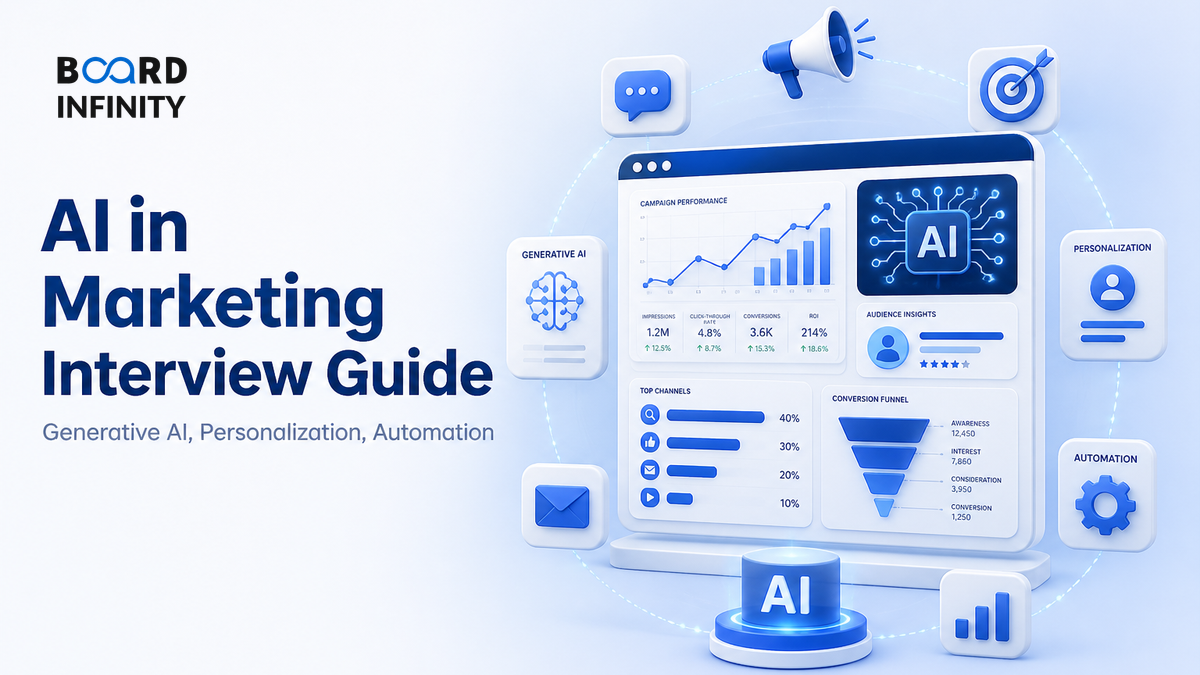
Yesterday, a marketer needed one campaign brief, one design team and one broad audience segment. Today, the same marketer can generate 50 copy variants, personalize the offer for each shopper, trigger it at the right moment and learn from the response before lunch.
- AI in marketing means using machine learning, generative AI and automation to improve targeting, content, timing, measurement and customer experience.
- Generative AI creates new text, images, video, audio or code from prompts and training patterns.
- Personalization decides what each customer should see, buy, receive or experience based on data and context.
- Automation executes marketing actions - emails, push notifications, ad bids, lead nurturing, CRM triggers - without manual repetition.
- The winning model is not “AI creates ads”; it is data - model - content - channel - feedback.
- Track AI marketing with conversion lift, CAC, ROAS, retention, unsubscribe rate and human approval rate.
- The biggest interview trap is treating AI as a magic content machine instead of a governed business system.
Big Picture: AI Turns Marketing from Campaigns into a Learning System
Traditional marketing often worked like a calendar: plan, launch, report, repeat. AI marketing works more like a nervous system: it senses customer data, predicts intent, creates or selects the right message, delivers it through a channel and learns from the response.
Core Explanation: The AI Marketing Engine
AI in marketing has three connected jobs. Generative AI creates or adapts content. Personalization chooses the best message, product, offer or journey for a customer. Automation executes the decision at scale and captures feedback.
Think of it as an engine, not a tool. A GenAI copy prompt without customer data is just faster content production. A personalization model without automation is a recommendation sitting unused. Automation without governance can annoy customers, waste media spend or create brand risk.
The Three Layers of AI in Marketing
Each layer answers a different managerial question:
Where Marketers Use AI Across the Funnel
AI creates value throughout the marketing funnel, but the use case changes by stage.
The Use-Case Matrix: Value Versus Governance Risk
The smartest marketers do not automate everything. They rank use cases by business value and risk, then decide where human approval is mandatory.
Metrics: How to Judge Whether AI Marketing Is Working
AI marketing must improve business outcomes, not just make teams feel faster. Use a control group wherever possible, because AI often looks impressive until you compare it against what would have happened anyway.
Worked Example: Measuring Conversion Lift
Suppose an e-commerce brand tests AI-personalized product recommendations against a normal best-seller widget.
Conversion lift = (4.6% - 4.0%) / 4.0% = 15%. The interview-safe answer is: “AI improved conversion by 15% relative to control, but I would still check statistical significance, margin impact, discounting and long-term repeat behavior.”
Definitions You Should Be Able to Say Clearly
- Kotler and Keller: “Marketing is meeting needs profitably.”
- Generative AI: AI that creates new text, images, audio, video or code from learned patterns and prompts.
- Personalization: Tailoring messages, offers and experiences to an individual or segment using customer data.
- Marketing automation: Software-led triggering, scheduling and measurement of marketing actions across channels using rules or models.
- Next-best-action: The recommended offer, message or service action most likely to help the customer and the business now.
Case Study: Myntra and AI-Led Fashion Discovery
Myntra shows how AI in marketing becomes powerful when generative search, recommendations and lifecycle automation work together to reduce discovery friction in fashion.

Situation: Fashion e-commerce has a hard discovery problem. A customer may not know the exact product name; she may search for “airport look,” “wedding guest outfit” or “office wear under budget.” Traditional keyword search can miss this intent because fashion language is visual, contextual and occasion-led.
The move: Myntra has publicly experimented with AI-led discovery, including conversational and generative search experiences such as MyFashionGPT. The idea is to let shoppers express intent in natural language, then connect that intent to relevant styles, product recommendations and shopping journeys. The primary driver is lower discovery friction. Supporting drivers include Myntra’s fashion catalogue depth, customer behavior data, recommendation systems, app-first user experience and campaign automation across push, email and in-app surfaces.
Outcome and lesson: The lesson is not “Myntra used AI, so it won.” The sharper lesson is that AI is most useful when it solves a real customer job - in this case, translating vague fashion intent into shoppable options. For an interview, say: “Myntra’s AI use case is strong because it improves both customer experience and conversion logic: better discovery creates more relevant recommendations, which creates richer feedback data for the next interaction.”
How AI Changes AI in Marketing
By 2026, the question is no longer whether marketers will use AI. The question is how well they combine AI with data quality, brand judgment and privacy-aware execution.
Practical student workflow: Before a marketing interview, load the company’s annual report, app reviews and two recent campaigns into NotebookLM. Ask it to generate: “What are five AI marketing use cases this company could deploy, what data would each require, what metric would prove success and what privacy risk should be managed?” Then use ChatGPT or Claude to convert the best use case into a 90-second interview answer.
Interview Relevance
“How would you use generative AI, personalization and automation to improve marketing for an Indian e-commerce or D2C brand?”
A strong answer separates creation, decisioning and execution. Say: “GenAI creates variants, personalization decides relevance and automation delivers at scale.”
Common Mistake
The mistake that costs candidates is saying, “AI will make marketing faster,” and stopping there. Speed alone is not strategy; it can produce faster spam, faster bias and faster budget waste. The one-line fix: Always connect AI to a customer problem, a data input, a controlled experiment, a business metric and a governance guardrail.
What to Revise Next
Once this framework is clear, move from concept to execution. Revise AI Tools Every Marketer Should Know in 2026 to understand the tool landscape, then study The Marketer's AI Workflow: NotebookLM, ChatGPT & Prompting That Works to turn AI into a repeatable marketing operating habit.