
Sustainability & Purpose-Driven Marketing: Interview-Ready Framework, Metrics and Case Study
In Kanpur, flowers once thrown into the Ganga after temple rituals became incense sticks, biomaterials and a brand story people could believe. That is the heart of sustainability and purpose-driven marketing: not saying “we care”, but building a business where the caring is visible in the product, supply chain and customer choice.
- Sustainability marketing uses marketing to create customer value while reducing environmental or social harm across the value chain.
- Purpose-driven marketing connects a brand to a meaningful reason for existence beyond short-term sales.
- The strongest brands move from claim to proof: product design, sourcing, packaging, operations, communication and measurable impact.
- Do not confuse purpose with CSR. CSR may sit outside the product; purpose should shape the business model and customer experience.
- The biggest risk is greenwashing: overstating sustainability claims without evidence, which destroys trust and can invite regulatory scrutiny.
- Use the interview frame: problem - purpose - proof points - customer value - metrics - risks.
- A good answer balances ethics and economics: purpose must help customers, society and the brand’s long-term competitiveness.
Big Picture: Purpose Must Travel From Belief to Proof
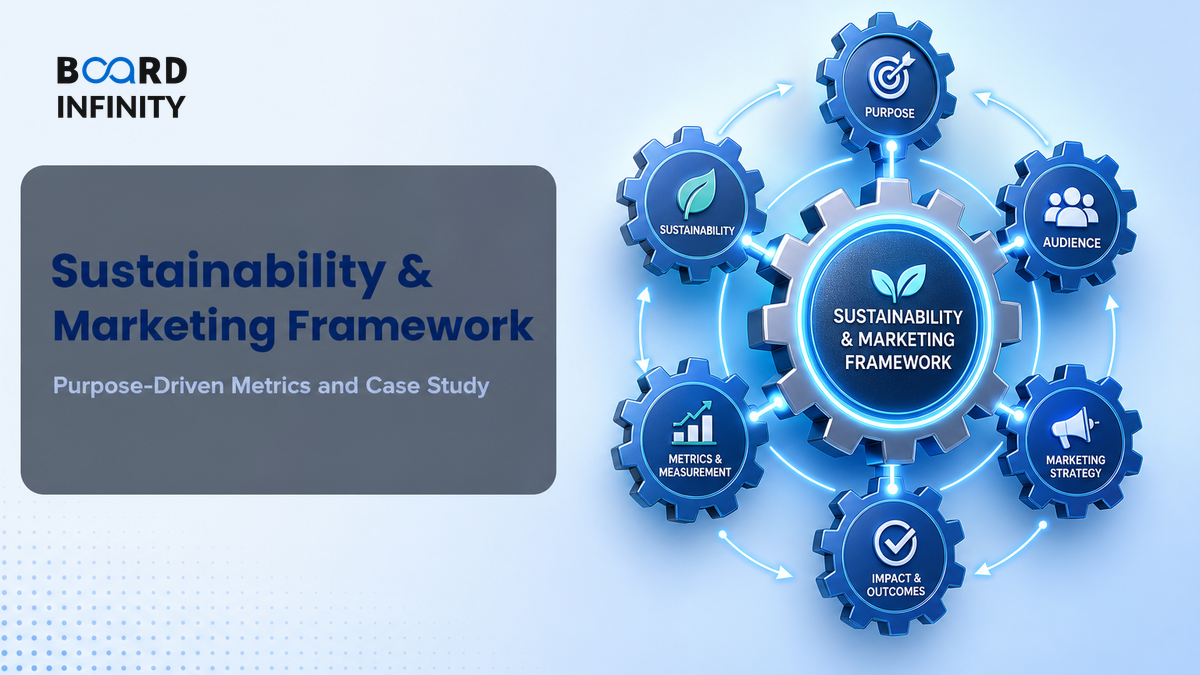
Sustainability and purpose-driven marketing work only when the brand’s promise is backed by operating choices. The mental model is simple: start with a real societal or environmental issue, translate it into a business purpose, prove it through product and operations, communicate it honestly, then measure both business and impact outcomes.
Core Explanation: What Sustainability and Purpose-Driven Marketing Really Mean
Sustainability marketing asks: can we grow demand while reducing harm to the environment and society? It is not only about recyclable packaging or a green ad. It includes product design, sourcing, manufacturing, logistics, pricing, claims, customer usage and disposal.
Purpose-driven marketing asks: what meaningful problem does the brand help solve, beyond selling a product? The purpose should be close to the category. A hygiene brand can credibly speak about handwashing; a footwear brand can credibly speak about responsible materials and worker conditions; a bank can credibly speak about financial inclusion.
The best way to separate strong purpose from weak purpose is to check whether the claim changes actual business decisions.
The Authenticity Test: Is It Purpose or Just a Campaign?
Interviewers like this topic because it tests judgment. A candidate who says “purpose is good for branding” sounds superficial. A strong candidate checks fit, proof and trade-offs.
A Practical 6-Step Framework to Build Purpose-Driven Marketing
Metrics: How to Track Whether Purpose Is Working
A serious sustainability answer must include measurement. Track two scorecards together: brand/business outcomes and impact proof. If only the first moves, purpose may be performative. If only the second moves, the business has not converted impact into customer value.
Tata Tea’s Jaago Re is a strong Indian example of purpose-driven marketing because it connected tea, a daily habit, with the idea of social awakening. The primary driver was category fit: tea is associated with waking up. Supporting drivers included consistent campaign memory, topical social themes and a simple participation idea. The strategic so what: purpose becomes stronger when the cause is naturally linked to what the product already means in culture.
Definitions You Can Say Cleanly
Kotler: “Marketing is the science and art of exploring, creating, and delivering value to satisfy the needs of a target market at a profit.”
Brundtland Commission: “Sustainable development is development that meets the needs of the present without compromising the ability of future generations to meet their own needs.”
Purpose-driven marketing: Marketing that links brand growth to a meaningful, category-relevant reason for existence beyond short-term selling.
Greenwashing: Misleading communication that exaggerates or obscures the environmental or social proof behind a brand claim.
Case Study: Phool - Turning Temple Waste Into a Purpose-Led Brand
Phool built an Indian sustainability brand by upcycling temple flowers into incense and biomaterials, turning a visible waste problem into product proof.

Situation: In many Indian cities, flowers used in religious offerings are discarded into rivers or waste streams. The issue is emotionally sensitive because the flowers are sacred, and operationally difficult because the waste is wet, scattered and perishable.
The move: Phool created a business around collecting floral waste and converting it into incense and other materials. The primary driver of credibility is direct product proof: the product itself comes from the waste stream the brand talks about. Supporting drivers include a culturally familiar problem, a clear upcycling story, women-linked livelihood narratives and a premium gifting-friendly category where customers are willing to listen to provenance.
Outcome and lesson: The brand became memorable because its purpose is not bolted on after manufacturing. It is the manufacturing logic. That is the key lesson for interviews: the strongest purpose-driven brands make the sustainability story inseparable from the product, not a separate communication layer.
How AI Changes Sustainability & Purpose-Driven Marketing
AI is making purpose claims easier to create, but also easier to challenge. In 2026, the advantage shifts to brands that can connect storytelling with auditable evidence.
Use NotebookLM or Perplexity to study a company before an interview: upload the company sustainability report, recent annual report and two campaign pages, then ask, “What sustainability claims does this brand make, what proof supports them, and where could an interviewer challenge the claim?”
Interview Relevance
“A brand wants to launch a purpose-driven sustainability campaign. How would you evaluate whether it is authentic and commercially useful?”
Use this sentence in an answer: “I would not judge the campaign only by the message; I would judge whether the message is backed by product, operations and measurable impact.”
The biggest mistake is treating purpose as a communication idea rather than a business choice. It costs candidates because they sound like they are writing an ad, not building a brand. One-line fix: always connect the purpose claim to product proof, customer value and measurable impact.
What to Revise Next
Next, connect this topic to how marketing jobs and Indian consumer behaviour are changing. Purpose now overlaps with new roles, new channels and new India-specific growth spaces.