
The Marketer's AI Workflow: Use NotebookLM, ChatGPT and Prompts Like a Placement-Ready Marketer
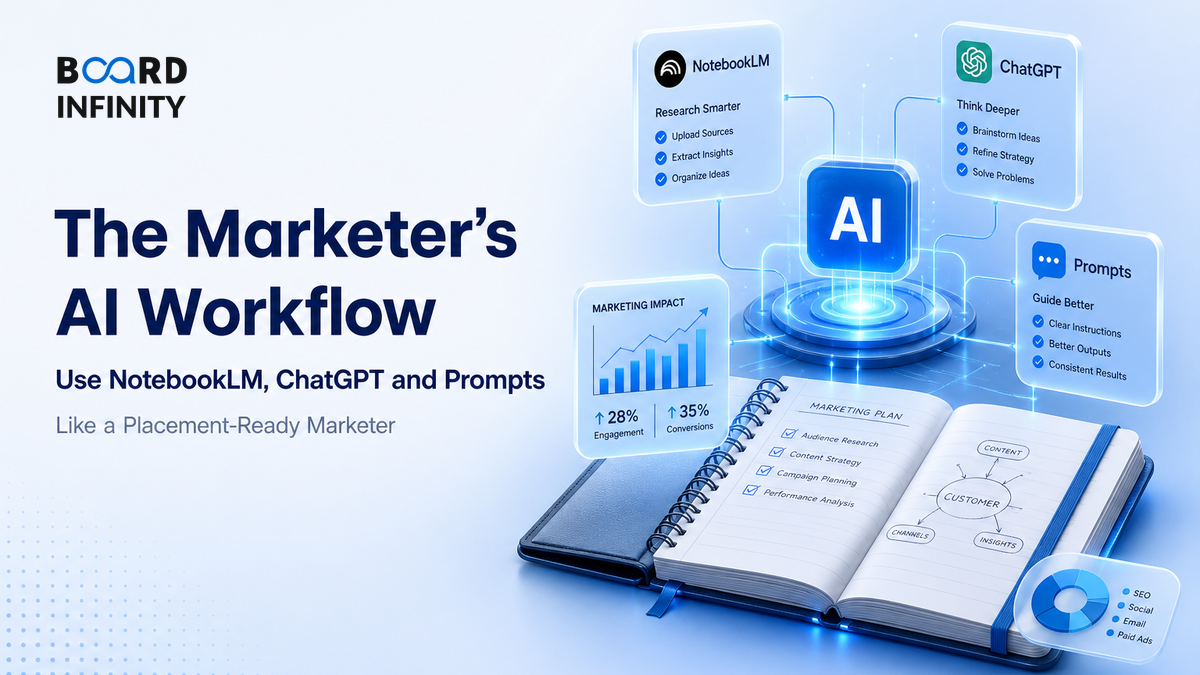
If AI can write a campaign in 30 seconds, why do so many AI-generated marketing answers still sound generic? Because the winning marketer is not the one who types fastest - it is the one who controls the workflow: source, brief, prompt, judge, and iterate.
- Use NotebookLM for grounded research: upload trusted sources like annual reports, brand pages, campaign articles and consumer reviews before asking questions.
- Use ChatGPT or Claude for generation: briefs, positioning options, campaign routes, copy variants, personas and objections.
- Use Perplexity for live discovery: recent market signals, competitor activity and source-linked exploration.
- A strong prompt has six parts: role, objective, context, constraints, output format and verification instruction.
- Never outsource judgment: AI is good at first drafts and pattern finding; the marketer owns strategy, consumer insight, brand fit and ethics.
- Measure the workflow: track cycle time, source accuracy, edit ratio, brand compliance, variant lift and hallucination rate.
- Interview line to remember: “I use AI as a thinking partner, not an autopilot - first to understand, then to create, then to validate.”
Big Picture: AI Is Not a Tool, It Is a Marketing Workbench
A marketer's AI workflow is a repeatable system for moving from messy inputs to sharper decisions. NotebookLM gives you source-grounded understanding, ChatGPT gives you creative and strategic variants, and human review turns AI output into market-ready thinking.
The Core Workflow: From Marketing Question to Boardroom-Ready Output
The biggest shift is this: do not ask AI for “ideas” first. Ask it to help you understand the market first. A good AI-assisted marketer moves through five stages.
Which Tool Should You Use for Which Marketing Task?
NotebookLM, ChatGPT and Perplexity are not substitutes for one another. Think of them on two axes: how source-grounded the task must be and how much creative generation is needed.
Prompting That Works: The 6-Part Brief
A prompt is not a magic sentence. It is a miniature marketing brief. If the brief is vague, the output becomes vague. The safest structure is: Role - Objective - Context - Constraints - Output - Verification.
Role: Act as a brand manager for a premium Indian D2C skincare brand. Objective: propose three positioning routes for first-time sunscreen buyers aged 22-30. Context: the brand is dermatologist-led, online-first and priced above mass brands. Constraints: avoid fear-based messaging; keep it credible and India-relevant. Output: give a table with insight, positioning line, proof point, channel idea and risk. Verification: list assumptions and what data I should check before using this.
The Human-in-the-Loop Review: Where Marketers Add Real Value
AI can produce ten routes quickly. Your job is to decide which route deserves oxygen. Review every output through four filters: consumer truth, brand fit, commercial logic and execution feasibility.
How to Measure Whether Your AI Workflow Is Working
Do not measure AI by how impressive the first draft looks. Measure whether it improves speed, quality, accuracy and business impact against your own pre-AI baseline.
Definitions You Should Be Able to Say in One Breath
American Marketing Association: “Marketing is the activity, set of institutions, and processes for creating, communicating, delivering, and exchanging offerings that have value for customers, clients, partners, and society at large.”
Myntra: AI-Assisted Discovery in Indian Fashion Commerce
Myntra shows how AI becomes powerful when it is connected to real shopper intent, product catalogues and a clear category problem: helping consumers discover fashion faster.

Situation: Fashion discovery is messy. A customer may not search for “black A-line midi dress”; she may search for “what to wear for a beach wedding” or “office party outfit under a budget.” Traditional keyword search often struggles with this occasion-led, mood-led behaviour.
The move: Myntra introduced AI-led discovery experiences, including natural-language shopping assistance such as MyFashionGPT. Instead of forcing shoppers to think in catalogue keywords, AI helps translate loose intent into product exploration. The primary driver is better matching of human shopping language to a structured fashion catalogue. Supporting drivers include Myntra's large product assortment, fashion taxonomy, personalization data, mobile-first experience and merchandising discipline.
Outcome and lesson: The lesson is not “AI writes better copy.” The lesson is that AI creates value when it reduces friction between consumer intent and business inventory. In interview language: Myntra used AI not as a content shortcut, but as a discovery layer that can improve relevance, engagement and conversion if backed by catalogue quality and human merchandising.
How AI Changes the Marketer's AI Workflow
By 2026, the marketer's workflow is moving from manual execution to AI-assisted orchestration. Three changes matter most.
Before a company interview, load the company's annual report, recent campaign pages, app-store reviews and two competitor pages into NotebookLM. Ask: “What are the top customer promises, pain points, proof points and risks?” Then take the summary to ChatGPT and ask for three STP-based campaign ideas with assumptions clearly flagged.
Interview Relevance
“How would you use AI tools like NotebookLM or ChatGPT to plan a marketing campaign for our brand?”
Use this sentence to sound mature: “I would not ask AI to decide the strategy. I would use it to compress research, expand options and improve the quality of human judgment.”
Common Mistake
The mistake that costs candidates is treating AI output as the answer instead of as a draft. It makes your response sound generic and unsafe because you cannot defend sources, assumptions or brand fit. Fix: always say how you will ground the input, prompt with constraints, verify claims and apply human marketing judgment.
What to Revise Next
Now that you know how to use AI inside the marketer's workflow, revise the systems and data foundations that make this workflow powerful in real companies.