
Martech Stack & CDPs: Explain the Data-to-Revenue Engine in Interviews
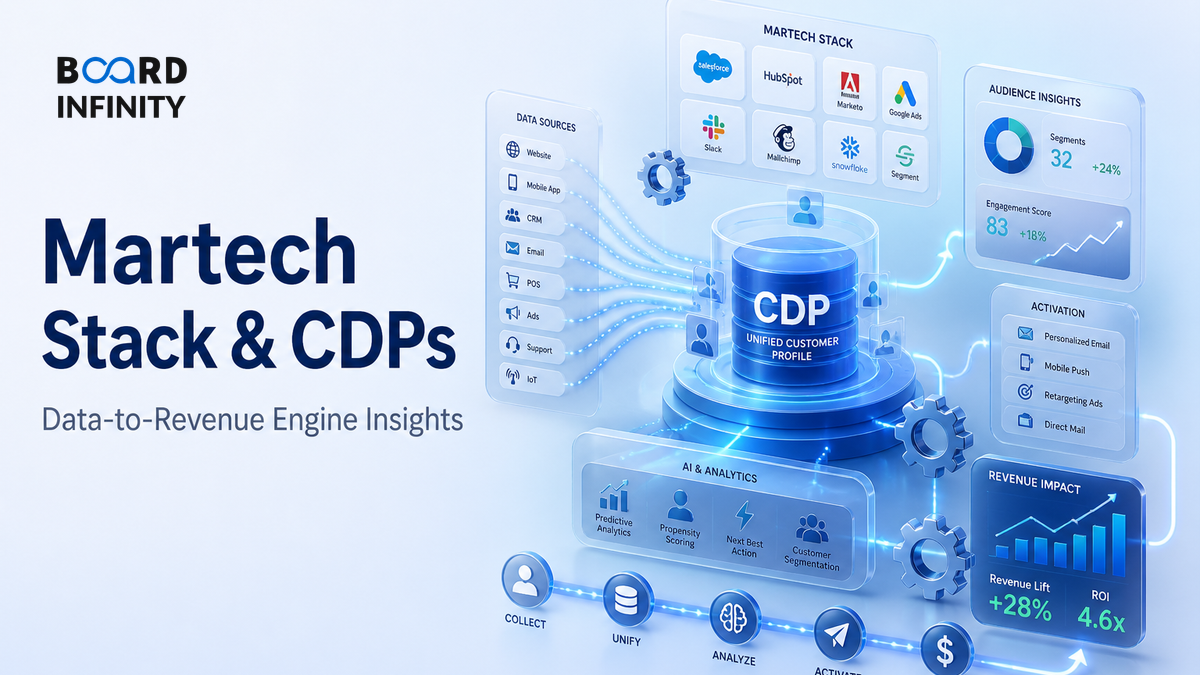
A customer browses a smartwatch on an app, abandons the cart, walks into a store two days later, and still receives a relevant warranty offer instead of a random discount blast. That is not “digital marketing magic” - it is a martech stack doing its job, with customer data stitched, governed, activated, and measured across channels.
- Martech stack means the connected tools marketers use to acquire, engage, retain, analyse, and automate customer journeys.
- CDP is the data spine of the stack: it unifies consented customer data into persistent profiles and shares them with activation tools.
- The core flow is: collect data → resolve identity → build segments → activate journeys → measure lift.
- CDPs are strongest when first-party data matters: retail, BFSI, travel, OTT, telecom, D2C, loyalty-led businesses, and omnichannel brands.
- Do not confuse CRM, DMP, and CDP: CRM manages known customer relationships, DMP historically handled anonymous ad audiences, CDP unifies first-party profiles for activation.
- Strong CDP metrics include identity match rate, consent coverage, profile completeness, activation latency, incremental lift, and data freshness.
- The biggest interview trap: describing tools without linking them to a business outcome such as retention, conversion, CAC efficiency, or customer lifetime value.
The Big Picture
Think of a martech stack as a factory line for customer growth. Raw material is customer data, the CDP is the central processing unit, and the output is timely, relevant action across email, app, ads, website, call centre, and stores.
Core Explanation: Stack, CDP, and Activation
The martech stack is not a shopping list of SaaS tools. It is an operating system for marketing decisions - who to target, what to say, where to say it, when to trigger it, and how to prove it worked.
A typical stack has five layers:
- Acquisition layer: ad platforms, SEO tools, affiliate tools, landing page tools.
- Engagement layer: email, SMS, WhatsApp, push notification, in-app messaging, marketing automation.
- Data layer: CDP, data warehouse, tag manager, consent management, event tracking.
- Analytics layer: dashboards, attribution, experimentation, cohort analysis, customer lifetime value models.
- Operations layer: campaign planning, workflow approvals, asset management, sales or service integrations.
The Customer Data Platform matters because modern customers do not live in one channel. They browse on mobile, compare on desktop, ask support on WhatsApp, buy in-store, and expect the brand to remember them without becoming creepy. The CDP creates the memory layer.
The CDP Funnel: From Anonymous Signal to Loyal Customer
The simplest way to explain a CDP is as a narrowing funnel. Many people create signals; fewer become identifiable, consented profiles; fewer still receive personalised journeys that improve business outcomes.
What a CDP Actually Does
CDP vs CRM vs DMP: The Interview-Critical Difference
Candidates often mix these up. Use this clean distinction: CRM records relationships, DMP rented audiences, CDP unifies first-party customer data for action.
Sephora is a strong global example of martech done well because its loyalty programme, app, stores, recommendations and content create a rich first-party data loop. The primary driver is a loyalty-led customer identity layer, supported by trained store associates, digital content, product discovery, and personalised offers. The strategic so what: CDPs work best when the customer gets visible value for sharing data.
When a Company Actually Needs a CDP
A CDP is not automatically the answer. It is justified when customer identity, consent, and activation complexity are high enough that spreadsheets, CRM exports, and manual audience uploads become slow, risky, or inconsistent.
Metrics to Track in a Martech Stack or CDP
Good martech teams do not celebrate “number of campaigns sent.” They track whether cleaner data and better journeys create measurable customer and commercial improvement.
Definitions
CDP Institute: “A Customer Data Platform is packaged software that creates a persistent, unified customer database that is accessible to other systems.”
- Martech stack: the connected set of marketing technologies used to acquire, engage, retain, analyse, and automate customer journeys.
- Customer 360: a unified customer profile combining identity, behaviour, transactions, preferences, consent, and engagement history.
- Identity resolution: the process of linking multiple identifiers to the same customer, using deterministic or probabilistic matching.
- Activation: sending segments, triggers, or decisions from the data layer into customer-facing channels.
- Consent management: capturing, storing, and enforcing customer permissions for data collection and marketing communication.
Case Study: Tata Neu and the First-Party Data Spine
Tata Neu shows why a CDP-style customer data spine matters when one group wants to coordinate loyalty, commerce, payments, and cross-brand journeys.

Situation: The Tata Group has a wide consumer ecosystem - grocery, electronics, fashion, hotels, aviation, finance, and more. For a customer, these categories feel connected by the Tata name. For data and marketing teams, they are complex because each business can have its own systems, purchase cycles, consent flows, and customer context.
The move: Tata Neu, launched in 2022, brought multiple Tata consumer brands into a super-app experience with NeuCoins as a common loyalty currency. The CDP lesson is not that one app magically solves everything. The strategic move is the creation of a first-party identity and loyalty layer that can recognise a customer across different categories and support cross-brand activation.
Outcome or lesson: The primary driver is a shared loyalty and identity proposition. Supporting drivers include app-based discovery, payments, cross-category commerce, rewards, partner integrations, and customer engagement journeys. The lesson for interviews: omnichannel martech is hard because the challenge is not only technology - it is data governance, consent, brand coordination, journey design, and measurable customer value.
So what: Tata Neu proves that CDPs create the most value when the company has multiple customer touchpoints and a genuine reason for customers to share data. The win does not come from software alone; it comes from the combination of identity, loyalty, ecosystem breadth, consent discipline, and useful activation.
How AI Changes the Martech Stack and CDPs
AI does not replace the martech stack. It makes the stack more decision-led. In 2026, the shift is from “marketer manually defines every segment” to “AI recommends the next best action, creative, channel, and timing - within consent and brand guardrails.”
- Predictive segmentation becomes mainstream: CDPs increasingly use ML scores for churn risk, purchase propensity, product affinity, discount sensitivity, and next-best-offer instead of only static rules like “purchased in last 30 days.”
- Generative campaign operations speed up: LLMs help draft email variants, push messages, landing-page copy, WhatsApp templates, and campaign briefs. The marketer’s job shifts to guardrails, brand voice, compliance, and testing.
- AI agents start coordinating journeys: Agentic tools can monitor campaign performance, suggest audience exclusions, create experiment variants, and route insights to CRM or ad platforms. The risk is over-automation without consent checks, frequency caps, or human approval.
Use NotebookLM or Perplexity: upload a company annual report, privacy policy, app screenshots or public campaign pages, then ask, “Map this company's likely martech stack, first-party data sources, CDP use cases, privacy risks, and 5 interview questions.” Validate every factual claim before using it.
Interview Relevance
“Our D2C brand has website, app, store, CRM and ad-platform data, but customers get irrelevant offers across channels. How would you design the martech stack, and where would a CDP fit?”
Use the sentence: “A CDP is valuable only if it converts fragmented first-party data into governed, personalised activation that improves a measurable business outcome.” This line sounds senior and prevents a tool-list answer.
Common Mistake
The mistake: treating the CDP as a magic database that automatically creates personalisation. Why it costs you: interviewers know martech fails when data quality, consent, journey design, and measurement are weak. One-line fix: always connect the CDP to a specific use case, consent rule, activation channel, and metric.
What to Revise Next
Now that you can explain the martech stack and CDP, revise the two topics that sit immediately around it: the data environment that feeds the stack, and the AI layer that increasingly runs campaigns.