
Anatomy of a Research Report and How Ratings Actually Work for Finance Interviews
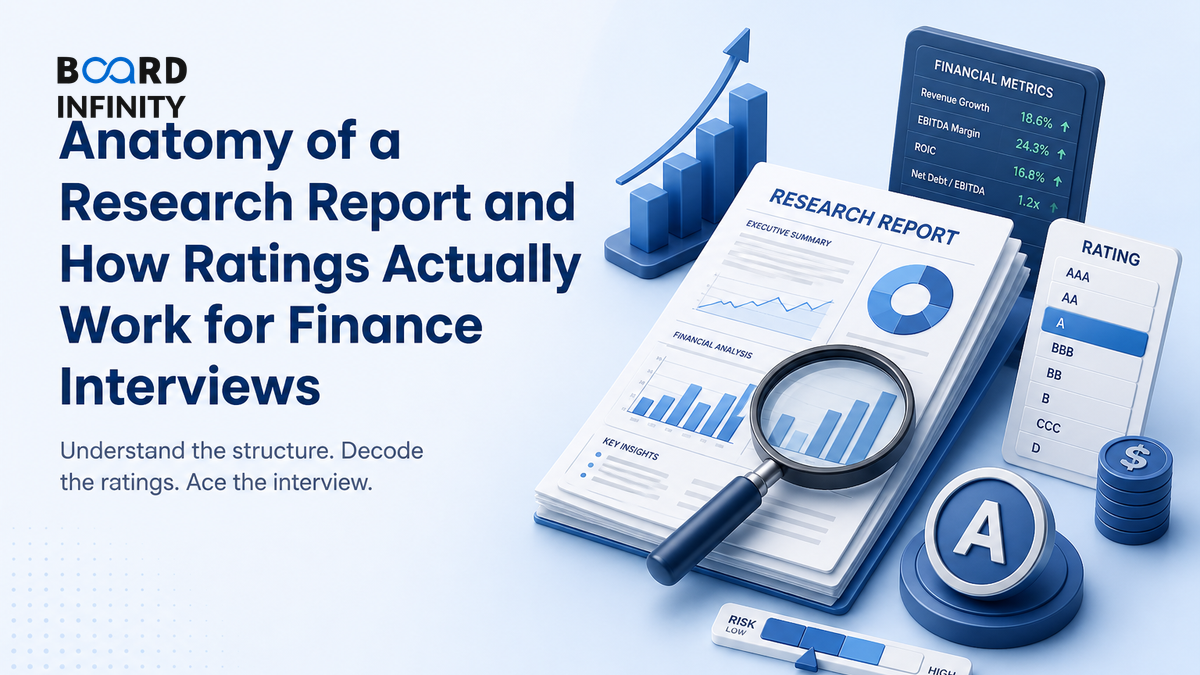
A stock can fall after a “Buy” report and rise after a “Hold” report. That is not always bad research - it often means the market, the valuation model and the time horizon were telling different stories.
The before-after contrast is sharp: beginners read the rating; professionals read the assumptions behind the rating. A research report is not a verdict - it is a structured investment argument.
- An equity research report converts business analysis into a valuation-backed recommendation: usually Buy, Hold, Sell or equivalent labels.
- The rating is driven by expected upside or downside to the target price, adjusted for risk, time horizon and analyst conviction.
- A target price is not a guarantee; it is the analyst's estimated fair value under stated assumptions.
- The core report flow is: business model - industry - financials - forecasts - valuation - risks - recommendation.
- Always check the assumptions: revenue growth, margins, capex, working capital, discount rate, terminal value and valuation multiple.
- In India, research reports are governed by SEBI's Research Analyst framework, so disclosures and conflicts matter.
- The best interview answer does not say “the report says Buy”; it explains why the analyst believes the stock is mispriced.
The Big Picture: A Rating Is the Last Line, Not the First Thought
A research report is a chain of reasoning. The analyst starts with how the business makes money, estimates future performance, values those future economics, compares value with price, and only then assigns a rating.
Core Explanation: What an Equity Research Report Contains
Think of a research report as an investment memo written for decision-making. It must answer one question clearly: Is the market price attractive relative to the company's expected future economics?
The standard report has seven moving parts. In interviews, name the parts in order - that immediately makes your answer sound structured.
How Ratings Actually Work
Most brokerage houses translate expected return into rating buckets. A simple version is: if target price is meaningfully above current market price, it may be a Buy; if it is close, Hold; if it is materially below, Sell. But each firm defines its own thresholds, so never assume one broker's Buy equals another broker's Buy.
The rating depends on four variables together:
Buy, Hold, Sell: The Rating Decision Matrix
A high-upside stock is not automatically a Buy. If the business is risky, governance is weak, liquidity is poor or the thesis depends on heroic assumptions, the analyst may reduce the rating despite apparent upside.
The Metrics Analysts Actually Check
Research reports are full of numbers, but six measures usually decide whether the story is financially credible. The “good” level depends on sector, so benchmark against peers, history and cost of capital.
Worked Example: How a Target Price Becomes a Rating
Assume an analyst estimates a stock's fair value at ₹550 per share. The current market price is ₹480.
Expected upside = (Target price - current price) / current price
Expected upside = (₹550 - ₹480) / ₹480 = ₹70 / ₹480 = 14.6%
If the brokerage's rating framework treats, say, meaningful double-digit upside as Buy and the risk level is acceptable, this may become a Buy. If the same company has high regulatory risk, stretched leverage or very uncertain assumptions, the analyst may choose Hold despite the mathematical upside.
The calculation gives the mechanical upside. The rating adds judgment: risk, timing, liquidity, governance and confidence in the forecast.
Definitions You Must Be Able to Say Cleanly
- Research report: A structured analyst document that evaluates a security and presents forecasts, valuation, risks and investment recommendation.
- Equity rating: A recommendation label expressing expected stock performance over a stated horizon relative to current price and risk.
- Target price: The analyst's estimated fair value per share based on valuation assumptions for a stated time horizon.
- Damodaran on value: “The value of an asset is the present value of expected cash flows on that asset.”
- Credit rating: An opinion on an issuer's or instrument's creditworthiness, not a recommendation to buy or sell equity.
Equity Rating vs Credit Rating: Do Not Mix Them Up
This confusion hurts many finance answers. Equity research asks, “Is the stock attractive?” Credit rating asks, “Will the borrower meet debt obligations?”
Case Study: Trent - Why the Same Stock Can Invite Both Praise and Caution
Trent became a useful Indian example of how analysts separate business quality from valuation risk while assessing ratings.

Situation: Trent, part of the Tata Group, drew investor attention as its retail formats, especially Westside and Zudio, expanded strongly in India's branded apparel market. The business story was attractive: a growing urban consumer base, value-fashion positioning, private-label economics and store-led execution.
The analyst's move: A good research report would not stop at “Trent is a great company.” It would break the thesis into store expansion, same-store growth, gross margin, operating leverage, working capital, lease liabilities and competitive pressure. Then it would ask whether the current market price already discounts a lot of future success.
Outcome or lesson: This is why high-quality companies can receive Hold or Reduce ratings after a sharp re-rating. The primary driver of Trent's investment debate is the balance between growth durability and valuation. Supporting drivers include execution discipline, differentiated formats, sourcing/private-label strength, brand trust from the Tata ecosystem and competitive intensity in Indian fashion retail.
So what: The case proves the central point of research reports - the rating is not a moral judgment on the company. It is a valuation-backed view on the stock at a specific price.
How AI Changes Research Reports and Ratings
AI is not replacing the analyst's judgment; it is compressing the research workflow and making assumption-checking faster. In 2026, three shifts matter for students.
Student workflow: Load a company's latest annual report, investor presentation and earnings-call transcript into NotebookLM. Ask it to generate: “What assumptions would an equity analyst need for revenue growth, margins, capex, working capital and valuation?” Then verify every output against the original documents before using it.
Do not let AI invent valuation assumptions. Use it to find and organize evidence; you must still judge whether the assumptions are economically sensible.
Interview Relevance
“Walk me through an equity research report. If a report says Buy with a target price above the current price, what should you check before trusting the rating?”
Use the phrase “business quality versus valuation comfort.” It signals that you understand why a strong company may not always be a Buy.
Common Mistake
Mistake: Treating Buy, Hold and Sell as absolute truth without reading the assumptions. This costs candidates because it makes them sound like retail headline readers, not finance professionals. One-line fix: Always say, “I would verify the target-price assumptions, risk factors, time horizon and disclosures before accepting the rating.”
What to Revise Next
Once you can read a research report, move to the inputs that shape analyst estimates and ratings. Revise Reading Earnings Calls, Guidance & Management Commentary next, then Behavioural Biases in Investing and How to Counter Them so you can separate evidence-based analysis from market emotion.