
Investment Objectives, Constraints & IPS - Interview-Ready Framework for Portfolio Decisions
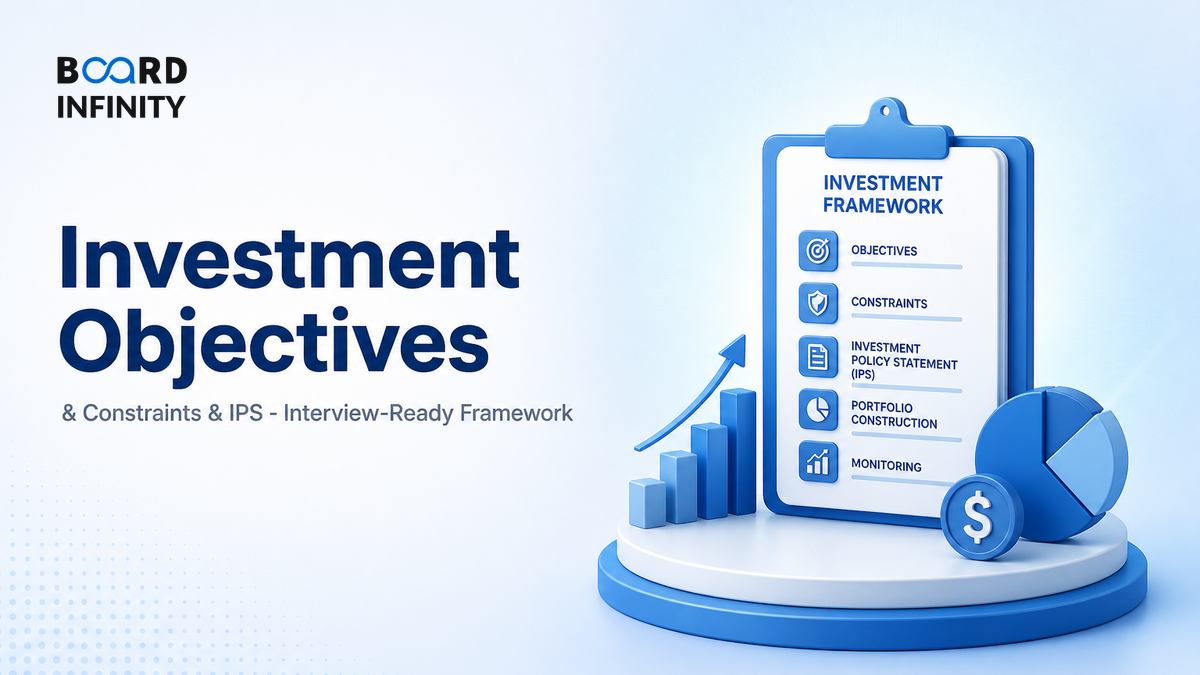
A 28-year-old NPS subscriber, a family office treasurer, and a mutual fund CIO may all say the same thing - “we want good returns.” But the moment one needs money in 18 months, another cannot tolerate a 10% drawdown, and the third is bound by regulation, their portfolios must look completely different.
- Investment objectives answer two questions: how much return is required, and how much risk is acceptable.
- Investment constraints are the limits within which the portfolio must operate: liquidity, time horizon, tax, legal/regulatory and unique circumstances.
- An Investment Policy Statement converts objectives and constraints into written rules for asset allocation, rebalancing, monitoring and governance.
- The IPS prevents emotional investing because decisions are made against a pre-agreed policy, not market noise.
- Return without risk is incomplete; risk without time horizon is meaningless; asset allocation without constraints is dangerous.
- For interviews, answer in this order: client facts - objectives - constraints - strategic asset allocation - IPS rules - monitoring.
- The common mistake is jumping straight to “60% equity, 40% debt” before defining the investor’s required return, risk capacity and liquidity needs.
Big Picture
The IPS is the bridge between “what the investor wants” and “what the portfolio is allowed to do.” It begins with the investor’s goals, filters them through constraints, and ends in a disciplined portfolio mandate.
Core Explanation
Think of portfolio construction as a funnel. Many wishes enter at the top - high return, low risk, liquidity, tax efficiency, ethical preferences, regulatory limits. The IPS forces these wishes into a clear mandate: what to buy, what to avoid, when to rebalance and how performance will be judged.
Investment Objectives: Return and Risk
An investment objective has two inseparable halves.
- Return objective - the return the portfolio must earn to meet the investor’s goal.
- Risk objective - the uncertainty, volatility or possible loss the investor can accept while pursuing that return.
Return should be stated as required return, not “highest possible return.” Risk should be stated as both risk ability and risk willingness.
Two investors may both target 10% annual return. A 30-year-old salaried investor with stable income and no near-term cash need may accept equity volatility, while a retired investor withdrawing monthly income may not. The same return objective produces different portfolios because risk capacity and liquidity constraints differ.
Investment Constraints: The Five Limits
Constraints are not “minor details.” They often dominate the asset allocation decision. A portfolio that ignores constraints may look optimal on Excel and fail in real life.
How to Build an IPS in Six Steps
Metrics That Make the IPS Measurable
A strong IPS is not vague. It defines success in numbers, so the portfolio can be reviewed without emotion.
Worked Example: Turning a Goal into an IPS Constraint
Suppose an investor has ₹45 lakh today and wants ₹1 crore in 7 years for a house down payment. The required return is:
Required return = (₹1 crore / ₹45 lakh)^(1/7) - 1 = approximately 12.1% per year.
Now add constraints. The investor also needs ₹8 lakh within the next 12 months and says a loss beyond 10% would force them to exit. The IPS cannot simply recommend an aggressive equity-heavy portfolio. A better IPS would ring-fence the ₹8 lakh in liquid or short-duration instruments, set a maximum drawdown tolerance, and then invest the remaining corpus for growth. If the required return still needs too much risk, the adviser must change the goal, horizon or contribution plan.
Definitions
Investment objective: A statement of required return and acceptable risk for a portfolio.
Investment constraint: A limit that restricts how the portfolio can pursue its objective.
Investment Policy Statement: A written mandate translating objectives and constraints into portfolio rules, governance and review standards.
CFA Institute framework: Objectives are risk and return; major constraints are liquidity, time horizon, tax, legal/regulatory and unique circumstances.
Case Study: NPS Auto Choice - An IPS Logic Built into a Pension Product
NPS Auto Choice uses lifecycle-based allocation so a retirement investor’s portfolio gradually becomes more conservative as the time horizon shortens.

The National Pension System, regulated by PFRDA, is a useful Indian example because it embeds suitability into product design. A young subscriber saving for retirement has a long time horizon and higher ability to bear equity volatility. A subscriber approaching retirement has a shorter horizon and higher need for capital stability and withdrawal planning.
The move: NPS offers Auto Choice lifecycle options, where allocation across equity, corporate debt and government securities changes with age. The aggressive, moderate and conservative lifecycle choices reflect different risk appetites, while the age-based glide path reflects the shrinking time horizon. At exit, withdrawal and annuity rules add a legal and liquidity constraint that an IPS must respect.
The primary driver is lifecycle allocation - risk reduces as the goal approaches. Supporting drivers include regulatory oversight, defined asset classes, pension withdrawal rules and investor choice among risk profiles. The lesson for interviews is powerful: a good IPS is not about maximizing return; it is about making the portfolio fit the investor’s goal, horizon and constraints.
How AI Changes Investment Objectives, Constraints & the IPS
AI does not replace suitability judgment, but it changes how quickly objectives, constraints and policy breaches can be detected.
- AI-assisted suitability profiling: Robo-advisory platforms can process age, income, goals, risk questionnaires and behaviour signals to suggest an initial risk profile. The caveat is important: the adviser must still check whether the output is suitable and explainable.
- Scenario testing and stress simulation: AI tools can rapidly test how a proposed portfolio behaves under inflation shocks, rate changes, equity crashes or liquidity events. This makes the IPS more practical because risk limits can be tested before capital is deployed.
- LLM-based document intelligence: Large language models can summarize client meeting notes, trust deeds, fund mandates or board policies to extract constraints such as prohibited assets, liquidity needs and review frequency. Human review is essential because legal and tax errors can be costly.
Use NotebookLM or ChatGPT with a mock client profile, an annual report or a fund factsheet. Ask: “Extract the investor’s objectives, constraints, likely IPS rules, suitable asset classes and three interview questions.” Do not upload confidential client data.
Interview Relevance
“A 35-year-old professional wants to invest ₹25 lakh for wealth creation but may need ₹5 lakh in one year. How would you prepare an Investment Policy Statement?”
Use the phrase “required return versus desired return.” It signals maturity because you are not blindly chasing high returns; you are matching the portfolio to the goal.
Common Mistake
The mistake is recommending an asset allocation before diagnosing the investor. It costs candidates because it sounds like product-pushing, not portfolio management. The fix: always say, “I will first define objectives and constraints, then translate them into asset allocation and IPS rules.”
What to Revise Next
Once you understand how an IPS defines the investor’s mandate, revise the building blocks used inside that mandate.