
Behavioural Biases in Investing: How to Spot Them and Counter Them in Interviews
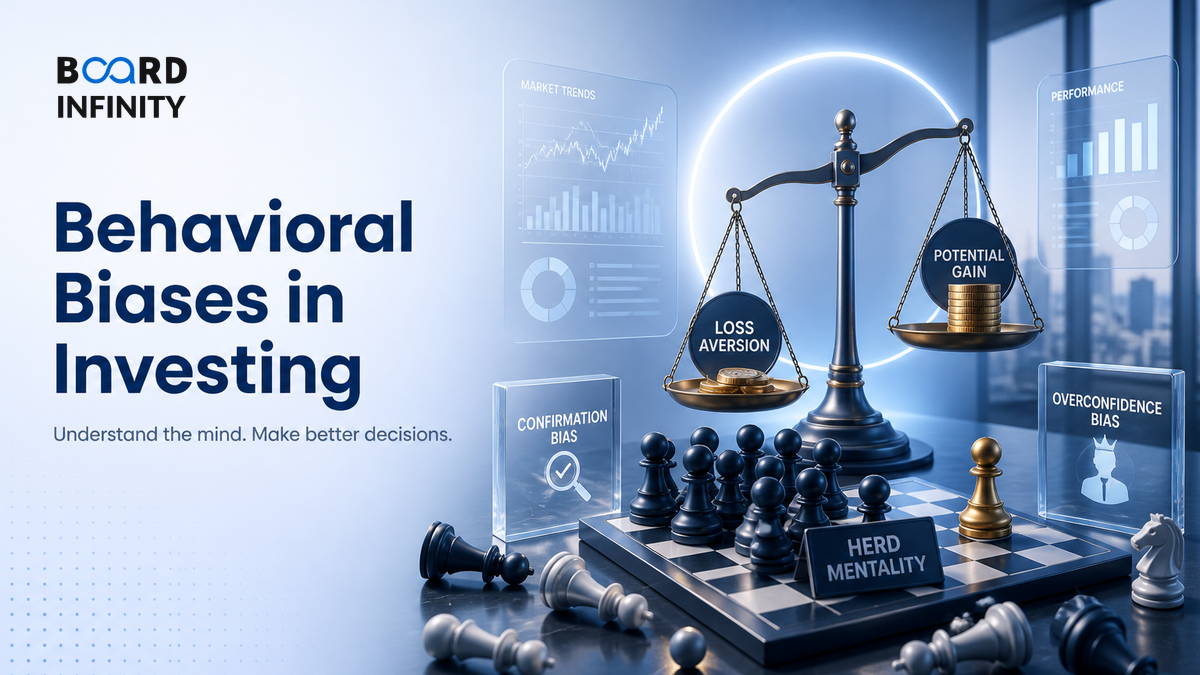
Why does an investor hold a falling stock for months, yet book a small profit in a winning stock within days? The spreadsheet says “evaluate expected return,” but the brain says “avoid regret, protect ego, follow the crowd.” Behavioural biases are the hidden operating system behind many bad investment decisions.
- Behavioural bias is a systematic thinking or emotional pattern that can distort investment judgement.
- The biggest investing biases are overconfidence, confirmation bias, anchoring, loss aversion, herding, recency bias and mental accounting.
- Biases matter because they damage returns through wrong entry price, poor position sizing, panic selling, overtrading and holding losers too long.
- The clean counter is not “be rational.” It is pre-commitment - written thesis, valuation range, risk limit, exit trigger and review calendar.
- Use a bias journal: write the reason before the trade, then compare outcome versus original thesis later.
- In interviews, always connect bias to investment behaviour, portfolio impact and a practical control.
- The common mistake is listing biases like a psychology answer without showing how they change actual buy, sell or hold decisions.
Big Picture: Investing Biases Are a Decision-Loop Problem
Behavioural biases do not usually appear as one dramatic mistake. They enter quietly at each stage of the investing loop - what information you notice, how you interpret it, what action you take, and how you explain the result to yourself later.
Core Explanation: The Seven Biases That Hurt Investors Most
Behavioural finance studies how psychology affects financial decisions. Traditional finance assumes investors process information rationally; behavioural finance asks a more realistic question - what happens when fear, pride, regret and social proof enter the portfolio?
A good answer separates biases into two buckets:
- Cognitive biases - errors in information processing, such as anchoring or confirmation bias.
- Emotional biases - decisions driven by feelings, such as loss aversion or overconfidence.
The Bias Map: Know Whether You Need Better Evidence or Better Discipline
Not every bias needs the same cure. Some require better information design; others require emotional friction. This 2x2 helps you diagnose the error quickly.
Definitions You Can Say in One Breath
- Behavioural bias: a systematic thinking or emotional pattern that can push investors away from evidence-based decisions.
- Behavioural finance: the study of how psychology influences financial decision-making and market outcomes.
- Loss aversion: the tendency to feel losses more intensely than equivalent gains.
- Prospect theory: investors evaluate gains and losses relative to a reference point, not only final wealth.
Kahneman and Tversky captured the core idea behind loss aversion in the famous phrase: “losses loom larger than gains.”
How to Counter Biases: The Five-Step Investment Firewall
The practical answer is not “control your emotions.” That is too vague. The answer is to build decision rules before the market tests your temperament.
Bias Audit: Five Measures That Make Behaviour Visible
Bias control improves when it becomes observable. These measures are not universal rankings because trading style matters, but they help a portfolio manager or analyst detect behavioural drift.
Mini worked example: suppose an investor had 20 winning positions and sold 10 of them, so gains realized = 10/20 = 50%. The same investor had 10 losing positions and sold 2 of them, so losses realized = 2/10 = 20%. Disposition ratio = 50% / 20% = 2.5. That is a red flag: the investor is much more willing to book gains than recognize losses.
Real Example: Paytm IPO and Anchoring to a Story
One97 Communications, the parent of Paytm, listed in India in 2021 after a heavily discussed IPO. Many retail investors were attracted to the brand familiarity and digital-payments narrative, but the stock fell sharply after listing. The lesson is not that famous consumer brands are bad investments; it is that brand recall, IPO price and growth stories can become anchors unless checked against valuation, profitability path, competition and regulatory risk.
The primary behavioural driver was anchoring to narrative - the belief that a widely used app must automatically be a good stock at any price. Supporting drivers included herding around a high-profile IPO, availability bias from daily app usage, and underweighting business-model uncertainty. The strategic “so what” is simple: product love is not investment analysis.
Case Study: Zerodha Uses Friction to Fight Trading Biases
Zerodha shows how a broking platform can use product design, warnings and self-control tools to reduce impulsive trading behaviour.
Situation: India has seen a sharp rise in retail participation in equities and derivatives. That is positive for financial inclusion, but it also exposes new investors to overconfidence, FOMO, leverage, recency bias and loss-chasing - especially in fast-moving segments like intraday and F&O trading.
The move: Zerodha built behavioural friction into the trading journey through features such as risk warnings, educational content through Varsity, nudges around risky instruments, and self-control options such as disabling trading segments for a cooling-off period. These are not full solutions, but they change the choice architecture at the exact moment a biased decision may occur.
The lesson: The primary driver is timely friction - interrupting the impulsive click before the order is placed. Supporting drivers include investor education, transparent portfolio visibility, risk disclosures and platform-level design choices. The win is not “users stop being biased.” The win is that the product makes risky behaviour harder to execute mindlessly.

How AI Changes Behavioural Biases in Investing
AI makes behavioural finance more important, not less. It can reduce some biases by improving analysis, but it can also scale bad judgement if the investor prompts it poorly.
- AI can detect behavioural drift: portfolio tools can flag turnover spikes, concentration increases, repeated averaging down, or trading after volatile news days. That helps convert bias from a feeling into a measurable pattern.
- AI can fight confirmation bias: an investor can ask a model to generate the strongest bear case, identify missing assumptions, compare sector base rates and summarize contrary evidence.
- AI can amplify false confidence: a polished LLM answer can sound more certain than it is. If the prompt is leading - “prove this stock is undervalued” - the output may reinforce the user’s existing thesis.
Use NotebookLM for a bias check: upload the company annual report, latest earnings call transcript and your stock thesis. Ask: “List evidence that weakens my thesis, assumptions I have not tested, and three follow-up questions a skeptical fund manager would ask.”
Interview Relevance
“Explain any three behavioural biases in investing and tell me how an investor or wealth manager can reduce their impact.”
If the interviewer pushes you, move from psychology to process: “A professional investor cannot rely on willpower, so the control has to be built into the investment process.”
Common Mistake
The biggest mistake is giving a list of bias definitions without explaining the investment consequence. It sounds like a psychology answer, not a finance answer! The fix: for every bias, say bias - behaviour - portfolio damage - control.
What to Revise Next
Now move from behavioural theory to investment communication. Revise Case Study: A Two-Minute Stock Pitch That Survives Follow-Ups so you can present a stock idea with thesis, valuation, risks and bias-aware follow-up handling.