
Modern Portfolio Theory & Efficient Frontier - Interview-Ready Revision Guide
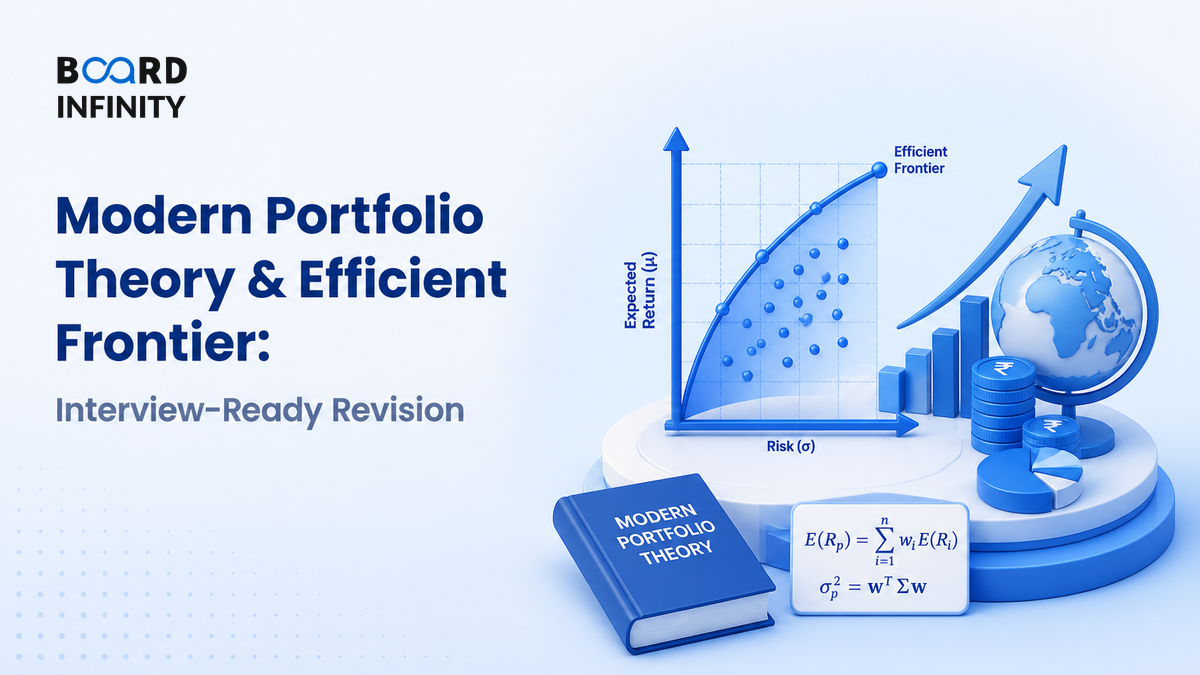
A fund manager does not lose sleep because one stock may fall tomorrow. She loses sleep because every holding may fall together when inflation, rates or panic hit the same nerve. Modern Portfolio Theory begins exactly there - not with “which asset is best?”, but with “which combination gives the best return for the risk we must live with?”
- Modern Portfolio Theory says portfolio risk depends on each asset's risk and how assets move together.
- The efficient frontier is the set of portfolios with maximum expected return for each risk level.
- A portfolio below the frontier is dominated: another portfolio offers higher return for the same risk or lower risk for the same return.
- Correlation is the magic variable. More assets do not automatically reduce risk; low or negative correlation does.
- The minimum variance portfolio is the lowest-risk portfolio on the frontier.
- With a risk-free asset, the best risky portfolio is the tangency portfolio, which leads naturally into CAPM.
- In interviews, answer MPT through four blocks: return, risk, correlation, optimization.
Big picture: MPT converts portfolio selection from a “pick good securities” problem into a risk-return trade-off problem. Every possible portfolio sits somewhere on a risk-return map; the efficient frontier is the upper-left boundary a rational investor cares about.
Core Explanation: What Modern Portfolio Theory Actually Says
Modern Portfolio Theory, introduced by Harry Markowitz, is a framework for choosing portfolios using expected return, risk and covariance between assets. The breakthrough was simple but powerful: portfolio risk is not the weighted average of individual risks because assets interact.
If two assets do not move together, one can soften the other's fall. That is why a portfolio of equities, bonds, gold and cash can have lower risk than a portfolio concentrated only in equities, even if each individual asset carries uncertainty.
The Four Building Blocks of MPT
The Key Formula: Portfolio Risk Is About Interaction
For a two-asset portfolio, expected return is straightforward:
Portfolio expected return = wA × RA + wB × RB
But risk includes correlation:
Portfolio variance = wA²σA² + wB²σB² + 2wAwBρABσAσB
Here, w is weight, R is expected return, σ is standard deviation and ρ is correlation. The third term is the diversification engine. If correlation is low, total portfolio risk can fall sharply.
A Small Worked Example
Assume an investor combines an equity fund and a debt fund:
Expected return = 0.60 × 12% + 0.40 × 8% = 10.4%.
Portfolio variance = 0.60² × 20%² + 0.40² × 10%² + 2 × 0.60 × 0.40 × 0.20 × 20% × 10% = 0.01792.
Portfolio standard deviation = √0.01792 = 13.4% approximately. Notice the weighted average risk would have been 16%, but correlation reduces it to 13.4%. That reduction is diversification, not luck.
Key Metrics to Track
Assumptions You Should State Clearly
India's National Pension System offers lifecycle choices that automatically adjust exposure across asset classes as investors age. The primary logic is MPT-like asset allocation: balance expected growth with risk control. Supporting drivers include regulation by PFRDA, long investment horizons, disciplined rebalancing and capped equity exposure. The so what: portfolio construction matters more than trying to pick one perfect instrument.
Definitions: Say These Cleanly
Modern Portfolio Theory: A mean-variance framework for selecting portfolios using expected return, risk and covariance between assets.
Efficient Frontier: The set of portfolios offering the highest expected return for each level of risk.
Minimum Variance Portfolio: The portfolio on the frontier with the lowest possible risk among all feasible portfolios.
Correlation: A standardized measure from -1 to +1 showing how two assets move together.
Diversification: Risk reduction achieved by combining assets that do not move perfectly together.
smallcase: Portfolio Thinking Made Retail-Friendly
smallcase turned baskets of stocks and ETFs into investable model portfolios, making diversification and rebalancing easier for Indian retail investors.

Situation: Indian retail investors often enter equity markets through stock tips, recent winners or sector stories. The weakness is concentration: even a smart stock idea can create poor portfolio risk if it moves with everything else the investor already owns.
The move: smallcase packaged investment ideas as baskets, often around themes, strategies or asset allocation logic, and connected them with broker accounts. Its primary driver was portfolio-as-product architecture: the investor buys a constructed basket rather than a single security. Supporting drivers included broker integrations, rebalancing workflows, clearer risk labels and simple narratives that retail investors could understand.
Outcome and lesson: The important lesson is not that every basket is automatically efficient. It is that the retail investing conversation shifted from “which stock?” to “what portfolio exposure am I taking?” That is exactly the MPT mindset: return must be evaluated together with risk, correlation and weights.
The strategic so what: MPT is not only a quant model used by institutions. Its logic shows up in retail products whenever a platform makes investors think in portfolios, weights and rebalancing rather than isolated bets.
How AI Changes Modern Portfolio Theory & the Efficient Frontier
AI does not replace MPT's core math. It changes the quality, speed and personalization of the inputs that feed the frontier.
Use NotebookLM before an interview: upload a mutual fund factsheet, an index factsheet and this lesson, then ask, “Compare these portfolios using expected return, volatility, correlation logic, Sharpe ratio and drawdown. What questions could an interviewer ask?” Verify every number against the original factsheet before quoting it.
Interview Relevance
“Explain Modern Portfolio Theory and the Efficient Frontier. If I give you two risky assets, how would diversification reduce portfolio risk?”
If you can say “diversification comes from low correlation, not from owning many names,” you will sound much sharper than most candidates.
Common Mistake
The biggest mistake is saying “more securities means less risk.” That is incomplete and can be wrong because 20 highly correlated stocks may behave like one large bet. Fix: always say diversification reduces risk when assets are not perfectly positively correlated.
What to Revise Next
Once MPT and the efficient frontier are clear, move to the models that price risk and evaluate whether a portfolio manager actually added value.