
Asset Allocation & Rebalancing: Sample Portfolios You Can Explain in Interviews
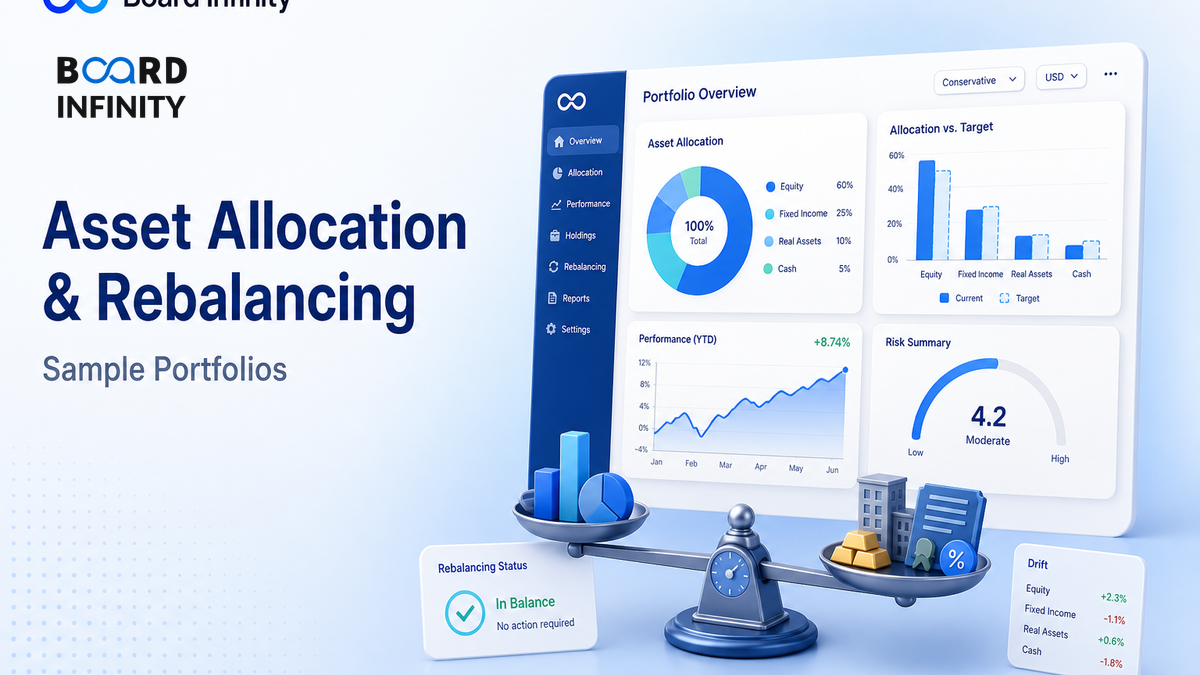
If equity gives the highest long-term return, why not put everything in equity? Because the best portfolio is not the one that looks heroic in a bull market - it is the one you can hold through a job loss, a market crash, a tax deadline and a real-life liquidity need.
- Asset allocation means deciding how much money goes into broad asset classes like equity, debt, gold, real estate and cash.
- Rebalancing means bringing the portfolio back to its target mix after markets move it away.
- The right mix depends on three variables: goal horizon, risk capacity and risk tolerance.
- Equity drives long-term growth, debt stabilises the portfolio, gold hedges stress and inflation shocks, and cash manages liquidity.
- A simple Indian moderate portfolio could be 60% equity, 30% debt, 10% gold - but only if the investor can tolerate equity volatility.
- Use a rebalancing rule: calendar-based, threshold-based, or both - for example, review quarterly and rebalance if an asset class drifts by more than 5 percentage points.
- The biggest trap is recommending a product before defining the investor's goal, time horizon and risk profile.
Big Picture: Allocation Is the Portfolio's Operating System
Security selection asks, “Which stock or fund should I buy?” Asset allocation asks the bigger question: “How should my total wealth behave?” For most investors, the allocation decision explains more of the portfolio experience than any single winning stock.
Core Explanation: The Four Building Blocks
Asset allocation divides wealth across asset classes whose returns do not move perfectly together. The purpose is not to eliminate risk. It is to choose the risks you can live with, and avoid the risks that can force bad decisions.
Think of the major asset classes like different jobs inside a portfolio:
The key insight: an asset is not “good” or “bad” in isolation. It is useful if it improves the portfolio's ability to meet a goal.
The Risk Fit Matrix: Capacity and Tolerance Are Not the Same
Two investors can both say “I want high returns,” but one may be 24 with no dependents while another may be 54 funding a child's education next year. Asset allocation must separate risk capacity - the financial ability to take risk - from risk tolerance - the emotional willingness to stay invested during losses.
Sample Portfolios: How the Mix Changes by Goal
These are illustrative learning portfolios, not investment advice. In a real recommendation, you would adjust for income stability, liabilities, tax bracket, existing EPF or PPF, dependents, emergency fund and goal deadlines.
The logic is simple: as the time horizon becomes longer and risk capacity rises, equity can increase. As the goal becomes nearer or cash-flow dependent, debt and cash deserve more space.
India's National Pension System offers lifecycle-style options where the allocation becomes more conservative as the subscriber ages. The strategic lesson is powerful: a long-horizon retirement portfolio can afford more growth assets early, but should reduce sequence-of-return risk as withdrawals come closer.
Rebalancing: The Discipline That Keeps Risk Honest
Suppose your target mix is 60% equity, 30% debt and 10% gold. If equity rallies sharply, your portfolio may become 67% equity without you actively choosing that risk. Rebalancing forces the portfolio back to the agreed risk level.
A Worked Example: Rebalancing a ₹10 Lakh Portfolio
Target allocation: 60% equity, 30% debt, 10% gold. Initial investment: ₹10,00,000.
If the policy allows a 5 percentage point band around each target, equity's upper band is 65%. The equity weight is now 66.4%, so rebalancing is triggered.
The investor is not predicting a market fall. The investor is simply refusing to let a 60:30:10 portfolio silently become a higher-risk portfolio.
Key Metrics to Track
A professional portfolio discussion should move from “this looks diversified” to measurable portfolio health. Use these metrics carefully because good values depend on the mandate, investor and benchmark.
Definitions You Can Say in One Breath
- Asset allocation: Dividing a portfolio across asset classes to match the investor's goals, horizon, risk capacity and risk tolerance.
- Strategic asset allocation: A long-term target mix designed around the investor's core objectives and risk profile.
- Tactical asset allocation: Short-term deviations from the target mix to exploit a market view, within defined risk limits.
- Rebalancing: Restoring actual portfolio weights to target weights after market movements or cash flows cause drift.
- Glide path: A planned reduction in risky assets as the goal date approaches.
Parag Parikh Flexi Cap Fund: Asset Allocation as Behaviour Control
Parag Parikh Flexi Cap Fund became a memorable Indian example of using domestic equity, overseas equity and cash or debt flexibility to make allocation a discipline, not just a product label.

Situation: Many Indian retail investors think diversification means owning many Indian stocks or many equity funds. That can still leave the portfolio exposed to the same domestic market cycle, valuation cycle and investor behaviour cycle.
The move: Parag Parikh Flexi Cap Fund, from Parag Parikh Mutual Fund, became known for a differentiated approach that combined Indian equities with overseas equities and maintained flexibility around cash or debt when valuations demanded caution. The primary driver was portfolio-level diversification across geographies and asset buckets. Supporting drivers included a value-conscious investment style, long-term investor communication, and willingness to look different from benchmark-hugging peers.
The lesson: The fund's story is useful not because every investor should buy it, but because it proves a deeper concept: asset allocation is a behavioural design tool. A portfolio that diversifies across return sources can reduce the urge to chase whichever market is currently fashionable.
How AI Changes Asset Allocation & Rebalancing
AI does not remove the need for judgement; it changes the speed and granularity with which portfolios can be analysed.
- Robo-advisory becomes more personalised: AI-led platforms can map goals, cash flows, risk questionnaires and market scenarios into model portfolios. The danger is false precision - a model can score risk tolerance, but it cannot fully know how an investor will behave in a crash.
- Rebalancing becomes more tax-aware: Algorithms can evaluate which lots to sell, whether new SIP flows can correct drift, and how transaction costs affect the rebalance decision. In India, this matters because taxation differs across equity, debt, gold and holding periods.
- Scenario analysis becomes easier: AI tools can simulate inflation shocks, equity drawdowns, interest-rate changes and withdrawal needs, helping advisers explain why a portfolio needs debt or cash even when equity is performing well.
Use NotebookLM like a revision analyst: upload this note, a mutual fund factsheet and a company annual report, then ask, “What asset allocation risks, rebalancing triggers and investor suitability issues could an interviewer ask me about?”
Interview Relevance
“A 28-year-old salaried investor wants to invest ₹10 lakh for long-term wealth creation. How would you design an asset allocation, and when would you rebalance it?”
Always say, “This is an illustrative allocation; the final mix depends on the investor's goals and constraints.” That one sentence makes your answer sound professional.
Common Mistake
The most common error is jumping straight to “buy equity mutual funds” or “buy an index fund” without defining the goal, horizon and risk profile. It costs candidates because it sounds like product selling, not portfolio construction. The one-line fix: start with investor suitability, then recommend the asset mix, then choose products.
What to Revise Next
Once you understand allocation, revise how to implement it and defend it. Go next to Active vs Passive Investing in India: What the Evidence Shows, then Building an Investment Thesis: The Structure That Holds Up.