
Applicant Tracking Systems and Recruitment Technology
A recruiter posts one campus role at 9 a.m.; by lunch, hundreds of resumes have arrived, many with similar degrees and keywords. The company that wins this chaos is not the one with the most recruiters - it is the one whose recruitment technology turns applications into a clean, fair, auditable hiring pipeline.
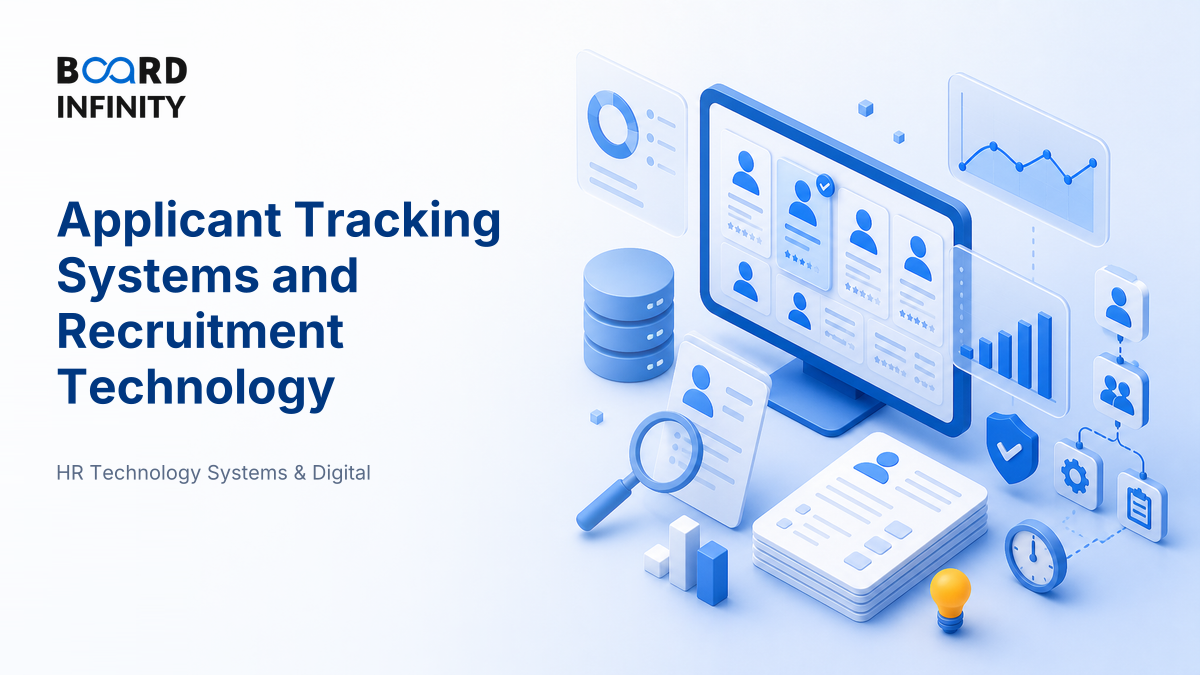
- Applicant Tracking System (ATS) is the workflow engine that captures applications, stores candidate data, screens profiles, tracks interviews and manages offers.
- Recruitment technology is broader than ATS: it includes sourcing tools, career sites, assessments, interview platforms, candidate relationship management, background verification and HRIS integrations.
- The best way to explain ATS is as a hiring funnel plus data system: requisition - attraction - application - screening - interview - offer - onboarding.
- ATS does not simply “reject resumes by keywords”; modern systems combine structured fields, knockout questions, recruiter workflows, integrations and analytics.
- Key metrics include time to fill, source conversion, screening pass rate, interview-to-offer ratio, offer acceptance rate and quality of hire.
- In India, recruitment tech must be discussed with scale, campus hiring, multilingual candidate experience, assessment integrity and DPDP-style data privacy in mind.
- The interview-winning answer connects technology to business outcomes: faster hiring, better quality, lower cost, fairer process and stronger candidate experience.
Big Picture
Think of recruitment technology as the operating system of hiring. The ATS is the central workflow, while surrounding tools feed it candidates, test them, schedule them, communicate with them and hand final data to HR systems.
Core Explanation
An Applicant Tracking System is best understood through three layers: the hiring workflow, the candidate database and the analytics/control layer. Most weak answers stop at “resume screening software”; strong answers show how the ATS connects people, process and data.
The hiring manager starts with a job requisition - an approved request to hire for a specific role, budget and location. The recruiter publishes the role to a career site, job boards, campus portals or employee-referral channels. Applications flow into the ATS, where candidate profiles are parsed, tagged, screened and moved across stages.
The system then supports collaboration: recruiters shortlist, hiring managers review, interviewers submit feedback, offer teams generate letters and HR operations prepare onboarding. This creates one version of truth: who applied, why they progressed, who approved, where delays occurred and what source produced the best hires.
The Recruitment-Technology Stack
Recruitment technology is not one tool. In a mature organization, the ATS sits in the middle of a stack that covers sourcing, evaluation, communication, compliance and onboarding.
TCS iON National Qualifier Test shows how recruitment technology can handle India-scale early-career screening. Its primary driver is standardized digital assessment at scale, supported by remote access, structured candidate data and a platform model that can connect candidates with hiring opportunities. The strategic so what: in high-volume hiring, process design matters as much as recruiter effort.
How an ATS Screens Candidates Without Becoming a Black Box
Screening usually happens through a combination of rules, structured data and human review. A responsible ATS design should make each movement explainable: why a candidate was rejected, advanced or held for later.
Key Metrics to Track in ATS and Recruitment Technology
Do not quote one universal “good” benchmark for hiring metrics. Ranges vary by role, seniority, industry and labour market. In interviews, give the formula and say a number is strong when it improves against the company’s own baseline without hurting quality, fairness or candidate experience.
Worked Example - Reading an ATS Funnel
Suppose a company hires management trainees through a campus process. The numbers below are hypothetical, but the logic is exactly how an ATS dashboard is read.
The insight is not just “28 people joined.” A recruiter would ask: Did a source send many ineligible applicants? Was the assessment too difficult or correctly selective? Did interview capacity create delay? Was the offer acceptance rate healthy compared with the company’s own past campus cycles?
Definitions
- Applicant Tracking System: Software that manages candidate data and hiring workflows from application to offer decision.
- Recruitment Technology: Digital tools used to attract, assess, select, communicate with and onboard candidates.
- Candidate Relationship Management: A system for building and nurturing talent pools before a specific vacancy must be filled.
- Resume Parsing: Converting unstructured resume text into searchable fields such as skills, education, experience and employers.
- Knockout Question: A mandatory screening question that removes candidates who fail a non-negotiable job requirement.
- Structured Interview: An interview format where candidates are assessed using the same job-relevant questions and scoring criteria.
Case Study - TCS iON NQT: Recruitment Technology at India Scale
TCS iON NQT demonstrates how a digital assessment platform can standardize early-career hiring signals across a large and geographically spread Indian talent pool.
Situation: India’s entry-level hiring market is high-volume, fragmented and geographically distributed. Recruiters need a way to compare candidates from different colleges, cities and academic backgrounds without relying only on campus reputation or resume formatting.

The move: TCS iON built the National Qualifier Test as a structured digital assessment pathway. The primary driver is standardized testing at scale. Supporting drivers include online access, reusable candidate scores, organized candidate records and a platform approach that can connect assessed candidates with opportunities.
Outcome or lesson: The lesson is not that assessments replace recruiters. The lesson is that recruitment technology improves hiring when it converts volume into comparable, auditable signals and then hands those signals to human decision-makers for role-fit evaluation.
A shallow answer says “technology makes recruitment faster.” A complete answer says recruitment technology improves hiring when standardization, data quality, candidate experience, assessment validity and human oversight work together.
How AI Changes Applicant Tracking Systems and Recruitment Technology
AI is changing recruitment technology, but the best candidates discuss it with both power and caution. The goal is not “replace recruiters”; the goal is better matching, faster administration and more evidence-based decisions.
Student workflow: Use Perplexity or NotebookLM to compare one company’s career page, annual report hiring priorities and recent job descriptions. Ask: “What recruitment technology stack would this company likely need, and what ATS metrics would reveal bottlenecks?” Then convert the output into a 60-second interview answer.
Interview Relevance
“Our company receives thousands of applications for management trainee roles. How would you use an ATS and recruitment technology to improve hiring quality without damaging candidate experience?”
Use this one-line structure: “I would treat ATS as a funnel-control and data-governance system, not just a resume filter.” That sentence instantly sounds more mature than a keyword-based answer.
Common Mistake
The biggest mistake is saying “ATS rejects resumes that do not have keywords.” That sounds outdated and shallow because it ignores requisitions, structured data, recruiter workflow, integrations, candidate experience, analytics and compliance. Fix: explain ATS as an end-to-end hiring workflow system with human oversight and measurable funnel outcomes.