
The HR Technology Stack and How the Pieces Connect
A new hire accepts an offer on Friday, joins on Monday, and still has no laptop access, payroll record, ID card, or onboarding checklist. Nobody is lazy - the recruitment tool, HRIS, IT system, payroll engine and manager workflow simply did not talk to each other.
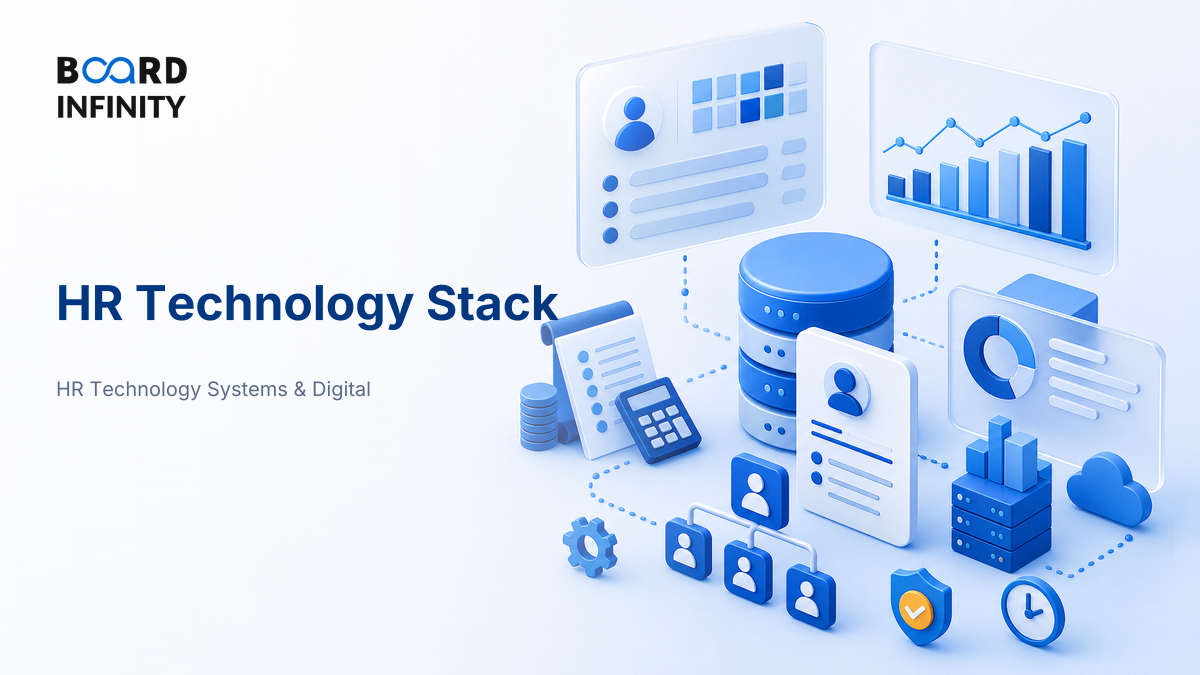
- An HR technology stack is the connected set of systems that manage people data, HR workflows, talent decisions and employee experience.
- The foundation is the system of record - usually an HRIS or HCM platform holding employee master data, job data and org structure.
- Talent tools sit around the core: ATS, learning, performance, engagement, succession, compensation and internal mobility platforms.
- The stack works only when data flows across systems - offer to employee record, employee record to payroll, skills data to learning, performance data to rewards.
- Integration is not a technical footnote; it is the difference between a digital HR experience and five disconnected portals.
- Good HR tech is measured by adoption, data accuracy, process speed, SLA performance, integration reliability and decision quality.
- The best interview answer explains layers, connections and governance - not just brand names like Workday, SAP SuccessFactors, Darwinbox or Zoho People.
Big Picture: Think of the HR Stack as a Layered Pyramid
The easiest mental model is a pyramid. The lower layers create trusted data and stable workflows; the upper layers create better decisions, better experiences and strategic talent outcomes.
Core Explanation: What Sits in the HR Technology Stack
The HR technology stack is not one product. It is an architecture of systems that support the employee lifecycle - from workforce planning and hiring to payroll, performance, learning, engagement and exit.
The stack usually has five connected parts:
The key idea: each layer is useful alone, but the business value comes when they connect. A candidate hired through the ATS should become an employee record in the HRIS. That record should trigger onboarding, identity access, payroll setup, learning assignments and manager tasks.
The Main Components and How They Connect
A clean answer separates systems by role: which system owns the data, which system runs the process, and which system improves the decision.
Darwinbox, founded in Hyderabad, is a useful Indian example because it positions itself as a cloud HCM suite for large, mobile-first workforces across Asia. The strategic point is not the brand name; it shows why Indian enterprises often need HR tools that handle distributed employees, manager approvals, payroll complexity, compliance and mobile self-service in one connected flow.
Suite, Core System or Best-of-Breed: The Architecture Choice
Most companies choose one of three patterns. A core HR system is the employee data foundation. A talent suite bundles multiple HR modules on one platform. A best-of-breed stack uses specialist tools for each capability and integrates them.
Definitions You Can Say in One Breath
- HR technology stack: The connected set of HR systems managing people data, workflows, talent processes, employee experience and workforce analytics.
- HRIS: The system of record that stores employee master data, job information, org structure and core HR transactions.
- HCM suite: An integrated platform covering core HR and talent processes such as hiring, learning, performance, compensation and workforce management.
- ATS: Recruitment software that manages job requisitions, candidate pipelines, interviews, offers and hiring approvals.
- Employee experience layer: The interface through which employees and managers access HR services, knowledge, approvals and self-service workflows.
- Integration layer: The APIs, connectors and data rules that move information accurately between HR systems.
How to Evaluate an HR Tech Stack: Metrics That Matter
Do not say “implementation was successful” without evidence. Evaluate the stack by whether it makes HR faster, cleaner, more reliable and more useful to the business.
Mini Case Study: Unilever and the Connected Talent Stack
Unilever used a connected talent and learning approach to make internal opportunities more visible and match employees to projects, skills and growth paths.

Situation: A global company like Unilever has talent spread across countries, functions and brands. The problem is not just hiring from outside; it is knowing who inside the organisation has the skills, aspiration and availability for new work.
The move: Unilever has publicly discussed its internal talent marketplace approach, often associated with “Flex Experiences”, where employees can access projects, gigs and development opportunities. The primary driver was skills visibility - making internal talent easier to discover and deploy. Supporting drivers included learning pathways, manager participation, employee self-service, consistent people data and a culture that encouraged internal mobility.
The outcome or lesson: The lesson is not “buy a marketplace tool.” The lesson is that a talent marketplace works only when the stack connects core employee data, skills profiles, learning content, manager approvals and workforce planning. Without those connections, it becomes a prettier job board.
The strategic “so what”: Unilever’s example shows that HR technology creates advantage when it changes how talent flows inside the company. The primary driver is skills visibility, supported by data quality, learning access, manager buy-in and process governance.
How AI Changes HR Technology Stack
AI changes the HR stack by shifting it from a workflow system to a decision-support system. But in HR, AI must be handled with care because decisions affect jobs, pay, privacy and fairness.
Before an interview, load the company annual report, careers page and one HR technology article into NotebookLM. Ask: “Map the likely HR tech stack of this company across core HR, recruitment, learning, performance, payroll, employee experience and analytics. Then generate five interview questions on risks and implementation challenges.”
Interview Relevance
“Suppose a 20,000-employee Indian company wants to modernise HR. What would the HR technology stack look like, and how would you ensure the pieces connect?”
Use the phrase “system of record, system of engagement and system of intelligence”. It instantly signals that you understand both HR process and technology architecture.
Common Mistake
The biggest mistake is giving a shopping list of tools - “Workday, SAP, Darwinbox, ATS, LMS, payroll” - without explaining which system owns which data and how information flows. The one-line fix: always answer with layers, lifecycle flows, integration points and governance.