
Core HR Systems versus Talent Suites versus Best-of-Breed
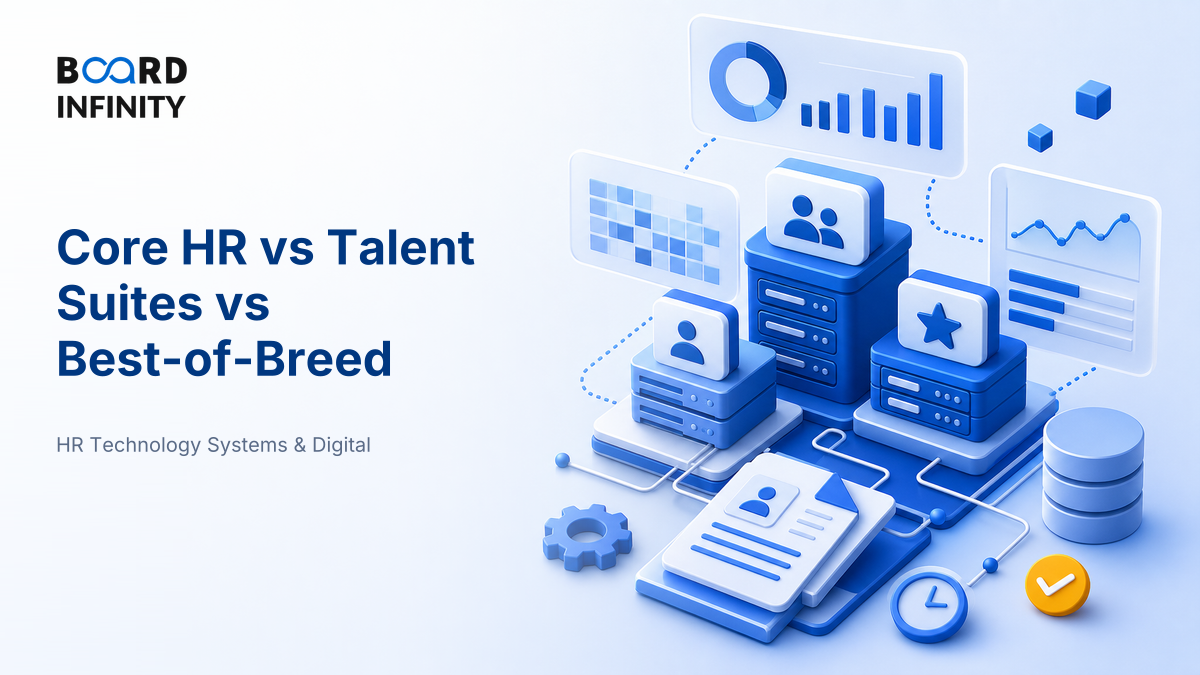
In one company, an HR manager still asks three teams whether an employee has changed role, moved city, or left the firm. In another, the change is entered once, flows to payroll, access control, performance goals and analytics, and no one argues about which spreadsheet is true. That gap is the real difference between a loose HR tool collection and a designed HR technology architecture.
- Core HR is the employee system of record - people data, jobs, org structure, lifecycle events and compliance.
- Talent Suites connect people processes - recruiting, onboarding, learning, performance, succession and compensation - on one platform.
- Best-of-Breed tools are specialist applications chosen for depth in one area, such as ATS, engagement, LXP or workforce analytics.
- The real decision is not “Which vendor is best?” but “Which architecture fits our scale, process maturity, integration capability and employee experience?”
- Core HR needs reliability and governance; talent suites need process consistency; best-of-breed needs strong integration and vendor management.
- In interviews, answer through the lens of system of record, process coverage, integration complexity, user experience and total cost of ownership.
Big Picture: Three Layers, Three Jobs
Think of HR technology as a stack. The bottom problem is truth - who works here, in what role, under which terms. The middle problem is talent flow - how people are hired, developed, assessed and moved. The edge problem is specialization - which niche tools create a better employee or manager experience.
Core Explanation: What Each System Really Does
Core HR systems hold the organization’s official employee record. They typically manage employee master data, job and position information, organizational hierarchy, employment lifecycle events, leave records, compliance fields, and integration with payroll and time systems. If Core HR is wrong, every downstream HR process becomes suspect.
Talent Suites sit around or above Core HR. They bring together recruiting, onboarding, performance management, learning, succession planning, compensation and sometimes engagement into a connected experience. The value is process consistency - one platform, one login, one workflow logic, one analytics layer.
Best-of-Breed tools are specialist systems that do one HR job exceptionally well. A company may use a dedicated applicant tracking system, an AI sourcing tool, a learning experience platform, a pulse engagement tool, or a workforce planning platform because that specific capability matters more than suite simplicity.
The Architecture Choice: Suite, Specialist, or Hybrid?
Most large organizations do not choose a pure model. They keep a reliable Core HR system, use a talent suite for major standardized processes, and selectively add best-of-breed tools where competitive advantage or employee experience demands depth.
Darwinbox, an India-origin HCM platform, has publicly referenced large Indian enterprises such as JSW Group among its customers. For Indian conglomerates, the appeal of an integrated HCM suite is not just digitizing HR forms - it is creating common workflows across diverse businesses, locations and employee types. The strategic lesson: a suite becomes valuable when process standardization matters as much as individual module depth.
Definitions You Can Say Aloud
- Core HR system: The authoritative system of record for employee data, jobs, organization structure, lifecycle events and HR compliance.
- Talent suite: An integrated platform covering multiple talent processes such as hiring, onboarding, performance, learning, succession and compensation.
- Best-of-breed system: A specialist application selected for superior capability in one HR process and integrated into the wider HR stack.
- System of record: The trusted source where official data is created, maintained and governed.
- System of engagement: A tool employees and managers actively use to complete tasks, make decisions or improve experience.
How to Evaluate an HR Tech Architecture
Use metrics, not vendor preference. A good HR technology decision improves data quality, process speed, adoption, compliance and cost-to-serve without creating integration chaos.
Schneider Electric: Building Talent Mobility on a Strong HR Backbone
Schneider Electric shows why HR architecture is not only about storing employee data - it is about using reliable data to create internal talent mobility at scale.

Situation: Schneider Electric operates across countries, business lines and technical roles. In a company like this, the hidden problem is internal talent opacity - employees may not know which projects, mentors or roles exist, while managers may not know where skills sit inside the organization.
The move: Schneider Electric developed its internal talent marketplace, widely known as Open Talent Market, to help employees discover gigs, mentoring and career opportunities. The important architecture lesson is that such a marketplace only works when the underlying HR data is credible: employee profiles, roles, skills, reporting lines and job opportunities must connect cleanly.
Outcome and lesson: The primary driver was a shift from HR as an administrative record-keeper to HR as an internal opportunity platform. Supporting drivers included leadership sponsorship, a skills-based view of talent, employee self-service, and integration with the broader HR ecosystem. The lesson for interviews: best-of-breed or AI-enabled talent tools create value only when Core HR data and governance are strong enough to feed them.
How AI Changes Core HR Systems versus Talent Suites versus Best-of-Breed
AI makes the architecture question sharper because AI tools are only as good as the HR data and permissions behind them.
- Core HR becomes a governed data layer. AI assistants can answer policy, leave, role or org questions, but only if employee data is accurate, permissioned and compliant with privacy rules such as India’s Digital Personal Data Protection Act, 2023.
- Talent Suites are adding AI copilots. Suites increasingly use AI for job description drafting, learning recommendations, performance-summary support and career path suggestions. The risk is bias or over-standardization if human review is weak.
- Best-of-Breed AI tools move faster. Specialist tools in sourcing, skills intelligence, engagement analytics and workforce planning may outperform suite modules, but they increase integration, explainability and data-sharing risk.
Use NotebookLM or ChatGPT like an HR tech analyst: load a company annual report, careers page and HR transformation article, then ask, “Which HR architecture does this company appear to follow - core HR, suite, best-of-breed or hybrid - and what interview questions could be asked?” Verify every claim before using it.
Interview Relevance
“Our company is scaling from 5,000 to 25,000 employees across India and Southeast Asia. Should we implement a full talent suite or pick best-of-breed HR tools?”
Use the phrase “system of record versus system of engagement.” It signals that you understand both HR operations and employee experience.
Common Mistake
The biggest mistake is treating Core HR, Talent Suites and Best-of-Breed tools as three interchangeable vendor choices. They solve different problems, so a one-line “Workday is better” or “best-of-breed is more flexible” answer sounds shallow. Fix it by starting with the architecture logic: record first, process layer second, specialist tools only where they add measurable value.