
Payroll & Time Systems and Their Integration Points
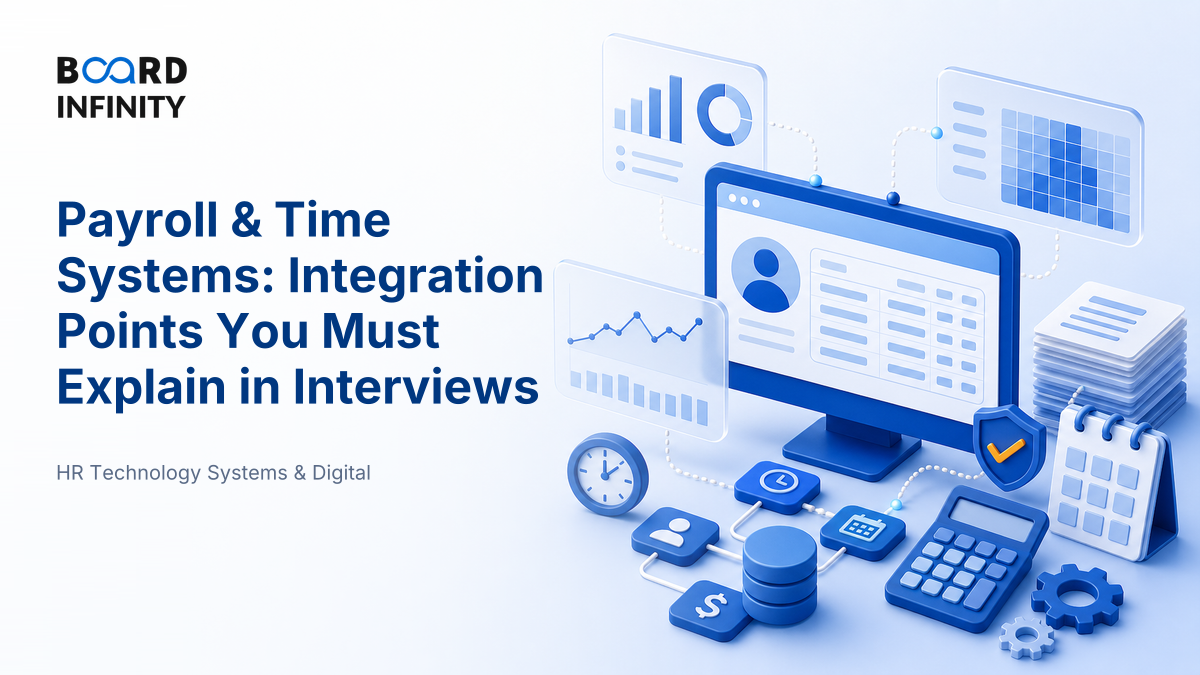
If an employee forgets to punch out after a night shift, is it a timekeeping error, a payroll error, a compliance risk, or a finance reconciliation issue? In a well-run company, it is all four - because payroll is where HR data, attendance, law, money, and trust collide.
- Payroll system calculates gross pay, deductions, net pay, payslips, statutory outputs, and accounting entries.
- Time system captures attendance, shifts, overtime, breaks, leave, and exceptions before payroll is run.
- The core integration chain is: employee master data + approved time + pay rules + statutory rules + finance posting.
- Bad integration causes the classic failures: wrong pay, delayed salary, compliance penalties, employee tickets, and GL reconciliation gaps.
- In India, payroll integrations must handle PF, ESI, Professional Tax, TDS, labour-law records, bank files, and state-level variations where applicable.
- The best interview answer is not “software features”; it is data flow, controls, compliance, and exception handling.
- The golden rule: payroll should calculate only after source data is approved and locked.
Big Picture: Payroll Is the Control Tower, Not a Calculator
Think of payroll as the final settlement layer of the employee lifecycle. Time systems tell payroll what happened; HRIS tells payroll who the employee is; compliance rules tell payroll what must be deducted or reported; finance tells payroll where the money and accounting entry must go.
Core Explanation: What Integrates With What
A payroll and time architecture is the set of systems, rules, approvals, and data exchanges that convert work performed into compliant pay. The interviewer is testing whether you see payroll as an enterprise process, not as an HR admin task.
1. HRIS to Payroll: The Employee Master Data Feed
The HRIS or core HR platform sends payroll the base facts: employee ID, legal name, date of joining, location, department, grade, cost centre, employment type, salary structure, bank details, tax declarations, and separation date. If this feed is wrong, every downstream calculation becomes suspect.
Integration point: New hires, transfers, promotions, salary revisions, exits, bank changes, and tax declarations should flow from HRIS to payroll through an approved workflow.
2. Time and Attendance to Payroll: The Work Data Feed
The time system captures shift schedules, punches, biometric attendance, mobile check-ins, leave, weekly offs, holidays, overtime, late marks, and absence exceptions. Payroll should consume only approved time data, not raw punches.
Integration point: Approved hours, payable days, overtime hours, loss of pay, holiday work, shift allowance triggers, and leave balances feed payroll before payroll lock.
3. Payroll to Finance: The Money and Accounting Feed
Once payroll is processed, finance needs salary payable, employer contributions, department-wise cost allocation, reimbursements, deductions, and provision entries. This is usually pushed to an ERP or accounting system as a general ledger posting.
Integration point: Payroll summary by cost centre, GL code mapping, bank payment file, reimbursement posting, and reconciliation reports.
4. Payroll to Compliance: The Statutory Output Feed
Payroll systems generate or support statutory outputs such as PF, ESI, Professional Tax, TDS, labour welfare fund where applicable, payslip records, wage registers, and audit trails. In India, this matters because rules vary by employee category, wage threshold, state, and establishment type.
Integration point: Statutory deductions, challan data, returns, Form 16 inputs, employee declarations, and year-end tax proof validation.
5. Payroll to Employee Service: The Trust Layer
Employees do not see integrations; they see whether their salary, payslip, leave balance, and tax deduction are correct. Employee service platforms connect payroll to self-service queries, tickets, payslip downloads, tax-proof submission, and grievance resolution.
Integration point: Payslips, tax statements, query status, correction requests, and case-management workflows.
The Integration Risk Matrix
Not all integration points carry equal risk. A broken report export is inconvenient; a broken statutory-deduction rule or unapproved overtime feed can become a salary, audit, or legal issue. Use this 2x2 to prioritise what deserves the strongest controls.
Definitions You Can Say Cleanly
- Payroll system: Software that calculates employee pay, deductions, net salary, payslips, statutory outputs, and accounting entries.
- Time and attendance system: Software that records work time, shifts, leave, overtime, absences, and attendance exceptions.
- Integration point: A controlled data exchange where one system sends information needed by another system to complete a process.
- Gross-to-net calculation: The conversion of gross earnings into take-home pay after deductions, taxes, and adjustments.
- Payroll lock: The cutoff after which approved pay inputs are frozen for calculation, review, payment, and reporting.
The Payroll-Time Process in 6 Steps
In interviews, this sequence is more valuable than naming tools. It shows that you understand the operational rhythm of payroll.
Worked Example: How Time Data Changes Payroll
Suppose an hourly employee is paid ₹300 per regular hour. In a pay period, the approved time record shows 152 regular hours and 8 overtime hours. Overtime is paid at 1.5 times the hourly rate.
The point is simple: payroll accuracy depends on the approved time feed. If overtime approval is delayed or wrong, the payroll engine may calculate perfectly and still pay incorrectly.
Key Metrics to Track Payroll and Time Integration Health
When discussing KPIs, do not say “accuracy” vaguely. Name the measure, formula, and what strong performance looks like. Benchmarks vary by industry and payroll complexity, but these are interview-safe operating indicators.
Case Study: Quess Corp and the Discipline of Payroll at Workforce Scale
Quess Corp, one of India's large business services and workforce management companies, shows why payroll and time integration is a scale-and-control problem, not merely an HR software problem.
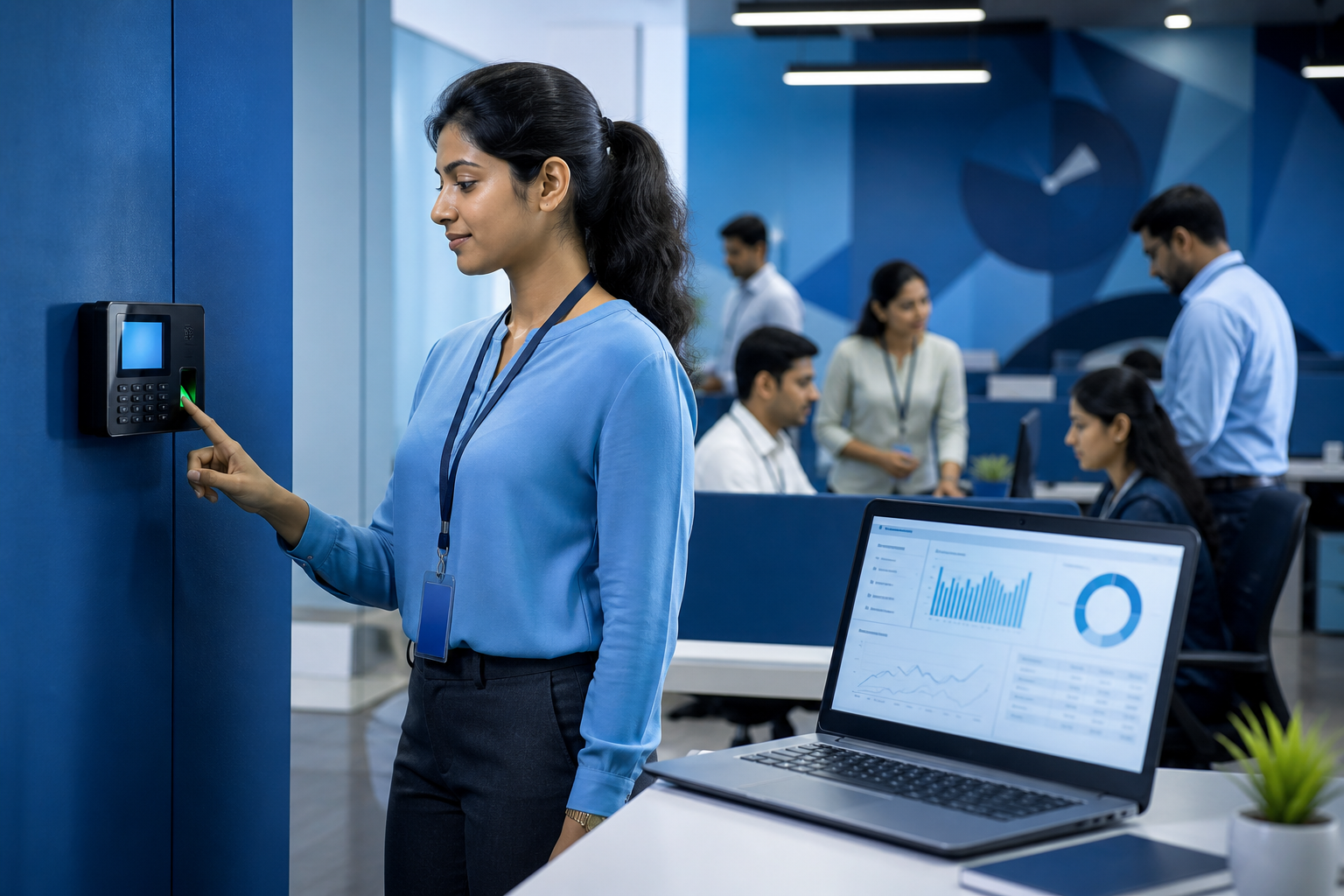
Situation: A workforce-services business deploys employees and associates across multiple client sites, locations, shifts, job roles, and attendance practices. Pay can be affected by client-approved attendance, weekly offs, overtime, shift rules, statutory deductions, and location-specific requirements. The complexity is not one big payroll run - it is thousands of small data dependencies that must be right before salary release.
The move: The operating logic is to connect workforce onboarding, attendance capture, client or manager approval, payroll processing, statutory compliance, invoicing, and finance posting into a controlled chain. The strongest driver is standardised source-data discipline: employee master data and approved time must be clean before payroll runs. Supporting drivers include exception workflows, maker-checker approvals, statutory-rule configuration, cost-centre mapping, and audit trails.
Outcome or lesson: The lesson for an MBA candidate is not “use a payroll tool.” It is that payroll accuracy at scale comes from integration governance - who owns each data field, when it is locked, who approves exceptions, and how finance and compliance reconcile the output.
So what: Quess illustrates the core principle beautifully - in large Indian workforce operations, payroll is only as strong as its time approvals, master-data governance, compliance configuration, and finance reconciliation.
How AI Changes Payroll & Time Systems
AI is not replacing payroll ownership; it is improving exception detection, employee service, and planning around time data. The risk is that payroll contains sensitive personal and financial information, so AI use must be governed carefully under privacy and access-control principles, including India's DPDP Act obligations where applicable.
Use NotebookLM or ChatGPT to upload a company annual report, HR-tech vendor page, and this lesson. Ask: “Map the payroll and time integration points, identify likely risks, and generate five interview questions with model answers.” Then verify all company-specific claims from the original sources.
Interview Relevance
“Explain how payroll and time systems integrate in a large organisation. What can go wrong, and how would you design controls?”
If the interviewer asks about tools, do not start with vendor names. First describe the architecture: system of record, source data, approvals, payroll calculation, compliance, finance posting, and employee self-service.
Common Mistake
The most common mistake is treating payroll as only “salary calculation.” That answer misses the real enterprise risk: wrong upstream data, unapproved time, weak statutory configuration, and poor reconciliation. Fix: always explain payroll as an integrated control process from HR master data to time approval to pay, compliance, finance, and employee service.