
A repeatable way to apply STP in case interviews.
A launch team has one budget, three possible customer groups, and a product that could be sold as premium, practical, or value-for-money. The wrong STP choice does not just weaken communication - it sends the salesforce, pricing, channel plan and product roadmap in different directions.
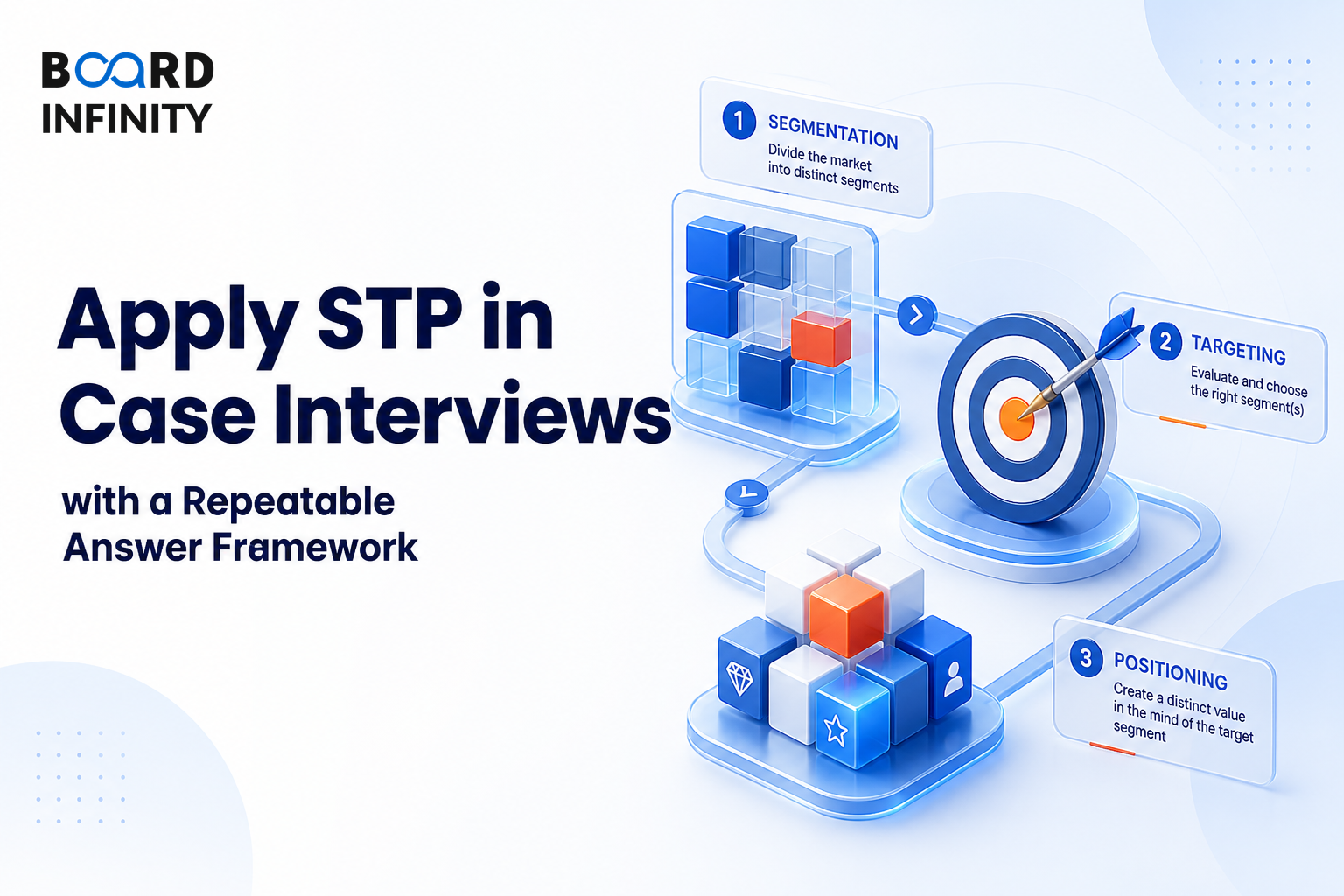
- STP = Segment, Target, Position: divide the market, choose the most attractive segment, then own a clear place in that segment's mind.
- In cases, do not start with ads. Start with who the customer is, what they need, and whether the company can win profitably.
- Good segmentation uses meaningful variables: needs, behavior, occasions, willingness to pay, geography, usage intensity and decision criteria.
- Targeting is a choice, not a list. Pick one primary target, justify it with attractiveness and fit, then mention secondary segments if relevant.
- Positioning must translate into the 4Ps: product features, price, place and promotion should all reinforce the same promise.
- The strongest STP answers use metrics such as segment growth, margin potential, CAC payback, LTV:CAC and awareness-to-trial conversion.
- The biggest trap is demographic labelling: saying “target millennials” without proving need, profitability, reachability or differentiation.
Think of STP as the bridge between market understanding and go-to-market execution. Segmentation creates the map, targeting chooses the battlefield, and positioning decides the message and offer that help you win there.
The Repeatable STP Case Approach
Use STP when the case asks about launch strategy, declining growth, new customer acquisition, brand repositioning, market entry, premiumization, channel choice or product-market fit. Your job is not to recite theory. Your job is to make a defensible strategic choice.
Step 1 - Segment the Market Without Making It Shallow
A segment is not “young people” or “urban consumers.” A good segment is a group with similar needs, decision criteria and response to the marketing mix. In a case, your segmentation should pass three tests: customers differ meaningfully, the company can identify and reach them, and the segment suggests a different strategy.
Netflix is often discussed as a company that segments viewers by viewing behavior and taste clusters rather than only age or income. The strategic point is simple: behavioral segmentation lets the platform personalize recommendations and content discovery, supported by data infrastructure, content breadth and product design. The so what: stronger segmentation improves relevance, not just targeting labels.
Step 2 - Target by Attractiveness and Fit
Targeting is where most case answers become managerial. You are choosing where the company should focus scarce resources. A large segment may still be a bad target if it is expensive to acquire, intensely competitive or outside the firm's capabilities.
Step 3 - Position With a Clear Promise
Positioning answers: “Why should this target choose us instead of the alternative?” A strong positioning statement has four parts: target customer, frame of reference, point of difference and reason to believe.
For [target segment], [brand] is the [frame of reference] that delivers [point of difference] because [reason to believe].
Example: For urban performance-conscious EV scooter buyers, Ather is the electric scooter brand that delivers a premium, connected riding experience because it combines product engineering, software-led features, experience centers and charging support.
The STP Answer Ladder
If you want to sound structured in a case, climb this ladder. Weak answers stop at demographics. Strong answers link customer insight to a strategic choice and then to execution.
STP Metrics You Can Quote in a Case
Use metrics to prove that your target segment is not just appealing but commercially sensible. Benchmarks vary by category, so in interviews compare against company history, nearest competitors and unit economics.
Definitions You Can Say in One Breath
- Market segmentation - AMA: “The process of subdividing a market into distinct subsets of customers that behave in the same way or have similar needs.”
- Targeting: Selecting the customer segment whose needs, economics and accessibility best match the firm's objectives and capabilities.
- Positioning - Ries and Trout: “Positioning is what you do to the mind of the prospect.”
- STP: A strategic process that segments the market, selects target customers and positions the offering distinctively for them.
Case Study - Ather Energy: Premium EV Positioning in India
Ather Energy built its early electric scooter strategy around a premium, tech-forward urban rider rather than trying to look like the cheapest two-wheeler option.

Situation: India's two-wheeler market is huge, but electric scooters faced familiar adoption barriers: upfront price sensitivity, range anxiety, charging access, service trust and comparison with petrol scooters. Ather did not begin by positioning itself as a generic low-cost mobility brand.
The move: It focused on urban customers who valued performance, technology, design and a connected ownership experience. The primary driver was a sharp target choice: riders willing to pay for a premium EV experience. Supporting drivers included software-led features, owned experience centers, charging ecosystem efforts, product engineering and a brand tone closer to technology than traditional commuter mobility.
Outcome and lesson: Ather created a differentiated position in the Indian EV scooter market even as the category became more competitive and price-sensitive. The lesson for STP cases: a narrower premium target can be strategically stronger than a broad mass target if the company's capabilities and economics support the choice.
Case takeaway: A complete STP answer explains not just who the company targets, but why that target is attractive, why the company can win there, and how the positioning survives through the 4Ps.
How AI Changes Applying STP in Case Interviews
AI does not replace STP judgment. It makes the diagnosis faster and the evidence sharper if you use it carefully.
- AI-assisted segmentation: Companies now use clustering models on transaction, app, CRM and browsing data to detect behavior-based segments. In a case, mention that AI can reveal hidden groups, but managers must still check whether the segments are reachable, profitable and strategically usable.
- Faster positioning testing: LLMs and social-listening tools can summarize reviews, competitor claims and customer pain points. This helps identify language that customers actually use, but it should be validated with real customer research.
- Personalized targeting at scale: AI enables dynamic offers, creative variations and next-best-action recommendations by segment. The risk is over-personalization without a coherent brand position.
Upload the company's annual report, investor presentation, app reviews and two competitor pages into NotebookLM. Ask: “Create segment hypotheses, evaluate each on attractiveness and company fit, and draft one positioning statement for the best target.” Then use your judgment to remove weak or unsupported claims.
Interview Relevance
“A premium D2C health-snack brand wants to enter offline retail in India. How would you apply STP to decide whom to target and how to position the brand?”
Say your target choice out loud: “I would prioritize Segment B, not because it is the largest, but because it combines willingness to pay, channel reachability and fit with the brand's premium equity.” That sounds like a manager, not a textbook.
Common Mistake
The mistake: confusing segmentation with demographics - “target Gen Z in metros” - and stopping there. Why it costs you: it does not prove need, profitability, reachability or differentiation. One-line fix: define the segment by need and behavior first, then support it with demographics only if they help reach the customer.
What to Revise Next
This is the final lesson, so do a capstone review rather than opening a new theory topic. Pick one company you know well and build a one-page case answer using STP, 4Ps, customer journey, unit economics and competitive advantage. If you can connect those five smoothly, you are placement-ready.