
SWOT, Porter's Five Forces, and the BCG matrix on demand
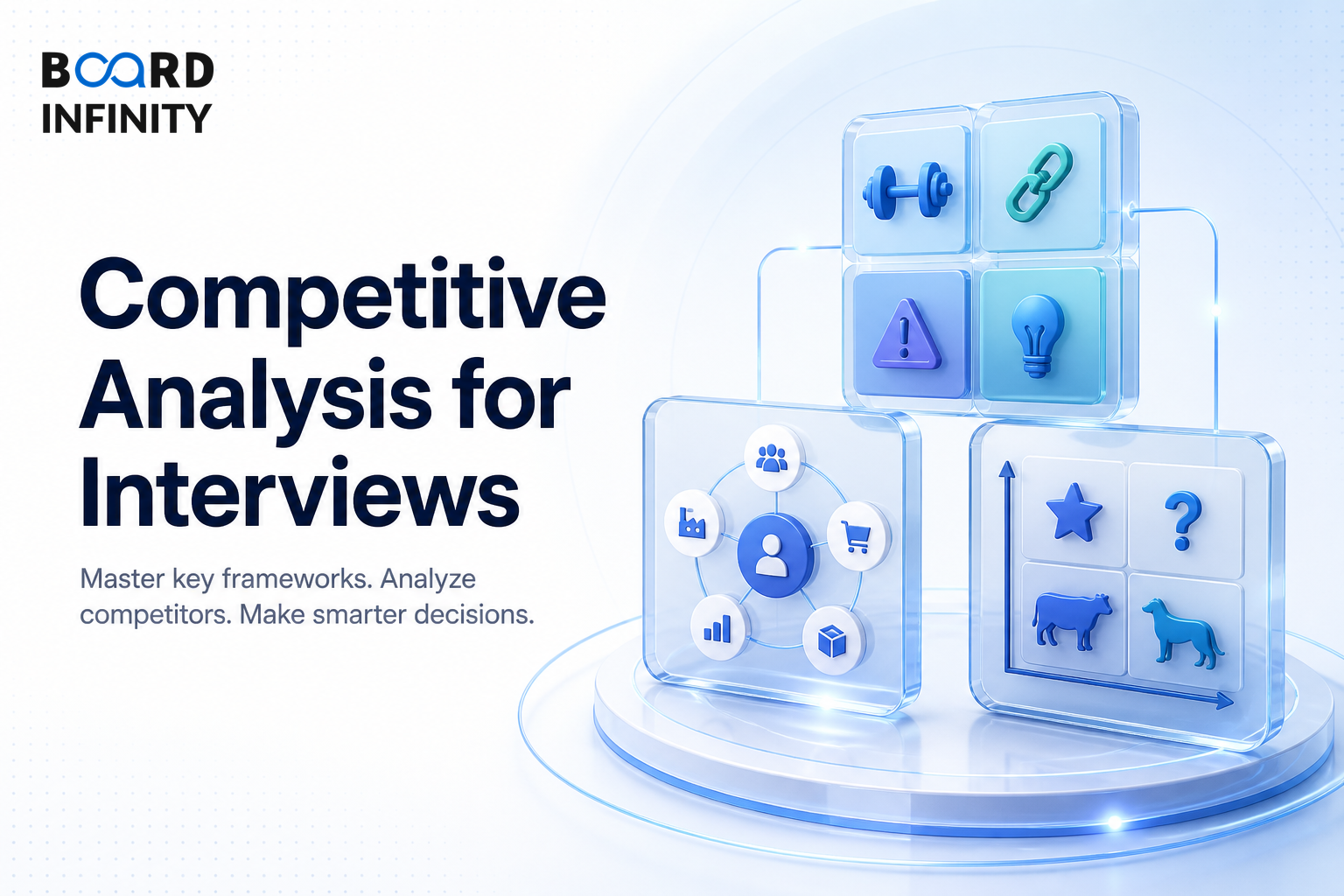
When Reliance Jio entered telecom with cheap data, incumbents did not merely face a new competitor - the profit logic of the whole industry shifted. That is the real job of competitive analysis: not to list rivals, but to understand where profit pools are moving, who has power and what strategic moves still make sense.
- Competitive analysis studies industry structure, competitor position and portfolio choices to decide where and how to compete.
- Porter’s Five Forces answers: “Is this industry attractive, and who captures value?”
- SWOT answers: “What internal strengths and weaknesses meet which external opportunities and threats?”
- BCG Matrix answers: “Which products or businesses deserve investment, harvesting or exit?”
- Use the tools in sequence: define market - analyze industry forces - map company fit - prioritize portfolio - choose actions.
- The strongest answers convert analysis into choices: pricing, channel, product, partnerships, cost position or market exit.
- The biggest mistake is writing generic SWOT points without evidence, linkage or strategic implication.
Big Picture: Competitive Analysis Is a Decision Flow, Not Three Separate Models
Think of SWOT, Five Forces and BCG as three lenses in one decision system. Five Forces looks outside at the industry, SWOT bridges outside and inside, and BCG helps allocate resources across businesses or products.
Core Explanation: What Each Framework Actually Does
The cleanest way to remember the three tools is by the question each one answers.
Porter’s Five Forces: Start With Industry Profitability
Porter’s Five Forces examines the competitive pressures that shape long-term industry profitability. The key idea is simple: your competitor is not only the brand next door. Suppliers, buyers, substitutes and potential entrants can also take away profit.
Apply the forces like this:
- Threat of new entrants: Are barriers like capital, regulation, distribution, data, network effects or brand trust strong?
- Bargaining power of suppliers: Can input providers increase prices or restrict supply?
- Bargaining power of buyers: Can customers compare easily, switch easily or demand discounts?
- Threat of substitutes: Can customers solve the same need differently?
- Rivalry among existing competitors: Is competition based on price, promotion, capacity or innovation?
In Indian quick commerce, rivalry is intense because players compete on assortment, delivery speed, discounts and dark-store density. The primary driver of advantage is fulfilment network design, supported by demand forecasting, private labels, supplier terms and unit economics. The strategic “so what”: a player cannot win by speed alone if every order loses money.
SWOT: Convert Diagnosis Into Strategic Options
SWOT analysis is a structured scan of internal strengths and weaknesses against external opportunities and threats. Its power is not in the four boxes - it is in matching them.
Use this conversion logic:
- Strength + Opportunity: Invest and scale. Example: strong brand trust plus rising organized retail demand.
- Strength + Threat: Defend advantage. Example: use distribution reach to resist new entrants.
- Weakness + Opportunity: Build, partner or acquire. Example: acquire digital capability to capture online growth.
- Weakness + Threat: Reduce exposure, reposition or exit. Example: leave a price-war segment where cost position is weak.
BCG Matrix: Decide Where to Put Money, Talent and Management Attention
The BCG Matrix, created by Boston Consulting Group, classifies businesses by market growth rate and relative market share. It is useful when a company has multiple products, categories or business units competing for capital.
- Stars: Invest to maintain leadership in high-growth markets.
- Cash Cows: Protect efficiency and generate cash for future bets.
- Question Marks: Selectively invest if the route to leadership is credible.
- Dogs: Fix, niche down, harvest or exit unless they serve a strategic role.
How to Measure Competitive Position: 6 Metrics That Make Your Answer Evidence-Based
Frameworks become interview-grade when you attach evidence. These measures are not universal pass-fail marks, but they help you compare position, attractiveness and momentum.
Definitions You Should Be Able to Say in One Breath
- Competitive analysis: A structured evaluation of rivals, industry forces and company position to choose where and how to compete.
- SWOT analysis: A framework matching internal strengths and weaknesses with external opportunities and threats.
- Porter’s Five Forces: Michael Porter’s framework for assessing industry attractiveness through rivalry, entrants, substitutes, suppliers and buyers.
- BCG Matrix: Boston Consulting Group’s portfolio tool classifying businesses by market growth and relative market share.
Titan: Competitive Analysis Across Jewellery, Watches and New Retail
Titan shows how a company can use trust, portfolio choices and category understanding to compete in fragmented Indian consumer markets.

Situation: Indian jewellery has historically been a fragmented, trust-heavy market where local jewellers held deep relationships. Organized brands had to overcome concerns around purity, pricing transparency, making charges and occasion-based buying behavior.
The move: Titan built Tanishq as a trust-led jewellery retail brand, supported by design variety, store experience, exchange programs, purity assurance and a national retail footprint. It also strengthened omnichannel reach through CaratLane, while its broader portfolio included watches, eyewear and wearables with different growth and margin profiles.
The lesson: Titan’s primary driver was trust-based organized retail execution. Supporting drivers included brand building, design capability, store network quality, customer financing and digital integration. A one-factor answer like “Titan won because of branding” is incomplete; the better answer is that branding worked because the operating system behind it reduced buyer risk.
The case proves the real value of competitive analysis: it prevents shallow labels. Titan is not just a “strong brand”; it is a portfolio manager competing across categories with different growth, rivalry and investment logic.
How AI Changes Competitive Analysis
AI does not replace judgment, but it makes competitive analysis faster, broader and more evidence-rich. In 2026, the difference is not whether you use frameworks - it is how quickly you can feed them with current signals.
- Always-on competitor monitoring: AI tools can summarize pricing changes, product launches, app reviews, job postings and news into weekly competitor briefs.
- Signal extraction from unstructured data: LLMs can scan earnings calls, annual reports, customer reviews and social chatter to identify emerging threats, capability gaps or customer pain points.
- Scenario planning: AI can help draft “what if” cases - for example, what happens if a low-cost entrant cuts price, a regulator changes rules or a substitute becomes mainstream.
Use Perplexity to collect recent competitor moves with sources, then load the company annual report, two rival reports and your notes into NotebookLM. Ask: “Create a Five Forces analysis, a SWOT and three strategic recommendations with evidence.” Then verify every claim before using it.
Interview Relevance
“Pick any company you follow. Do a competitive analysis using SWOT, Porter’s Five Forces and the BCG Matrix. What strategic recommendation would you make?”
Say fewer points, but make them sharper. A strong answer with two forces, three SWOT insights and one clear recommendation beats a long checklist with no decision.
Common Mistake
The most common error is treating SWOT as a laundry list: “strong brand, high competition, digital opportunity.” It costs candidates because it shows no diagnosis. The fix: attach evidence to each point and convert every major point into a strategic implication.
What to Revise Next
Once you can diagnose competition, revise the strategy choices that follow from it. Move next to Growth Strategy and the Ansoff Matrix to decide how a firm grows, then Blue Ocean Strategy and Category Creation to understand how companies escape direct rivalry instead of fighting harder inside it.