
Case study: positioning wars - Thums Up vs Coke, boAt vs global brands.
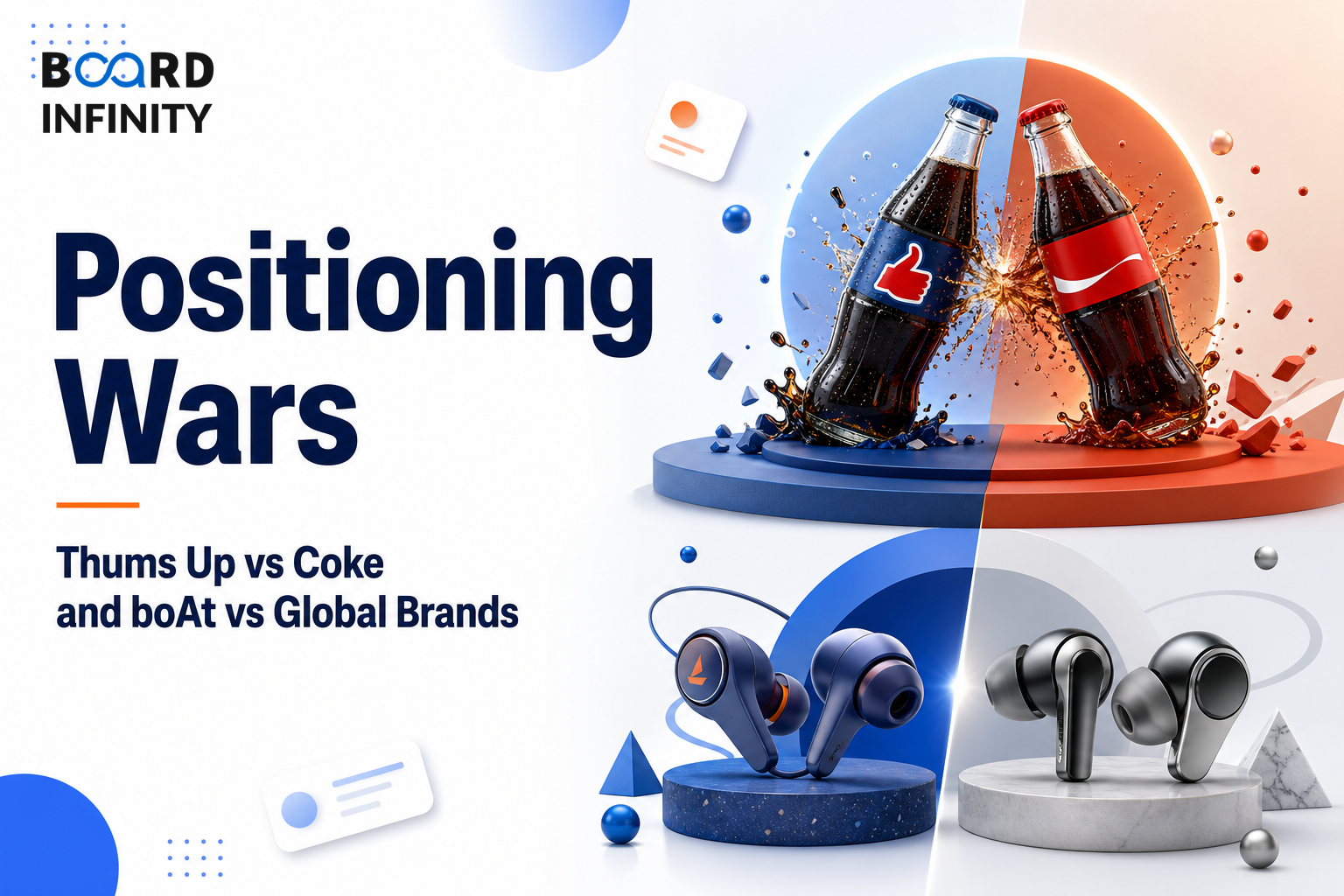
A positioning war is not won by shouting louder. Thums Up did not survive Coca-Cola’s India return because it had better fizz alone, and boAt did not challenge global audio brands by pretending to be Apple - both won by choosing a sharper meaning in the customer’s mind.
- Positioning is the place a brand deliberately occupies in the target customer’s mind versus alternatives.
- A positioning war has five moving parts: target segment, competitive frame, point of difference, proof points and memory cues.
- Thums Up vs Coke is a classic contrast: rugged, intense Indian masculinity versus global, happy refreshment.
- boAt vs global brands shows value-lifestyle positioning: affordable, fashionable, youth-first tech rather than pure engineering prestige.
- Strong positioning must be distinctive, believable, relevant and consistently repeated across product, price, channel and communication.
- Measure positioning through awareness, attribute ownership, preference, price premium, repeat rate and share of search - not just campaign likes.
- The biggest interview trap is calling a tagline “positioning.” A tagline expresses positioning; it is not the positioning itself.
Big Picture
Brands do not fight only on product features. They fight for a mental shortcut: when a customer thinks “strong cola,” “youth audio,” “safe bank,” or “premium phone,” which brand comes first, and why?
What a Positioning War Really Is
A positioning war happens when two or more brands compete to own the same customer need, occasion or identity. The fight is not only “Which product is better?” It is “Which brand becomes the default meaning?”
The cleanest way to decode any positioning war is to ask five questions:
Thums Up vs Coke: The Classic Indian Cola Positioning War
When Coca-Cola re-entered India in 1993, it acquired Indian cola brands including Thums Up. The obvious assumption would be that Coke, the global icon, should dominate and Thums Up should fade. That did not happen.
Thums Up had already built a powerful position around strength, fizz and masculine adventure, later reinforced by the long-running “Taste the Thunder” idea. Coke’s global position was broader: happiness, refreshment and togetherness. The strategic lesson is simple: a local brand can survive a global giant when it owns a sharper, culturally resonant need-state.
boAt vs Global Brands: Lifestyle Beats Specification Alone
Global audio brands often lead with engineering, premium sound, heritage or ecosystem. boAt entered from a different angle: not “we are the most advanced audio brand,” but “we are the stylish, accessible audio brand for young India.”
That matters because mass consumers do not always buy electronics as pure specifications. They buy a mix of sound, price, looks, convenience, influencer trust and identity. boAt’s primary driver was affordable youth lifestyle positioning, supported by marketplace distribution, fast product variety, influencer-led visibility and India-fit pricing.
How to Measure Whether Positioning Is Working
Do not measure positioning only through social media engagement. A viral campaign may entertain people without changing the brand’s mental position. Track whether the intended target remembers, prefers and pays for the meaning you want to own.
Definitions You Can Say Cleanly
Positioning, according to Kotler and Keller, is “the act of designing the company’s offering and image to occupy a distinctive place in the minds of the target market.”
Case Study: boAt Turns Audio Into a Youth Lifestyle Badge
boAt challenged global audio and wearable brands in India by positioning itself as affordable, fashionable tech for young consumers rather than premium engineering alone.
Situation: In India, global audio brands such as Sony, JBL, Bose and Apple carried strong credibility, but much of the youth market was value-conscious and style-seeking. The category was also shifting from wired earphones to wireless earbuds, headphones and wearables, sold heavily through online marketplaces.
The move: boAt did not try to out-premium the premium players. Its primary driver was a clear lifestyle position: stylish, accessible audio for young India. Supporting drivers made that position real - wide online availability, frequent launches, visible influencer and celebrity associations, bold product styling, India-fit pricing and a community-like brand language around “boAtheads.”
Outcome and lesson: boAt became widely recognized as one of India’s leading consumer audio and wearables brands in the early 2020s. The lesson is not “marketing beats product.” The better lesson is that positioning wins when product, price, channel and communication all reinforce the same promise.
How AI Changes Positioning Wars
AI is changing positioning wars because customers no longer discover brands only through ads, shelves and search results. They increasingly ask recommendation engines, marketplaces, creators and AI assistants what to buy.
Interview Relevance
“Compare the positioning of Thums Up and Coke in India. Now apply the same logic to boAt versus global audio brands.”
Use this sentence in interviews: “The real battle is not Thums Up versus Coke as products; it is strong cola versus happy refreshment as mental territories.”
Mistake: Saying “positioning is the tagline.” This costs candidates because it sounds superficial and ignores target, frame, differentiation and proof. Fix: answer with this one-line structure - “For target X, brand Y is positioned as Z versus competitor A, because of proof points B and memory cues C.”
What to Revise Next
Next, revise Applying STP in Case Interviews: A Repeatable Approach. Positioning is the final “P” of STP logic - once you can segment the market and choose the target, you can defend the exact mental space the brand should own.