
Automation and AI in Operations Consulting
A warehouse manager watches the morning wave go red: orders are piling up, pickers are waiting for locations, trucks are at the gate, and a dashboard says the algorithm is “optimising.” This is where automation and AI in operations consulting becomes real - not as a shiny technology story, but as a decision about flow, labour, service promises and cost under pressure.
- Automation executes repeatable tasks with minimal human intervention; AI improves sensing, prediction and decision-making.
- In operations consulting, the goal is not “add bots”; the goal is better throughput, lower variability, lower cost and reliable service.
- The right sequence is: stabilise the process, capture clean data, build decision intelligence, then automate execution.
- Use a volume versus judgment matrix: high-volume, low-judgment work is the best first automation candidate.
- Measure impact with throughput, cycle time, first-pass yield, cost per order, SLA adherence and exception rate.
- A strong business case includes one-time capex, recurring opex, labour impact, service improvement, risk and payback period.
- The biggest interview trap: recommending AI before diagnosing the process bottleneck.
Big Picture: Automation Is the Top Layer, Not the Foundation
Automation and AI create value only when the operating system underneath is disciplined. If the process is unstable, master data is wrong, and teams do not trust the workflow, AI simply accelerates confusion.
For a consultant, this means the recommendation must connect technology to operating levers: demand variability, capacity, constraints, handoffs, quality, workforce design and governance. If you want the broader context of where operations consulting sits relative to technology and strategy work, revise Strategy, Operations, Technology and Deal Advisory Compared.
Core Explanation: What Consultants Actually Automate
In operations consulting, automation and AI usually appear in four zones:
- Physical flow: conveyors, sorters, robotics, automated storage and retrieval systems, autonomous material movement.
- Information flow: digital work instructions, barcode/RFID scanning, warehouse management systems, transport management systems.
- Decision flow: demand forecasting, production scheduling, route optimisation, inventory replenishment, exception prioritisation.
- Control flow: dashboards, alerts, digital twins, performance management routines and human escalation rules.
The best consultants do not start with a vendor brochure. They ask: where is the bottleneck, what decision is delayed, what task is repetitive, and what failure mode hurts service or cost most?
The Consulting Approach: From Diagnosis to Scale
A placement answer should sound like a consulting project, not a technology pitch. Use this sequence when asked how you would apply automation or AI in an operations problem.
Metrics That Prove Automation Is Working
Do not say “efficiency improved” and stop. In consulting language, impact must be measurable. Benchmarks vary sharply by sector, so the safest interview phrasing is: establish the baseline, compare against peer or target, and check that cost improvement is not damaging service.
Worked Example: Simple Automation Payback
Assume a warehouse considers automating invoice matching and shipment documentation. The project is expected to reduce manual effort and rework.
The consulting answer should add two checks: first, whether savings are real cash savings or only freed-up capacity; second, whether service risk during transition has been included.
Definitions You Can Say in One Breath
- Automation: technology-enabled execution of repeatable tasks with minimal human intervention.
- Artificial intelligence: “the study of agents that receive percepts from the environment and perform actions” (Russell and Norvig, Artificial Intelligence: A Modern Approach).
- Operations consulting: advisory work that improves how organisations design, run and control processes, assets, capacity, cost and service.
- Digital twin: a virtual representation of a physical process or asset used to simulate, monitor and improve decisions.
Case Study: Ocado - Automation as an Operating System
Ocado shows why automation works best when the process, software, data and physical system are designed together, not bolted on separately.
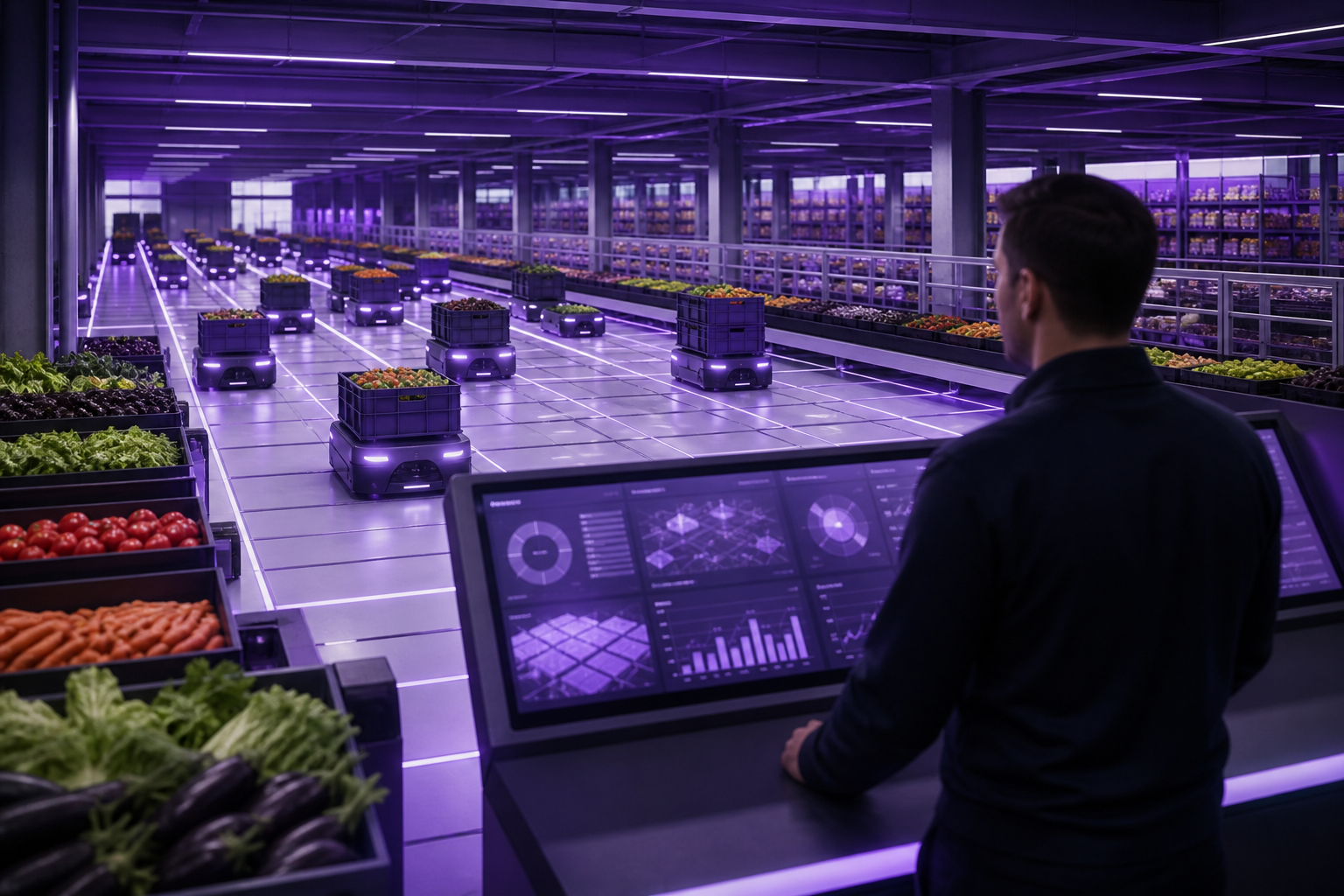
Ocado is a strong case for this topic because its automation story is not just “robots in a warehouse.” Its model combines online grocery demand, automated fulfilment centres, robotics, routing logic and partner technology through the Ocado Smart Platform, which the company describes as a suite for online grocery fulfilment (Ocado Group, Ocado Smart Platform).
Situation: Online grocery is operationally hard. Orders are small, baskets vary, cold-chain handling matters, substitutions affect customer experience, and delivery windows create tight capacity constraints.
The move: Ocado designed a system where fulfilment logic, warehouse automation and customer promise management work together. The primary driver is integrated system design: the physical grid, order orchestration and software are connected. Supporting drivers include demand forecasting, inventory accuracy, slot management, routing discipline and controlled exception handling.
The lesson: The value is not from one robot or one algorithm. It comes from redesigning the operating model so that machines, data and humans each do the work they are best suited for.
For an Indian quick-commerce player such as Zepto, the operations problem is not just fast delivery. It is a dense-city system of dark-store location, SKU availability, picker productivity, rider batching, substitutions, weather disruption and demand spikes. The strategic “so what”: AI helps most when it improves local replenishment and exception handling, while automation must fit India-specific density, labour, real estate and service economics.
How AI Changes Automation and AI in Operations Consulting
By 2026, AI changes this topic in three concrete ways.
- From dashboards to decision support: Earlier systems reported what happened. AI-enabled control towers can flag likely delays, recommend rerouting, prioritise replenishment and suggest labour redeployment.
- From broad averages to micro-optimisation: Instead of one network-level forecast, AI can forecast at SKU-location-time-window level, which matters in warehouses, dark stores, production lines and field service.
- From manual analysis to faster consulting work: Consultants can use AI to summarise process documents, cluster exception logs, generate root-cause hypotheses and draft pilot charters. The caution is data privacy, bias, explainability and over-trusting model output.
Use NotebookLM for interview prep: upload your notes, a company annual report and one operations case article, then ask, “Generate five automation use cases, the KPIs to test each, and the risks a consultant should raise.” Use ChatGPT or Claude next to pressure-test your answer structure, but never paste confidential client data.
Interview Relevance
“A retail client wants to use AI and automation to reduce warehouse cost. How would you approach the problem?”
Use the phrase “I would not automate the current process blindly; I would first redesign the flow, then automate the stable parts.” It signals consulting maturity.
Common Mistake
The mistake: treating AI as the answer before defining the operational problem. Candidates jump to robots, GenAI or predictive models without identifying the bottleneck, the decision owner, the data quality issue or the KPI impact. The fix: always say, “I will diagnose the process first, then choose automation only where it improves a measurable operating metric.”