
Supply Chain Resilience After Recent Global Disruptions
What if the cheapest supply chain is actually the most expensive one the moment a port shuts, a chip is delayed, or a supplier misses payroll? The last few years have exposed a hard truth: efficiency without resilience is not lean - it is brittle.
- Supply chain resilience is the ability to absorb disruption, recover fast, and adapt the network so the same shock hurts less next time.
- Do not confuse resilience with “more inventory”. Inventory is one lever; resilience also needs visibility, alternate capacity, supplier risk management, product flexibility and governance.
- The clean interview structure is: map the chain, identify critical nodes, quantify exposure, choose resilience levers, track recovery metrics.
- Use the probability-impact matrix to prioritise risks: low-probability, high-impact risks need contingency plans, not daily firefighting.
- Key metrics: Time to Recover, Time to Survive, OTIF, supplier concentration, days of cover and forecast error.
- The strategic trade-off is not “cost versus resilience”; it is cost of resilience versus cost of failure.
- AI improves resilience through demand sensing, supplier-risk monitoring, disruption simulation and faster scenario planning - but humans still decide trade-offs.
Big Picture - Resilience Is a System, Not a Buffer
A resilient supply chain does three jobs in sequence: it senses risk early, absorbs the shock without total service failure, and adapts the network after learning from the event. Think of it as a muscle: the point is not to avoid all shocks, but to recover stronger and faster.
Core Explanation - The 5-Part Framework
Supply chain resilience means designing the supply chain so that disruptions do not permanently break service, cost or customer trust. A disruption can be external, such as a pandemic, war, weather event or port congestion, or internal, such as a supplier quality failure, plant breakdown, cyberattack or labour shortage.
The best answers separate the network, the product, the supplier base, the inventory policy and the decision system. That prevents the most common shallow answer: “keep extra stock everywhere.”
The Resilience Risk Matrix
Use a 2x2 matrix when you need to prioritise risks. Do not spend equal energy on every possible disruption. A delayed low-value packaging supplier and a single-source semiconductor supplier are not the same problem.
The upper-right quadrant - high probability and high impact - is where management attention should go first. For a food company, that may be a climate-sensitive commodity. For an auto company, it may be a single-source electronic component. For a hospital chain, it may be critical medicines and consumables.
The Five Levers of Supply Chain Resilience
A strong answer uses levers, not slogans. If you already understand supply chain design, network and inventory decisions, resilience is the same topic under stress: where to place capacity, how much stock to hold, which suppliers to qualify and what service promise to protect.
The sourcing lever is especially important. Resilience often depends on procurement choices made months before a disruption. A buyer who has negotiated only the lowest price may discover that there is no qualified backup supplier when demand spikes. That is why procurement, sourcing and vendor negotiation levers are central to resilience, not just cost savings.
How to Measure Supply Chain Resilience
Resilience must be measured, otherwise it becomes a comforting story. There is no universal “good” benchmark because a pharma cold-chain, a quick-commerce network and an auto OEM have different risk tolerances. The right test is whether the metric beats the company’s own service promise and risk appetite.
Notice the interview-quality move: you do not say “increase all inventory.” You compare TTS versus TTR. If the chain can survive longer than it takes to recover, the risk is manageable. If recovery takes longer than survival, the company needs a redesign.
Definitions You Can Say in One Breath
- Supply chain: the network of organisations, activities and flows that fulfils customer demand from source to consumption.
- Supply chain resilience: the ability to absorb disruption, recover service quickly and adapt the chain to reduce future vulnerability.
- Robustness: the ability to withstand a shock without major performance loss.
- Flexibility: the ability to switch products, suppliers, routes or capacity with limited delay and cost.
- Redundancy: deliberate spare capacity, stock, suppliers or routes kept as protection against failure.
Case Study - Tata Motors and Semiconductor-Led Resilience
Tata Motors shows how supply chain resilience in autos is not about one heroic fix, but about managing constrained components, production priorities and supplier visibility together.
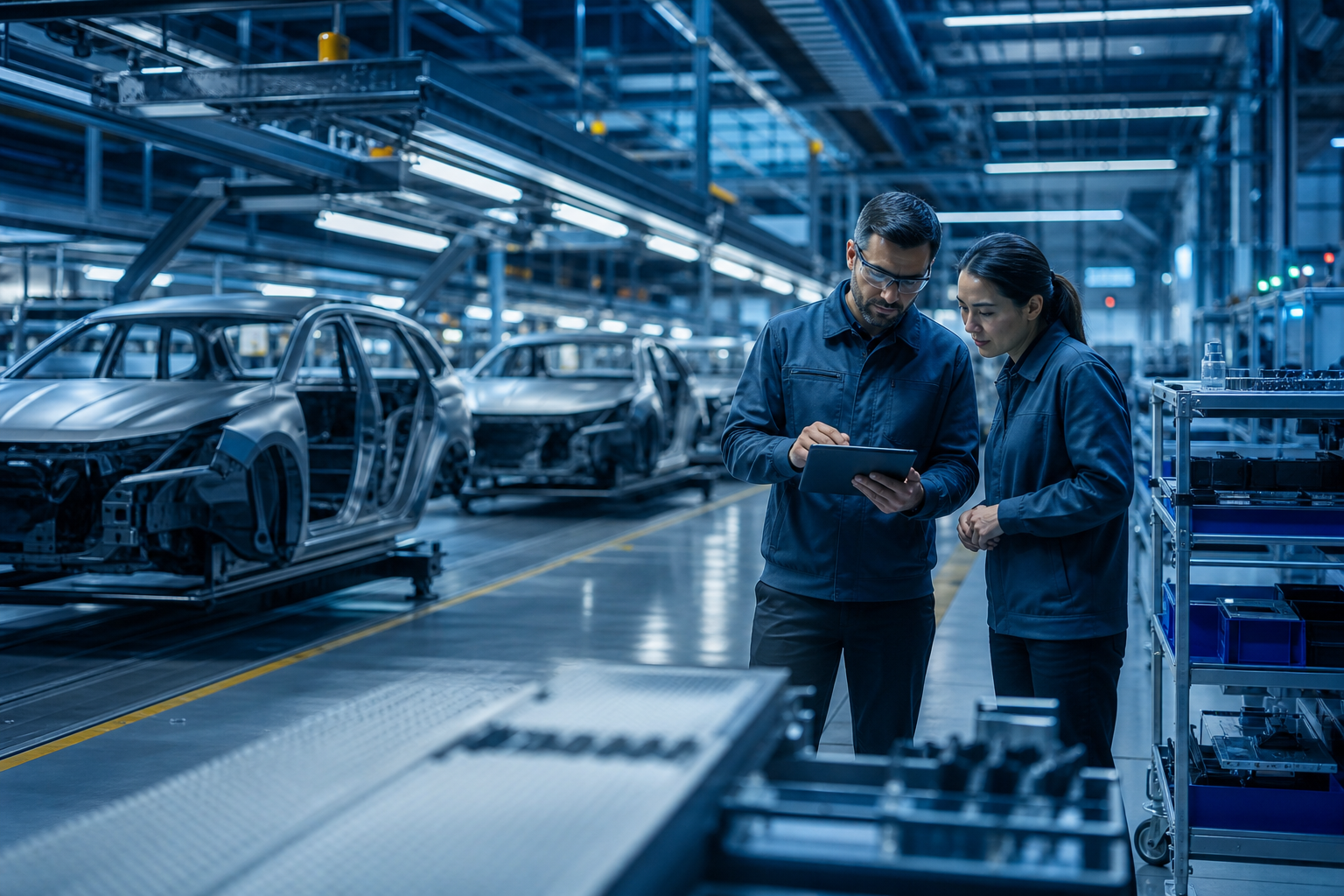
Situation: The automotive industry faced repeated disruption from COVID-era shutdowns, logistics volatility and semiconductor shortages. Tata Motors discussed semiconductor availability as an operational constraint in its public reporting (Tata Motors annual reports). For an auto OEM, this is a classic resilience problem: one low-cost but critical electronic component can hold up a high-value finished vehicle.
The move: The resilience response was not simply “buy more chips.” The primary driver was tighter governance of critical components - identifying constrained parts, aligning production plans with available supply and improving visibility across suppliers. Supporting drivers included prioritising high-demand vehicle variants, working closely with supplier partners, improving S&OP discipline and building more flexibility into component planning over time.
The lesson: In complex manufacturing, resilience is created by cross-functional choices. Procurement cannot solve it alone. Operations, sales, product engineering, finance and suppliers must decide which models to produce, which substitutions are acceptable, where to hold risk stock and how to communicate delays to customers.
The strategic “so what” is simple: resilient companies do not wait for the next shortage to discover their weak links. They know the parts, suppliers and lanes that can stop revenue - and they govern those risks before the shock arrives.
How AI Changes Supply Chain Resilience
AI makes resilience faster because it improves sensing, simulation and decision support. It does not remove trade-offs; it helps managers see them earlier.
A practical student workflow: load a company annual report, supplier-risk notes and this framework into NotebookLM, then ask: “Identify the top five supply-chain resilience risks, classify them in a probability-impact matrix and suggest interview-quality mitigation levers.” If you want to practise broader AI-led ops cases, revise automation and AI in operations consulting next.
Interview Relevance
“A consumer durables company has faced repeated disruption from imported components and port delays. How would you make its supply chain more resilient without making costs explode?”
Use the phrase “segment resilience by criticality”. It signals maturity: essential, high-margin, long-lead-time items deserve stronger protection than low-risk commodities.
Common Mistake
The mistake is treating resilience as “hold more inventory everywhere.” That hurts working capital, hides process problems and may still not protect the true bottleneck. The one-line fix: map critical nodes first, then choose targeted levers based on TTR, TTS, impact and probability.