
Trade-off: Automation versus Labour Flexibility
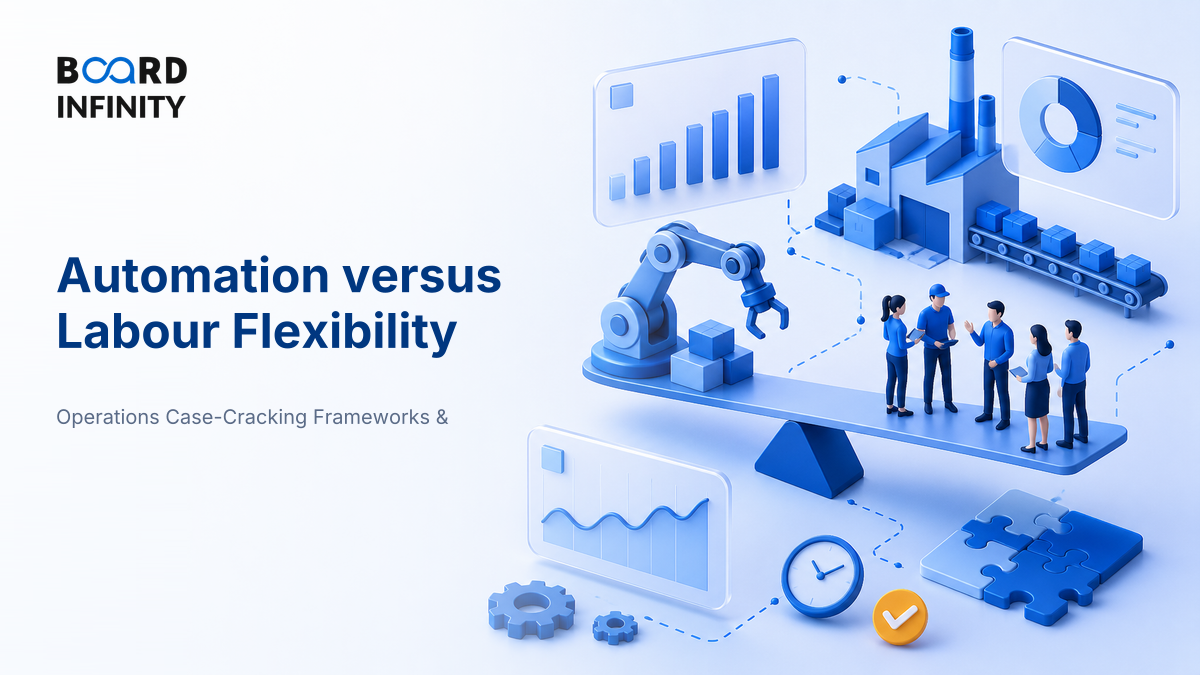
The line is running perfectly - until the order mix changes. A robot that was brilliant for yesterday’s high-volume SKU can become painfully rigid when today’s customer wants five variants, smaller batches, and faster changeovers.
- Automation wins when demand is predictable, volume is high, quality needs are repeatable, and the process is stable.
- Labour flexibility wins when demand is uncertain, product variety is high, tasks need judgement, and changeovers are frequent.
- The real trade-off is not “machines versus people”; it is fixed efficiency versus adaptive capacity.
- Automate the stable core of the process; keep human flexibility at the variability edge - exceptions, customization, recovery, and customer-facing judgment.
- Use metrics: payback period, break-even volume, utilization, changeover time, schedule adherence, and skill coverage ratio.
- The biggest interview mistake is justifying automation only through labour-cost saving while ignoring demand volatility and reversibility.
Big Picture: The Trade-off in One View
Automation converts variable labour cost into fixed capacity. That is powerful when the work is repeatable, but risky when demand, variety, or process design keeps changing. Labour flexibility does the opposite - it keeps capacity adjustable, but may sacrifice speed, consistency, and unit cost at scale.
Core Explanation: Fixed Efficiency versus Adaptive Capacity
Automation means using machines, software, robotics, or control systems to perform work with limited human intervention. It raises consistency and speed, but increases fixed cost and design rigidity.
Labour flexibility means the ability to vary workforce size, timing, skills, or task allocation as demand and product mix change. It protects responsiveness, but can increase training complexity and quality variation.
The decision is best understood as a layered choice. You do not decide “fully manual” or “fully automated” in one jump. You climb a ladder from basic standardization to selective automation to dedicated automation.
This is why operations managers first stabilize the process through standard work, takt time, and workstation design. If the line itself is unbalanced, automation may simply make the bottleneck more expensive. For that foundation, revise line balancing and workstation design before attempting automation trade-off answers.
The Four Questions That Decide the Trade-off
Use these four questions whenever you are given a plant, warehouse, service operation, or delivery network case.
Types of Labour Flexibility
Interviewers like this because many candidates treat labour flexibility as “hire more people.” That is too shallow. Labour flexibility has four distinct forms.
The strongest operations designs usually blend these forms. For example, a warehouse may use fixed automation for conveyor movement, functional flexibility for exception handling, and temporal flexibility for peak-hour staffing. When replenishment is demand-driven, Kanban and pull-based replenishment can reduce the need to solve every variability problem through either machines or extra labour.
What to Measure Before Choosing Automation
Do not answer this trade-off using adjectives like “efficient” and “flexible.” Use numbers. Benchmarks vary sharply by industry, so the best answer is to state the metric, formula, and decision signal.
Definitions You Can Say in One Breath
- Automation: The use of machines or software to perform work with limited human intervention.
- Labour flexibility: The ability to vary workforce quantity, timing, skills, or deployment as operating needs change.
- Operations trade-off: A choice where improving one performance dimension can weaken another under real resource constraints.
Mini Case Study: Lenskart and the Hybrid Operating Model
Lenskart is a useful Indian example of using automation for repeatable precision while keeping human flexibility for personalization, service, and exceptions.

Eyewear is operationally tricky. The product looks simple, but every order can vary by prescription, frame choice, lens coating, fit, store interaction, and delivery promise. That makes it a classic automation-versus-flexibility problem.
The situation: Lenskart operates in a category where scale matters, but customer requirements are highly personalized. Pure manual operations would struggle with consistency and speed at scale. Pure rigid automation would struggle with prescription variety, fit adjustments, store-level service, and exceptions.
The move: The operating logic is hybrid. Repeatable, precision-heavy work such as lens processing, routing, and standardized fulfilment can be systematized and automated. Human flexibility remains essential in eye testing support, frame fitting, customer counselling, repairs, exception handling, and local store responsiveness.
The lesson: Lenskart’s model is not “automation replaces labour.” The stronger answer is: automation handles repeatable precision; labour flexibility handles customer variability. The primary driver is separating stable work from variable work. Supporting drivers include digital order capture, standardized process flows, trained store staff, and an omnichannel network that connects demand to fulfilment.
How AI Changes Automation versus Labour Flexibility
AI changes this trade-off because it reduces the cost of prediction, scheduling, inspection, and coordination. That makes the boundary between “automate” and “keep flexible” more dynamic.
A practical workflow: load the plant layout, demand history, SKU mix, and shift roster into ChatGPT or Claude and ask it to identify which process steps are stable enough for automation and which should remain flexible. For demand-linked decisions, pair this with using AI for inventory optimisation and replenishment so your automation answer connects capacity with stock availability.
Interview Relevance
“A mid-sized manufacturer is considering automation because labour costs are rising, but demand is seasonal and product variety is increasing. How would you evaluate the decision?”
Use the phrase: “I would not automate the process first; I would first stabilize and segment the process.” It signals mature operations thinking.
Common Mistake
Mistake: Saying “automate because labour cost is high.” This fails because automation also adds fixed cost, maintenance dependence, utilization risk, and rigidity. Fix: justify automation only where volume, repeatability, quality impact, and payback remain strong under demand uncertainty.