
Guesstimates for Operations: Capacity, Volume & Cost
At 7:15 pm, a pizza outlet can look calm from the street and be seconds away from failure inside: ovens full, riders waiting, orders piling up. The difference between a good operator and a confused one is not a spreadsheet - it is the ability to estimate capacity, volume and cost fast enough to make a decision.
- Operations guesstimates are not random guesses - they are structured estimates using assumptions, units and sanity checks.
- The core sequence is capacity - volume - cost: what can the system handle, what demand will arrive, and what will it cost?
- Always identify the bottleneck: the slowest constrained step sets total output.
- Use both sides: top-down demand estimates and bottom-up capacity estimates. Reconcile the gap.
- Track the right metrics: utilization, throughput, cycle time, cost per unit, break-even volume and service level.
- Interviewers reward clear assumptions more than perfect numbers. Say the assumption, calculate cleanly, then test whether the answer feels realistic.
- The fastest fix for weak answers: keep units visible at every step - customers/hour, orders/day, ₹/order, minutes/order.
Big Picture: The Capacity - Volume - Cost Chain
An operations guesstimate answers one practical question: can this operating system serve expected demand at an acceptable cost? The cleanest way to solve it is to move from capability, to demand, to economics, and then run a sanity check.
Core Explanation: How to Build the Estimate
Most candidates start by multiplying random market numbers. Strong candidates first define the operating system. Are we estimating airport check-in counters, a cloud kitchen, a call centre, a warehouse picking line, or a delivery fleet? Each has a flow of work, a constraint and a unit of output.
The 5-Step Method
The key habit is to say your assumptions out loud. For example: “I will estimate dinner peak capacity for one outlet over 3 hours, with orders as the unit.” That one sentence prevents the answer from drifting.
Two Ways to Estimate: Demand Side versus Supply Side
Every good operations guesstimate has two lenses. The demand-side estimate asks, “How much volume may arrive?” The supply-side estimate asks, “How much can the system process?” If the two numbers are close, you have a planning problem. If they are far apart, you have a strategy question.
The Bottleneck Rule
A process is only as fast as its constrained step. If a warehouse can receive 2,000 orders/day, pick 1,500 orders/day and pack 1,200 orders/day, the system capacity is not 2,000. It is approximately 1,200 orders/day unless packing is improved.
This connects directly to line balancing and workstation design, where the goal is to reduce idle time and shift work away from bottleneck stations.
Worked Example: Estimating Dinner Capacity for One Pizza Outlet
Suppose you are asked: “Estimate how many dinner orders a single pizza outlet can fulfil between 7 pm and 10 pm.” Use simple, defensible assumptions.
The insight is more important than the arithmetic: adding another oven will not help if riders are the bottleneck. The operational lever is rider availability, delivery radius, batching, store density or demand smoothing.
Metrics You Should Name When Measuring the Estimate
When you move from guesstimate to decision, measure the system. These are useful interview-safe metrics; exact “good” levels vary by industry, but the direction is clear.
If the question moves deeper into cost modelling, revise should-cost analysis and cost breakdown modelling so you can separate labour, material, equipment, overhead and margin logically.
Definitions You Can Say in One Breath
- Guesstimate: A structured estimate made with transparent assumptions when exact data is unavailable.
- Capacity: The maximum output rate a process can achieve under stated operating conditions.
- Volume: The number of units demanded, processed or sold in a defined time period.
- Fixed cost: Cost that does not change directly with short-term output volume.
- Variable cost: Cost that changes with each additional unit produced or served.
- Bottleneck: The constrained process step that limits total system throughput.
Case Study: Domino’s India and the Capacity Logic Behind Fast Delivery
Domino’s India shows why delivery operations are a capacity problem first: hot food, short service windows and highly peaked demand make bottleneck thinking essential.
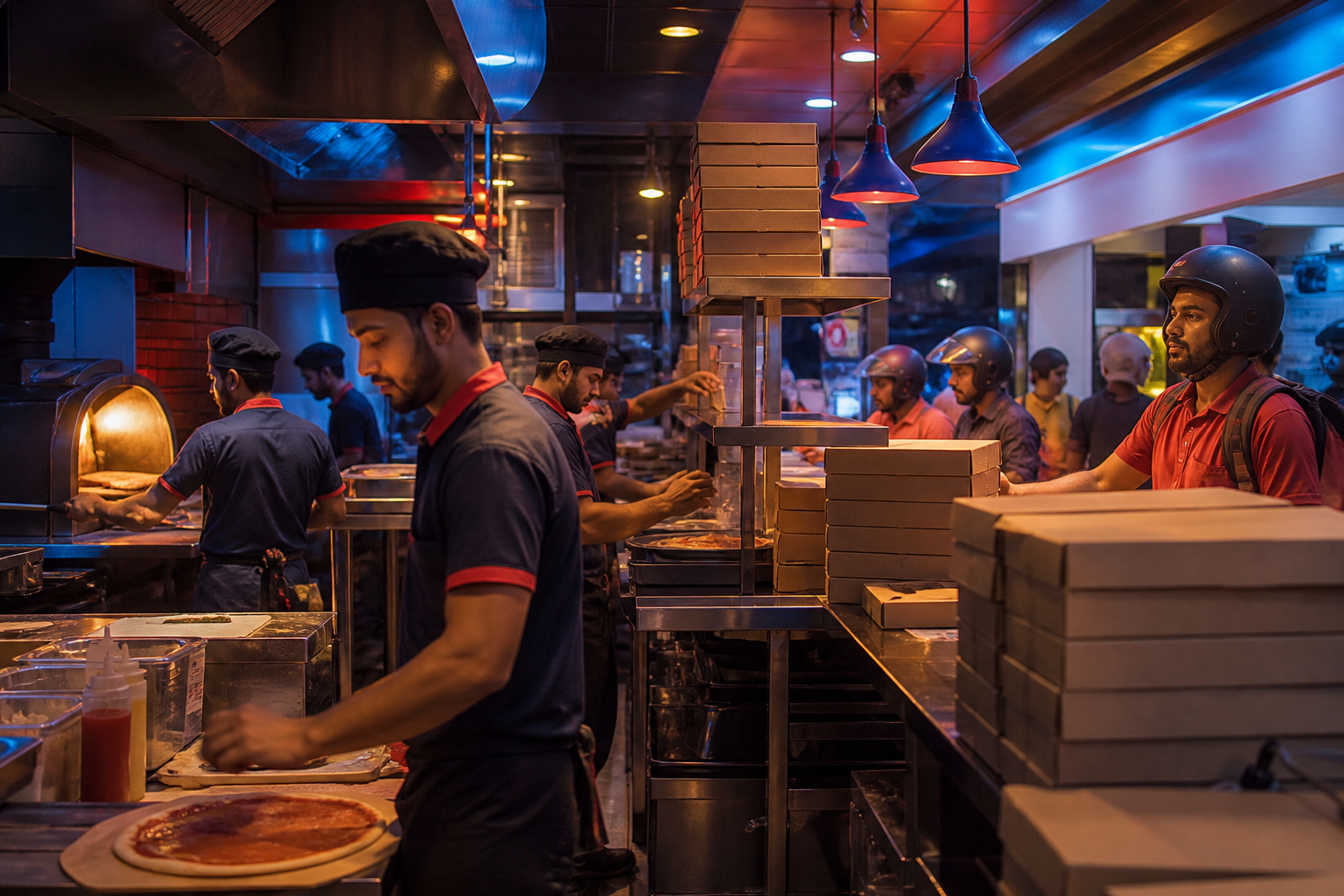
Pizza delivery looks like a marketing promise, but operationally it is a live capacity system. Demand spikes in the evening, the product is time-sensitive, and a late order damages both customer experience and unit economics.
Domino’s India’s operating logic can be read through a guesstimate lens. The primary driver is store-level capacity close to demand: a store must be near enough to customers and staffed enough to handle peak orders. Supporting drivers include a focused menu, standardized preparation, delivery-radius discipline, rider scheduling and repeatable kitchen processes.
A weak estimate would say, “More orders mean more revenue.” A strong estimate asks: “At dinner peak, which breaks first - dough preparation, oven slots, packing, riders, or delivery radius?” That is exactly how an operations leader thinks.
The lesson: a great operations guesstimate is not just a number. It tells management where to add capacity, where to reduce demand variability, and where cost will rise if service promises are tightened.
How AI Changes Guesstimates for Operations: Capacity, Volume & Cost
AI does not remove the need for guesstimates. It raises the bar. In 2026, interviewers expect you to know where human assumptions end and data-driven estimation begins.
For the inventory side of the same logic, revise using AI for inventory optimisation and replenishment, because capacity and stock availability often fail together during demand spikes.
Use ChatGPT or Claude like a pressure-testing partner: enter your guesstimate structure, assumptions and units, then ask, “Find the bottleneck, identify weak assumptions, and suggest two alternate estimation routes.” Do not ask it only for the final answer - ask it to attack your logic.
Interview Relevance
“Estimate the number of delivery riders required for a quick-service restaurant chain in one city during dinner peak. Walk me through your assumptions.”
Use round numbers deliberately. Saying “I will use 20 minutes per completed delivery cycle, so one rider can complete about 3 orders per hour” sounds far stronger than throwing five decimal-heavy calculations at the interviewer.
Common Mistake
The mistake that costs candidates is estimating demand but forgetting capacity. They calculate a large market volume, but never ask whether ovens, counters, machines, staff, vehicles or warehouses can actually process it. One-line fix: after every volume estimate, ask, “Which operating step becomes the bottleneck first?”