
Case Drill: Brand Repositioning from Legacy to Premium
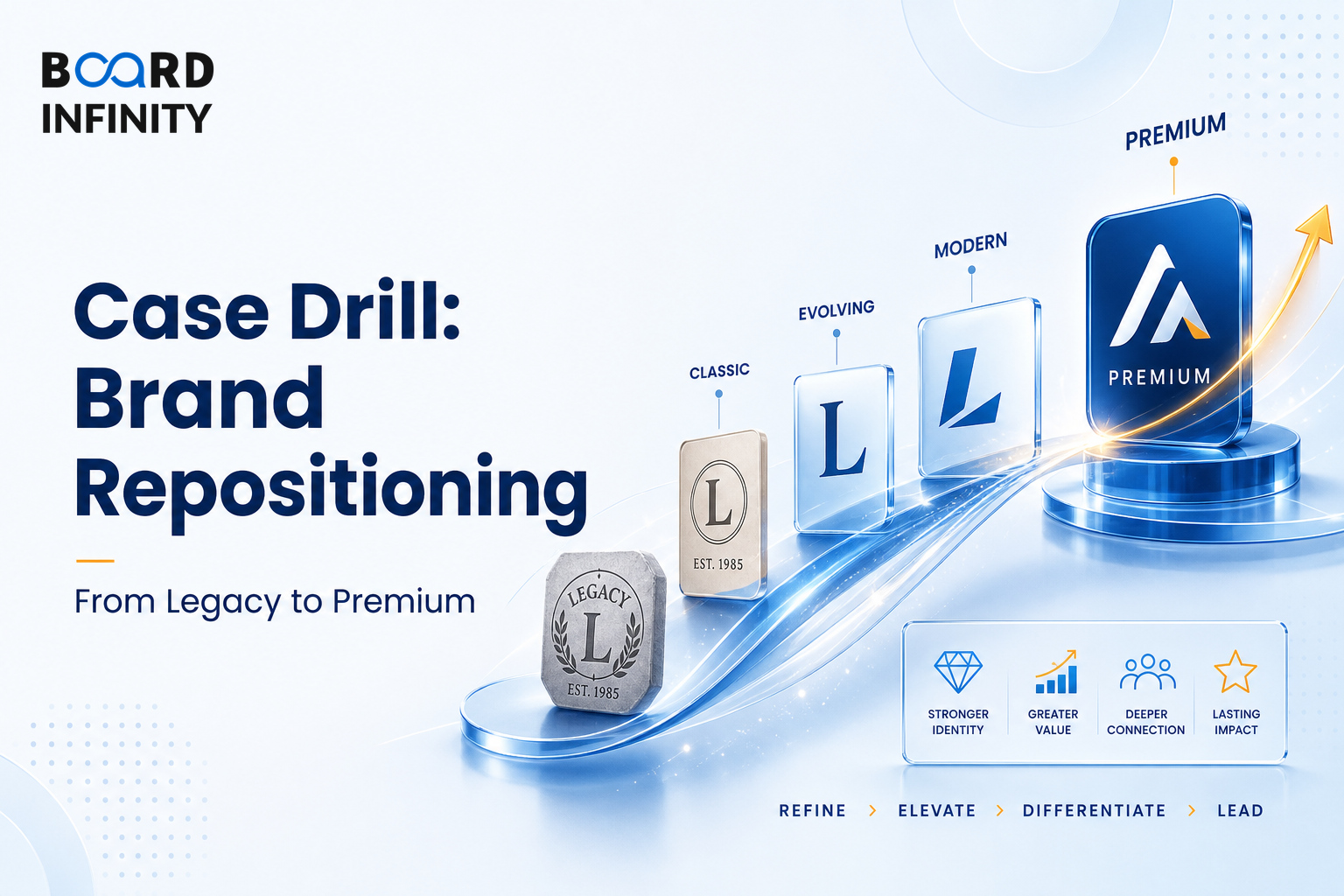
In the previous case drill on entering a new city in quick commerce, the core question was how to sequence markets, operations and demand. This case shifts the lens from expansion to perception: how does a 40-year-old Indian biscuit brand, in the Parle or Britannia tier, credibly launch a premium sub-brand at ₹80-150 per pack when its current range is ₹10-30? Interviewers use this case to test whether you understand that premium repositioning is not just about better ingredients - it is about brand architecture, controlled channels, sharper positioning and scarcity.
- A legacy mass biscuit brand should first decide its brand architecture: parent plus premium line, standalone premium brand or endorsed brand.
- The recommended route in this case is an endorsed brand such as XYZ Artisan by the parent brand, because it balances parent trust with a distinct premium identity.
- Premium perception is built through the 4Ps - Product, Price, Place and Promotion - not through product quality alone.
- The product plan should include 4-5 stock keeping units with premium ingredients, craft-style packaging and a clear positioning of everyday indulgence, artisanally crafted.
- The price anchor in the brief is ₹99 for a 200g pack, based on the stated impulse premium threshold in India.
- Channel control matters: launching on direct-to-consumer and modern trade, while avoiding general trade initially, helps preserve premium perception.
- Scarcity and context, such as premium cafés, Amazon Premium and ₹499-999 gift boxes, can make the brand feel more premium than a broad mass launch.
At a big-picture level, solve this case as a repositioning system rather than a packaging exercise: architecture defines the name, positioning defines the promise, price defines the premium boundary and channels define who experiences it first.
For urban millennials who want a better everyday snack, XYZ Artisan by the parent brand is a premium biscuit positioned as everyday indulgence, artisanally crafted, sitting between mass biscuits and imported brands like Pepperidge Farm and McVitie's Digestives.
Context: Why This Is a Premium Perception Problem
The brand in the brief is not unknown. A 40-year-old Indian biscuit brand at the Parle or Britannia tier typically has trust, familiarity and mental availability. The problem is that the same familiarity can become baggage when the brand asks consumers to pay ₹80-150 per pack instead of the current ₹10-30 range.
That is why this is not a simple product upgrade case. If the brand merely adds Belgian chocolate, California almonds or Himalayan honey but distributes the pack everywhere in the same way as its mass line, consumers may still decode it as a mass biscuit with a higher price. Premium repositioning needs deliberate separation in name, look, channel and occasion.
Brand Architecture: The First Strategic Decision
Brand architecture means the relationship between the parent brand and the new offer. In this case, it decides whether the premium biscuit should directly carry the parent name, avoid the parent completely or sit in the middle as an endorsed brand.
This matters because the parent brand offers trust, but also carries the memory of the ₹10-30 range. A strong answer should not jump straight to ingredients. It should first ask: how much of the parent brand should be visible?
The recommended answer in this drill is the endorsed brand route: launch a brand such as XYZ Artisan by the parent brand. This tells consumers that the product is connected to a trusted food company, but it also gives the premium line enough distance to build its own identity.
The nuance is that endorsed brands are not automatically premium. They need careful execution. If the pack design, retail placement or advertising looks too similar to the mass parent line, the endorsement may become a liability instead of an advantage.
Product and Positioning: Make the Upgrade Legible
SKU stands for stock keeping unit, meaning a distinct product variant that can be tracked and sold separately. In this case, the premium launch should start with 4-5 SKUs rather than a large range, because a focused portfolio is easier to position, merchandise and explain.
The product cues in the brief are premium ingredients such as Belgian chocolate, California almonds and Himalayan honey. These ingredients help, but only when they are part of a larger story. The packaging should use craft-style cues such as a matte finish and minimalist design so that the product looks different from the legacy mass range.
The positioning line is everyday indulgence, artisanally crafted. That phrase does two jobs. It makes the product premium, but not so rare that consumers treat it only as a festival purchase. It also places the biscuit between mass biscuits and imported brands such as Pepperidge Farm and McVitie's Digestives.
In interview terms, this section shows that you can convert a vague word like premium into visible consumer signals. The mistake to avoid is saying “better ingredients” and stopping there. Premium must be legible at the shelf, on the pack and in the buying occasion.
Price: Anchor Premium Without Killing Trial
The brief gives a target range of ₹80-150 per pack versus the current ₹10-30 range. The recommended price is ₹99 for a 200g pack, because the source states that price point research shows ₹99 is the impulse premium threshold in India.
This is a useful case-interview anchor because it connects pricing to trial. A ₹99 pack can feel meaningfully premium against ₹10-30 mass biscuits, but still stay within an impulse purchase zone for urban millennials. The price also supports the positioning of everyday indulgence rather than a rare imported treat.
Use ₹99 for a 200g pack as the trial anchor: high enough to signal a premium upgrade from ₹10-30, but still aligned with the stated impulse premium threshold in India.
The nuance is that price does not work alone. If the product is priced at ₹99 but sold in the same general trade context as the mass line from day one, the consumer may compare it directly with the parent brand's cheaper packs. That is why pricing and channel strategy have to be designed together.
Channel Strategy: Control Access to Build Scarcity
D2C means direct-to-consumer, where the brand reaches consumers through its own digital route rather than relying only on third-party stores. Modern trade refers to organized retail formats, while general trade refers to the broader traditional retail network. In this case, the recommendation is to launch exclusively on D2C and modern trade, with no general trade initially.
This is the heart of the case. The key insight interviewers look for is that premium repositioning is about channel control and scarcity as much as product quality. If the product appears everywhere immediately, it may inherit the mass cues of the parent brand.
Café partnerships are especially useful because they change the frame of reference. If the biscuit is placed in premium cafés such as Blue Tokai or Third Wave as the biscuit with your coffee, it is no longer competing only with routine tea-time biscuits. It becomes part of a more premium snack ritual.
The gifting angle extends that logic. Premium gift boxes at ₹499-999 for Diwali and Christmas can drive trial while positioning the sub-brand as a gifting brand. For an interviewer, this is a strong move because it links channel, occasion and perceived value.
Promotion: Use Context Before Mass Awareness
Promotion in the 4Ps means the set of activities used to create awareness, trial and desire. Here, the promotional plan should not behave like a mass biscuit launch. It should first build credibility in premium contexts.
Amazon Premium is part of that plan through A+ content, vine reviews and targeted ads on keywords such as premium cookies and biscuit gift box. The point is not only to sell online, but to control how the product is described, photographed, reviewed and discovered.
Promotions should reinforce the same premium story: everyday indulgence, artisanally crafted. If the brand overuses discounting too early, it may weaken the very premium perception it is trying to build.
Worked Example: Launching XYZ Artisan by a Legacy Biscuit Brand
The situation is a 40-year-old Indian biscuit brand with a ₹10-30 mass range that wants to launch a ₹80-150 premium sub-brand for urban millennials. The problem is credibility: the parent has trust, but its mass image may create a price ceiling.
The key learning is that the brand should not simply stretch the parent name upward and hope consumers accept the price. It must create a new premium world around the sub-brand while using the parent only as a trust endorsement.
Structuring a Case Drill Interview Answer
"A 40-year-old Indian biscuit brand wants to launch a premium sub-brand for urban millennials at ₹80-150 per pack, while its current range is ₹10-30. How would you approach this launch?"
The strongest answers make a clear architecture recommendation before discussing ingredients. Candidates lose structure when they jump straight to Belgian chocolate or packaging without first solving the parent brand versus premium identity tension.
Conclusion
A legacy biscuit brand can move premium only if it separates the new offer enough to feel special while still borrowing trust from the parent. The winning logic is endorsed branding, focused SKUs, ₹99 trial pricing, controlled channels and premium occasions that make consumers experience the product differently from the mass range.
The most frequent error is treating premium repositioning as an ingredient upgrade. That misses the real case insight: if the brand uses the wrong architecture or launches too broadly through general trade, the product may still be perceived as a mass biscuit with a higher price!