
Funnel Metrics, Cohort Analysis and Attribution Models Explained
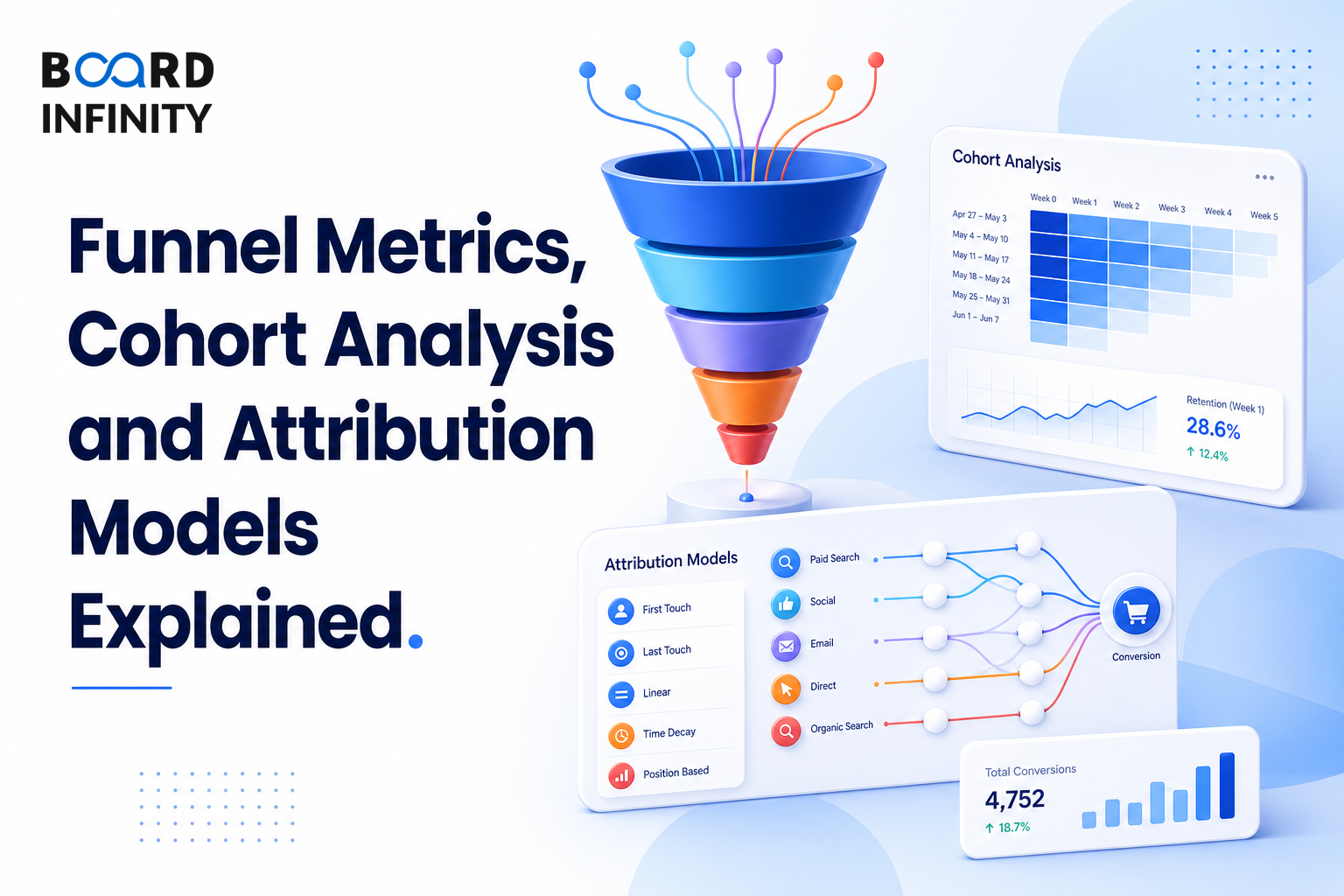
After learning LTV:CAC - the ratio between lifetime value and customer acquisition cost - the next interview question is usually diagnostic: if marketing is working or failing, which part of the journey deserves credit or blame? Funnel metrics, cohort analysis and attribution sit inside that metrics deep-dive, but attribution is the sharpest case-interview topic because it asks a deceptively simple question: which touchpoint gets credit for the conversion? In modern marketing roles, especially at tech companies, D2C brands and startups, interviewers expect you to understand that the answer is never perfectly captured by one model.
- Attribution answers: which touchpoint gets credit for the conversion.
- Last Click gives 100% credit to the final touchpoint, making it simple but biased toward bottom-funnel channels.
- First Click gives 100% credit to the first touchpoint, which values awareness but ignores the conversion trigger.
- Linear attribution splits credit equally across touchpoints, making it fair and easy to understand but not necessarily reflective of true influence.
- Time Decay gives more credit to touchpoints closer to conversion, which suits longer sales cycles such as B2B and EdTech, but can undervalue awareness.
- Data-Driven or Algorithmic attribution uses an ML model to assign credit based on incremental impact, but it needs large data volume and data infrastructure.
- A strong interview answer says no model is perfect and combines Marketing Mix Modelling for quarterly strategic allocation, multi-touch attribution for weekly tactical optimisation and incrementality testing as ground truth.
The Big Picture: Three Metrics Lenses in a Growth Discussion
In a metrics case, do not jump straight into a model name. First show the interviewer that you know what question each metrics lens is trying to answer, then choose the right depth for the case.
Attribution is the process of deciding which marketing touchpoint gets credit for a conversion.
Why Attribution Matters in Marketing Cases
Attribution matters because marketing journeys often involve more than one touchpoint. A user may first discover a brand through an awareness channel, engage again later and finally convert after a bottom-funnel trigger. If the business credits only one step, the budget decision can become biased.
The source framework makes the central trade-off clear: attribution is not just a technical calculation. It is a practical choice between simplicity, fairness, recency and data maturity. Small teams may choose a simpler model because it is easy to implement, while mature teams with data infrastructure may be ready for algorithmic attribution.
For interviews, the highest-scoring move is to say that attribution is useful but incomplete. No model is perfect, so strong candidates explain what the model is good for, what it misses and how they would validate it using broader measurement approaches.
The Main Attribution Models
The attribution models below differ in how they assign conversion credit across touchpoints. The right model depends on the business context, the length of the sales cycle, the available data and the decision being made.
ML means machine learning - a model-based method that learns patterns from data. In the attribution context, a data-driven or algorithmic model uses ML to assign credit based on incremental impact rather than a fixed rule like first click or last click.
How Each Model Works and Where It Breaks
Last Click is the easiest model to explain: the final touchpoint receives all credit. Its advantage is simplicity, which makes it useful for small teams with limited data. The problem is that it ignores all assist touchpoints and therefore over-rewards bottom-funnel activity.
First Click does the opposite. It gives all credit to the first touchpoint, which makes it useful for brand-focused businesses that care about awareness. Its weakness is that it ignores the conversion trigger, so it can overstate the role of early discovery.
Linear attribution spreads credit equally across all touchpoints. It feels fair and is simple to understand, so it works as a baseline comparison model. However, equal credit does not necessarily mean true influence, because some touchpoints may have mattered more than others.
Time Decay gives more credit to touchpoints closer to conversion. This reflects recency bias and is useful for longer sales cycles, including business-to-business (B2B) and EdTech contexts. The key limitation is that it can still undervalue awareness, because earlier touchpoints receive less credit.
Data-Driven or Algorithmic attribution uses an ML model to assign credit based on incremental impact. It is the most accurate model in the source framework and adjusts automatically, but it needs large data volume and data infrastructure. It can also become a black box, meaning stakeholders may not easily understand why the model assigned credit in a certain way.
Choosing the Right Attribution Model
There is no universally best attribution model. The right answer depends on what the team can implement, what decision it is making and how much reliable data it has.
This is the trade-off interviewers want to hear. Simpler models are easier to implement but less complete. Fairer models are easier to defend but may not reflect real influence. Recency-based models fit longer sales cycles but can under-credit awareness. Algorithmic models can be more accurate but require maturity and may be difficult to explain.
Attribution Is Not the Same as Ground Truth
The source material gives a clear interview tip: always acknowledge that no attribution model is perfect. Even a sophisticated model can misread causality if it only redistributes credit among observed touchpoints.
Marketing Mix Modelling (MMM) is used for strategic allocation on a quarterly basis. Multi-touch attribution (MTA) is used for tactical optimisation on a weekly basis. Incrementality testing, including geo holdouts and lift studies, is treated as the ground truth.
This combination is the mature answer. MMM helps with bigger allocation choices, MTA helps with ongoing tactical optimisation and incrementality testing checks whether marketing actually caused additional results rather than merely appearing near the conversion.
Worked Example: Choosing an Attribution Model for a Longer Sales Cycle
Consider an EdTech context with a longer sales cycle. The team needs to understand which touchpoints deserve credit, but it also knows that the final conversion trigger may not be the only influence.
The important interview move is not simply naming Time Decay. It is explaining why Time Decay fits the context, what it still misses and how you would avoid overclaiming its accuracy.
Practical Nuances Candidates Should Mention
First, attribution is a decision tool, not a perfect truth machine. It helps teams compare touchpoints, but each model carries a built-in bias. Last Click biases toward the bottom funnel, First Click values awareness, Linear assumes equal influence and Time Decay favours recency.
Second, data maturity matters. A data-driven or algorithmic model may be the most accurate in the framework, but it requires large data volume and data infrastructure. If a small team lacks that foundation, a simpler model may be more realistic.
Third, cadence matters. The source recommends MMM for strategic allocation quarterly and MTA for tactical optimisation weekly. That distinction shows that mature marketing measurement is not one dashboard or one model; it is a layered system.
Fourth, incrementality is the validation layer. Geo holdouts and lift studies are specifically called out as incrementality testing methods. In an interview, this is how you show that you understand causality, not just credit assignment.
Structuring a Funnel Metrics, Cohort Analysis & Attribution Models Explained Interview Answer
"Which attribution model would you use to evaluate marketing performance, and how would you explain its limitations?"
The number one way candidates lose points is by naming a model without explaining its bias. A better answer says what the model rewards, what it ignores and how the team would validate it.
The most frequent error is treating attribution as exact truth instead of a model with assumptions. This costs points because the source framework explicitly says no model is perfect and expects candidates to mention MMM, MTA and incrementality testing.
Conclusion
Attribution helps marketers decide which touchpoint gets credit for conversion, but the real skill is choosing the model that fits the context and then acknowledging its limits. In interviews, combine model trade-offs with MMM, MTA and incrementality testing to show mature, practical marketing judgment.