
Performance Marketing vs Brand Building - The 60/40 Trade-Off Explained
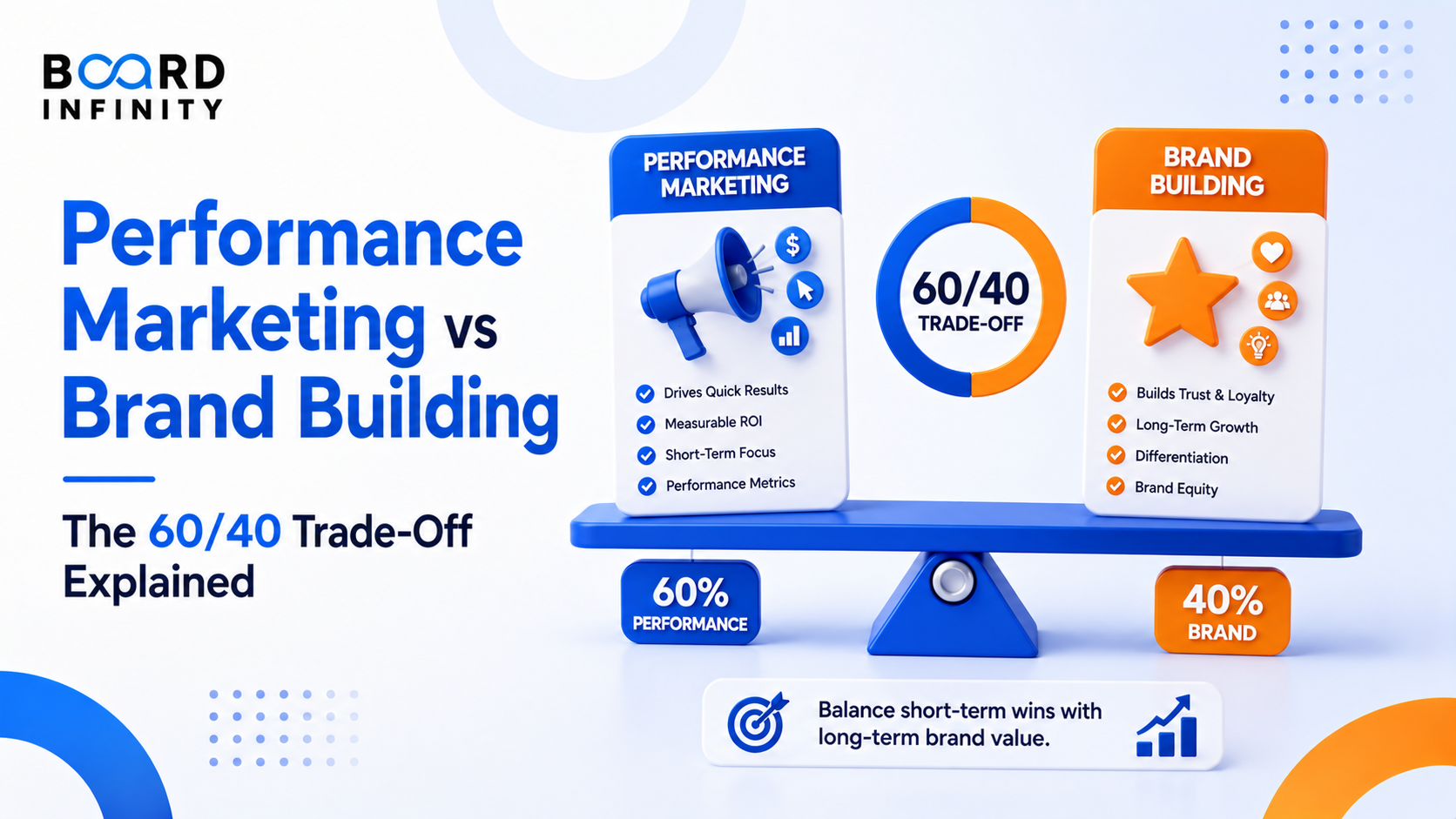
In the previous case drill on brand repositioning from legacy to premium, the core question was how a brand changes perception. This lesson moves one level deeper: once you know the desired perception, how much should a marketing leader spend on measurable acquisition versus long-term brand building? This trade-off matters in interviews because it tests whether you can balance clicks, conversions and return on ad spend with pricing power, loyalty and brand equity.
- Performance marketing focuses on measurable short-term outcomes such as clicks, conversions, cost per acquisition, return on ad spend and click-through rate.
- Brand building creates long-term demand, pricing power and loyalty, but its impact is harder to measure directly through metrics such as brand recall, net promoter score and salience.
- The central tension is that performance spends can show results in days to weeks, while brand investments typically compound over months to years.
- The Binet and Field framework recommends a rough 60% brand building and 40% performance or activation split for optimal long-term growth.
- The split is not fixed: business-to-business brands may use approximately 50/50, while new or unknown brands may temporarily shift to 70% performance and 30% brand.
- Meesho’s ₹200 Cr+ spend on Meta ads for app installs shows a performance-led acquisition example; Amul’s topical ads show brand equity built with zero media spend.
- In interviews, do not choose one side blindly. Diagnose stage, category position, product type and funding stage before recommending a budget mix.
The Big Picture: Budget Balance at a Glance
Marketing leaders are usually managing two engines with one budget: short-term activation and long-term demand creation. The right answer is not “performance or brand”; it is a stage-aware allocation that explains why the mix should shift over time.
Use the 60/40 rule as the anchor: start with roughly 60% of budget for brand building and 40% for performance or activation, then adjust based on stage, category position, product type and funding context.
What Performance Marketing Means
Performance marketing is marketing designed to generate measurable, short-term outcomes. In the source examples, these outcomes include clicks, conversions and ROAS, which means return on ad spend - the revenue or value generated for every unit of ad spend.
It is typically evaluated through metrics such as CPA, or cost per acquisition, which tracks how much it costs to acquire one customer; CTR, or click-through rate, which measures the percentage of people who click after seeing an ad; and ROAS. These metrics make performance marketing attractive in board meetings because the link between spend and action is easier to show.
The limitation is that performance marketing can hit a ceiling quickly. As spend scales, the source notes that CPA rises, meaning each additional customer can become more expensive. There is also platform dependency: changes in Meta or Google algorithms can affect results, so a brand that relies too heavily on paid platforms may face risk outside its direct control.
Meesho is the India-relevant example from the source: it spent ₹200 Cr+ on Meta ads for app installs. This is a performance-led approach because the goal - app installs - is measurable and directly tied to acquisition. In an interview, this example helps you show that performance marketing is powerful when the business needs immediate demand, user growth or clear conversion data.
What Brand Building Means
Brand building is marketing that creates long-term demand, pricing power and loyalty. Unlike performance marketing, it is harder to measure directly because its signals are often indirect: brand recall, NPS or net promoter score, and salience, which means how easily the brand comes to mind in a buying situation.
Brand building usually works over months to years. It compounds because a strong brand becomes a moat: customers remember it, trust it, and may be more willing to choose it even when alternatives exist. This is why brand building is especially relevant for market leaders, premium brands and category creation.
The source example is Amul’s topical ads, described as having zero media spend and massive brand equity. The lesson is not that every brand can copy Amul’s exact approach; the lesson is that repeated, distinctive brand communication can create salience and long-term equity even when the immediate conversion is not as measurable as a click or install.
The interview nuance is important: brand building is not “unmeasurable”; it is simply harder to measure directly. A strong answer should mention that brand effects may be tracked through recall, NPS and salience, even if those metrics do not behave like CPA or ROAS.
Performance Marketing vs Brand Building: Core Comparison
The trade-off becomes clearer when you compare time horizon, measurability, return pattern, risk and best use case. In case interviews, this table helps you avoid a one-sided answer.
The Binet and Field Framework
The source refers to research by Les Binet and Peter Field, described as among the most cited work in marketing effectiveness. Their framework, often called The Long and the Short of It, separates marketing into long-term brand building and short-term activation.
The headline recommendation is the 60/40 rule: allocate roughly 60% of budget to brand building and 40% to performance or activation for optimal long-term growth. This is a useful anchor because it prevents candidates from treating performance as the only serious marketing spend just because it is easier to measure.
However, the rule is not a rigid formula. For B2B, or business-to-business companies that sell to other businesses, the ratio shifts to approximately 50/50. For new or unknown brands, the source recommends temporarily shifting to 70% performance / 30% brand because the base must be built first.
The 60/40 rule says that, as a long-term anchor, a brand should allocate roughly 60% of marketing budget to brand building and 40% to performance or activation, then adjust the split based on business context.
When to Deviate from the 60/40 Rule
A strong case answer starts with the 60/40 rule but does not stop there. The source gives specific situations where the allocation should change.
D2C means direct-to-consumer, where a company sells directly to customers rather than primarily through intermediaries. The source separates early-stage and later-stage venture-funded D2C because the marketing task changes: early on, the business needs measurable acquisition and data; later, the brand may need a more balanced mix.
Worked Example: Choosing the Budget Mix for an App-Install Push
Use this structure when an interviewer gives you a marketing budget allocation problem. The example stays close to the source: Meesho is associated with a large Meta-led app-install push, while the decision logic comes from the 60/40 rule and its deviations.
The key learning is that a performance-heavy choice can be correct in the short term, especially when acquisition is the goal. But the recommendation should include the trigger for rebalancing: once the brand has revenue, data and a customer base, over-reliance on paid platforms becomes a strategic risk.
How to Decide the Right Mix in a Case
When you get a budget allocation question, avoid starting with a percentage. First diagnose the business context, then justify the allocation.
This checklist is reusable because it separates diagnosis from recommendation. In many interviews, the candidate who says “I would spend 80% on performance” without explaining stage, risk and time horizon sounds tactical rather than strategic.
Structuring a Performance Marketing vs Brand Building Interview Answer
"Meesho is seeing measurable app installs from Meta ads, but the leadership team is worried about long-term brand equity. How would you split the marketing budget between performance marketing and brand building?"
The strongest answers do not argue that brand is “soft” and performance is “real.” They show that performance is easier to measure in the short term, while brand building creates compounding demand and a moat over time.
The most frequent error is recommending the 60/40 split mechanically without adjusting for stage. A startup in its first 0-2 years, a category leader and a commodity product do not need the same allocation, so a fixed answer costs points because it ignores the core trade-off.
Conclusion
Performance marketing and brand building are not rivals; they are different time horizons competing for the same budget. Use the 60/40 rule as your anchor, then adjust the mix based on stage, category position and growth objective so your answer sounds commercially realistic.