
LTV:CAC Ratio - The Core Marketing Unit-Economics Test
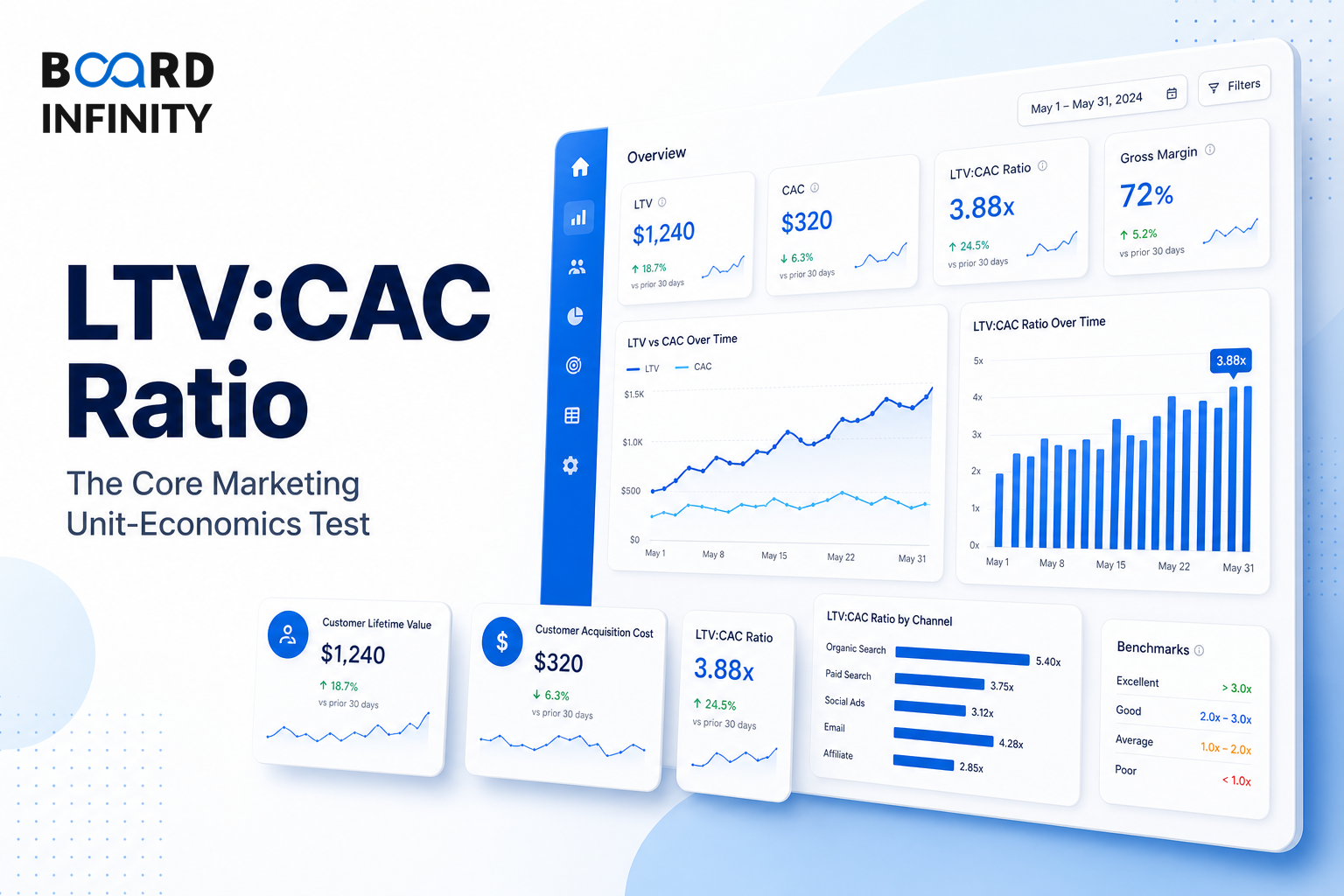
Budget Allocation Across Marketing Channels helps you decide where to spend marketing money. LTV:CAC answers the harder question: should you be spending that money at all? In interviews, this ratio is a core unit-economics test because it shows whether a marketing engine is destroying cash, barely sustainable, healthy enough to scale, or possibly too conservative.
- LTV means Lifetime Value - the total net revenue a customer generates over the entire relationship with the brand.
- CAC means Customer Acquisition Cost - total marketing plus sales spend divided by the number of new customers acquired.
- LTV:CAC compares customer value with acquisition cost; below 1:1 means the business is losing money on every customer.
- 3:1 is the healthy and sustainable benchmark described as the gold standard.
- 5:1+ can look excellent, but it may also mean the company is under-investing in growth.
- CAC payback period adds a time lens by asking how many months it takes to recover acquisition cost from customer revenue and gross margin.
- In case interviews, always pair the ratio with an action: reduce CAC, improve retention, maintain efficiency, or consider scaling spend.
Big Picture: LTV:CAC as a Marketing Unit-Economics Test
At the highest level, LTV:CAC turns marketing from a spend question into an economics question. You first estimate customer value, then calculate acquisition cost, then interpret the ratio, and finally test how quickly the business recovers that cost through CAC payback.
LTV:CAC Ratio = Lifetime Value divided by Customer Acquisition Cost. It shows how much customer value the business earns for every rupee spent to acquire a customer.
Definitions: LTV and CAC
Lifetime Value (LTV) is the total net revenue a customer generates over their entire relationship with your brand. If a customer buys repeatedly, stays longer, or buys higher-value products, LTV typically improves.
Customer Acquisition Cost (CAC) is the total cost to acquire one new customer. It is calculated as all marketing plus sales spend divided by the number of new customers acquired.
The ratio matters because a low CAC does not automatically mean good marketing. If the customers acquired do not stay, repeat, or generate enough revenue, the marketing engine may still be weak. Similarly, a high CAC can be acceptable if the customer generates high lifetime value and the payback period fits the business model.
Average Order Value (AOV) means the average rupee value of one order. Average Revenue Per User (ARPU) means the revenue generated per user, typically used in subscription models. Software as a Service (SaaS) businesses often use the quick SaaS LTV formula because churn directly affects how long customers keep paying.
Reading the Ratio: Bad, Break Even, Healthy, Excellent
The LTV:CAC benchmark converts a calculation into a decision. It is not just a finance metric; it tells a marketer whether the current acquisition engine needs urgent repair, careful optimisation, controlled scaling, or higher investment.
A useful way to remember the visual guide is: around 1:1 is bad, 2:1 is break even, 3:1 is healthy, and 5:1 is excellent but needs interpretation. The nuance is important: a very high ratio is not always a reason to celebrate. It may mean the brand could have acquired more customers profitably but held back spend.
Why 3:1 Is the Practical Benchmark
The source benchmark calls 3:1 the healthy and sustainable gold standard. In case terms, this means the customer generates enough value relative to acquisition cost for the business to consider maintaining the engine and exploring scale.
However, a 3:1 ratio should not be read in isolation. If CAC starts rising as the company spends more, the ratio can deteriorate, which is called CAC creep in the source action guidance. That is why the right interview answer does not simply say "spend more"; it says "explore scaling acquisition while watching for CAC creep."
CAC Payback Period: The Time Test
LTV:CAC tells you whether the customer is valuable enough. CAC payback period tells you how quickly the business recovers the acquisition cost. This matters because two businesses can have the same LTV:CAC ratio but very different cash-flow pressure depending on how fast customers pay back CAC.
CAC Payback Period = CAC / (Monthly Revenue per Customer × Gross Margin). Example: CAC = ₹5,000; Monthly ARPU = ₹500; Gross Margin = 70% → Payback = ₹5,000 / (₹500 × 0.7) = 14.3 months.
Direct-to-Consumer (D2C) e-commerce means a brand sells directly to customers. Small and Medium Business (SMB) SaaS refers to subscription software sold to smaller businesses. Annual Contract Value (ACV) is the value of a customer contract over a year, which helps explain why enterprise SaaS can tolerate longer payback.
The interview nuance is that "good" payback depends on the business type. Quick Commerce needs less than 3-4 months because margins are razor-thin, while Enterprise SaaS can accept less than 18-24 months because high ACV and longer sales cycles make a slower recovery more acceptable.
Worked Example: January Acquisition Spend
Use the ratio as a structured diagnostic rather than a standalone number. The following example combines the source CAC and LTV calculations to show how a candidate can move from data to decision.
This is the type of answer interviewers reward because it connects numbers to action. You do not stop at "CAC is ₹5,000"; you explain whether the resulting economics are good enough to scale.
Practical Interview Use: From Metric to Recommendation
In marketing cases, LTV:CAC is useful when the interviewer asks about growth, channel efficiency, retention, pricing, or profitability. It helps you avoid a common trap: recommending more marketing spend just because a channel brings in customers.
A strong answer usually separates three questions. First, is the customer valuable enough? Second, is acquisition efficient enough? Third, does the business recover CAC quickly enough for its model? Only after these checks should you recommend scaling acquisition.
Structuring a LTV Interview Answer
"A marketing team wants to increase acquisition spend because its current campaigns are bringing in new customers. How would you decide whether the business should scale the spend?"
The best candidates do not treat LTV:CAC as a vanity ratio. They explain the action behind the number: what to reduce, what to improve, whether to scale, and what payback risk to monitor.
Conclusion
LTV:CAC is the core test of whether marketing creates value after acquisition cost. Use it with CAC payback period, interpret it against the right benchmark, and turn every calculation into a clear business decision.
The most frequent error is saying a high LTV:CAC ratio is always good. A 5:1+ ratio can mean the company is very efficient, but it can also mean it is under-investing in growth and leaving profitable acquisition on the table.