
Case Drill - Declining Market Share for an FMCG Shampoo Brand
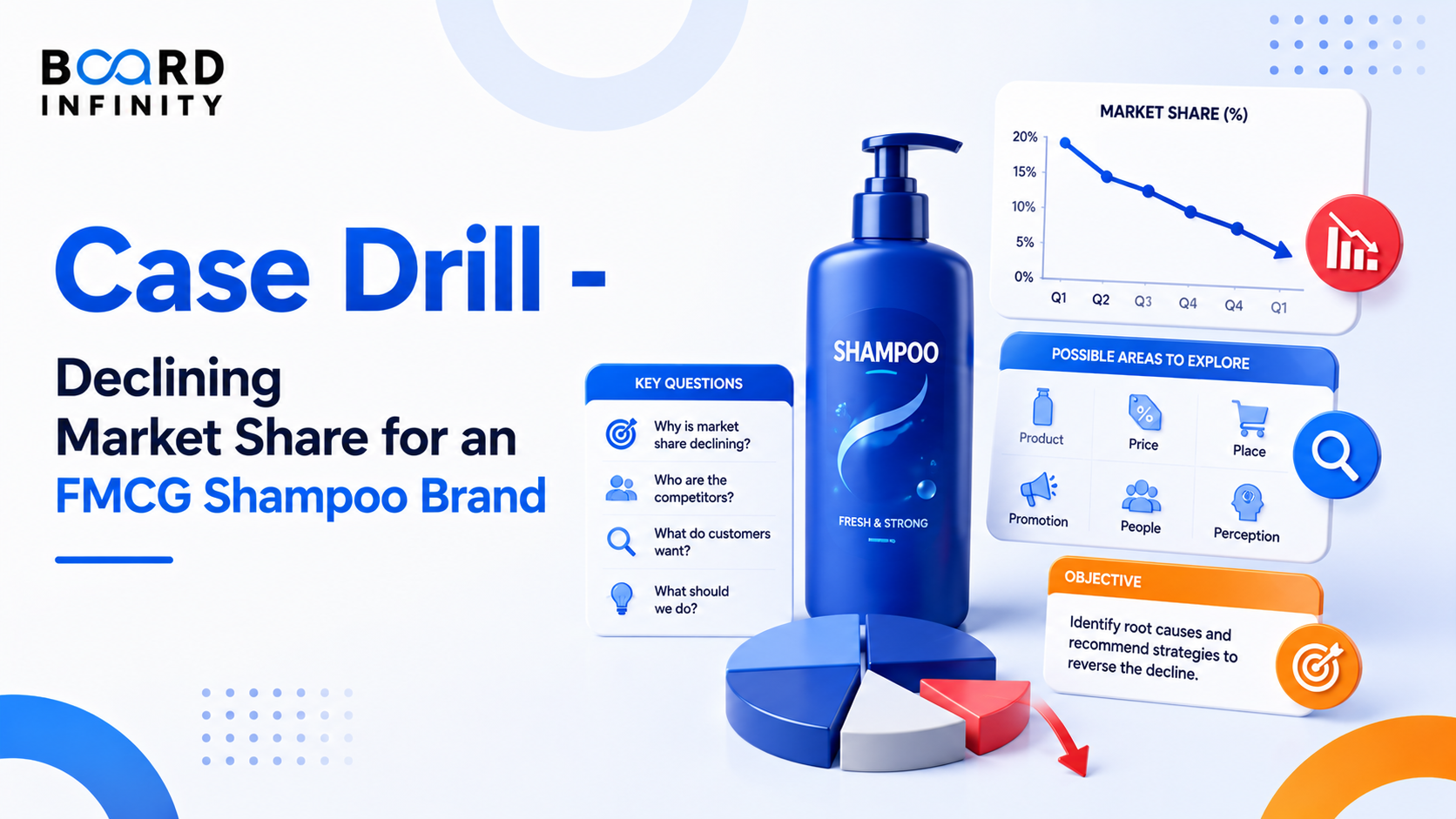
In the previous case drill on launching a D2C brand on a ₹50L budget, the core challenge was building a go-to-market plan from scratch. This drill flips the problem: you already manage a leading ₹500 Cr shampoo brand in India, but its market share has dropped from 24% to 19% over 18 months. In interviews, this matters because declining share cases test whether you diagnose before prescribing, instead of rushing to easy answers like higher ad spend.
- A market share decline should be treated as a diagnosis problem first, not a communication problem by default.
- The 5C framework checks Company, Customers, Competitors, Collaborators, and Context before recommending action.
- In this case, likely causes include distribution loss, innovation gap, price-value mismatch, and communication fatigue.
- D2C brands like WOW Skin Science and Mamaearth are relevant competitor signals because they launched sulphate-free and natural variants.
- The 12-month recovery plan should be phased: Month 1-3 quick wins, Month 3-6 brand refresh, and Month 6-12 sustain and grow.
- Strong answers link actions to root causes: natural range for innovation gap, ₹10 sachet and ₹99 trial size for penetration, and 500 merchandisers for visibility.
- The biggest interview mistake is jumping straight to increase ad spend without checking product, distribution, pricing, and competition.
The Big Picture: Diagnose, Prioritise, Then Recover
Fast-moving consumer goods, or FMCG, refers to high-frequency, widely distributed consumer products such as shampoo. In a share-loss case, the interviewer is usually not testing whether you know one clever campaign idea; they are testing whether you can isolate the cause of decline and design a practical recovery plan.
For a share-decline case, use this structure: define the decline, diagnose with 5C, form root-cause hypotheses, prioritise actions by time horizon, and link each recommendation back to the diagnosed cause.
Understanding the Case Brief
The brief is specific: you are the brand manager of a leading ₹500 Cr revenue shampoo brand in India, and market share has dropped from 24% to 19% over the past 18 months. The CEO wants a turnaround plan, which means the answer must combine diagnosis, strategy, and execution.
The phrase market share means the brand’s portion of the category market. A fall from 24% to 19% is a 5 percentage point decline, so the business issue is not merely a temporary campaign dip; it suggests that something in the brand’s offer, availability, consumer relevance, competitive position, or market context may have shifted.
A strong candidate should resist the urge to say, “increase ad spend.” Advertising may be part of the answer, but the source case explicitly warns that a structured turnaround always starts with diagnosis.
The 5C Diagnosis Framework
The 5C framework is a business diagnosis tool that studies five areas: Company, Customers, Competitors, Collaborators, and Context. In this shampoo case, it ensures you investigate internal performance, consumer behaviour, rival moves, trade execution, and category shifts before choosing the recovery plan.
SKU means Stock Keeping Unit, a specific product variant or pack size such as a sachet or trial size. P&L means Profit and Loss, the financial statement used to assess revenue, costs, and margins. NPS means Net Promoter Score, a customer advocacy metric, while TAM data refers to competitor advertising spend data used to understand media pressure.
This framework matters because a share decline can look the same at the top level but have very different causes underneath. If the shampoo is losing rural and semi-urban outlets, a new TV commercial will not fix shelf availability. If younger consumers have moved toward natural and sulphate-free options, a trade-only push will not solve relevance.
Company: Check the Brand’s Own Performance First
The Company lens asks whether the decline is caused by internal factors. The case points to product quality, supply issues, and the innovation pipeline as the first checks. The right data sources are Nielsen data, internal sales by SKU and region, P&L trends, and a comparison of new launches versus competitors.
This is important because FMCG share loss can be uneven. A shampoo brand may still look strong nationally while losing specific pack sizes, regions, or channels. The case does not provide those splits, so the interview answer should ask for them rather than assume a single national cause.
The most important nuance is that “Company” does not only mean product quality. It also includes whether the brand has kept its portfolio current. If competitors have launched natural or sulphate-free options and the brand has not, the issue may be an innovation gap, not just a product defect.
Customers: Separate Lost Loyalists from Weak Acquisition
The Customers lens asks whether the brand is losing existing loyal users or failing to acquire new ones. The source recommends checking brand health tracker data, purchase frequency, cohort retention, and NPS trends.
Cohort retention means tracking whether a group of consumers who bought during a certain period keep buying later. For example, if trial buyers do not repeat, the issue may be product experience or price-value mismatch. If loyal users are leaving, the issue may be relevance, availability, or competitor switching.
In this case, the health-conscious segment is especially important because the recovery plan includes a natural range sub-brand with sulphate-free and paraben-free variants. That recommendation only makes sense if the diagnosis shows a segment shift toward natural or organic haircare.
Competitors: Identify Who Gained and Why
The Competitors lens asks which brands gained share and what they did differently. The source highlights D2C, or direct-to-consumer, disruption in haircare and names brands like WOW Skin Science and Mamaearth as examples of players launching sulphate-free and natural variants.
D2C means a brand sells directly to consumers through its own channels rather than relying only on traditional retail. In this case, the competitive threat is not just online sales; it is the consumer proposition around natural, modern haircare. If the legacy shampoo brand has not updated its promise, younger consumers may see competitors as more relevant.
The source also suggests checking competitor ad spends, new launches, pricing changes, and distribution moves. That is a broad competitive diagnosis: rivals may be winning through product innovation, larger packs at similar price points, more aggressive shelf presence, or sharper communication.
Collaborators: Audit the Trade and Execution Layer
The Collaborators lens covers retailers, distributors, and agencies. In an FMCG category, collaborators influence whether the product is visible, stocked, and recommended at the point of purchase.
The source asks candidates to investigate trade feedback, distribution audits, and agency performance reviews. This matters because one likely root cause is distribution loss, where competitors gained shelf space while the brand lost rural and semi-urban outlets.
The turnaround plan’s trade push is directly tied to this diagnosis: increase retailer margins by 2% for 3 months and deploy 500 additional merchandisers for visibility. That is a concrete example of connecting collaborator diagnosis to execution.
Context: Read the Category Shift
The Context lens asks what is changing outside the brand and its immediate competitors. The source calls out regulatory changes, category trends, the shift to natural or organic products, premiumisation trends, and D2C disruption in haircare.
Premiumisation means consumers moving toward higher-value or more specialised products. In this shampoo case, premiumisation can show up through demand for natural, sulphate-free, paraben-free, or modern positioning. The case does not say the whole category has shifted equally, so a careful answer should treat this as a hypothesis to validate using category growth and trend data.
Likely Root Causes to Test
After the 5C diagnosis, candidates should translate observations into a hypothesis tree. A hypothesis tree is a structured list of possible causes that can be tested using data. The source lists four likely FMCG causes in this case.
The nuance is that these root causes can overlap. For example, a brand may be losing younger consumers because of both an innovation gap and communication fatigue, while also losing smaller towns because of distribution loss. In interviews, the better answer is not to pick one cause blindly, but to prioritise based on evidence.
The 12-Month Turnaround Plan
The turnaround plan should be sequenced because not every action has the same time horizon. The source divides the plan into three phases: quick wins in Month 1-3, brand refresh in Month 3-6, and sustain and grow in Month 6-12.
Phase 1 focuses on fast levers. The natural range addresses health-conscious consumers, the ₹10 sachet and ₹99 trial size improve penetration in Tier 2-3 towns, and the trade push improves retail visibility. These are practical because they target product relevance, affordability, and availability at the same time.
Phase 2 rebuilds brand salience. The source recommends a younger brand ambassador and a shift from legacy positioning to “modern, confident, natural.” It also recommends a digital-first launch on Instagram, YouTube, and beauty creators, with 40% of the media budget allocated to digital, up from 25%.
Phase 3 builds a more durable growth engine. The D2C channel includes an owned website with a subscription model, auto-replenish every 45 days, and a 10% discount. The plan also uses Marketing Mix Modelling, or MMM, to optimise spend across TV, digital, and trade.
Worked Example: Turning Diagnosis into a CEO-Ready Plan
This worked example shows the difference between a tactical answer and a structured case answer. A tactical answer might say “launch a new campaign.” A CEO-ready answer explains why the campaign is needed, what else must change, and how the recovery should be phased over 12 months.
How to Use Named Examples Without Overclaiming
The source names WOW Skin Science and Mamaearth as D2C brands that launched sulphate-free and natural variants. In an interview, use them as signals of category movement, not as proof that every consumer has shifted to natural haircare.
The source also names Lakme and Naturals as salon chain partners for sampling. The recommendation is to distribute trial sachets with every haircut, which links the product trial moment to a relevant haircare occasion.
This is a useful way to make the answer practical. Instead of saying “do sampling,” say “partner with salon chains such as Lakme and Naturals for trial sachets with every haircut.” That shows channel-context fit.
Structuring a Case Drill Interview Answer
"You are the brand manager of a leading ₹500 Cr shampoo brand in India. Over 18 months, market share has dropped from 24% to 19%. What turnaround plan would you recommend?"
The best answers sound like a brand manager, not just a marketer. Mention the data you would inspect, the root causes you would test, and the operating levers you would deploy before talking about communication.
The most frequent error is jumping straight to “increase ad spend” when market share declines. That costs points because the case explicitly requires checking product, distribution, pricing, competition, collaborators, and category context before prescribing communication fixes.
Conclusion
A strong FMCG share-loss answer starts with diagnosis and ends with a phased recovery plan. Use the 5C framework to find the real drivers of decline, then connect each 12-month action to a specific business problem so your recommendation feels practical, structured, and CEO-ready.