
Brand Storytelling & Emotional Branding
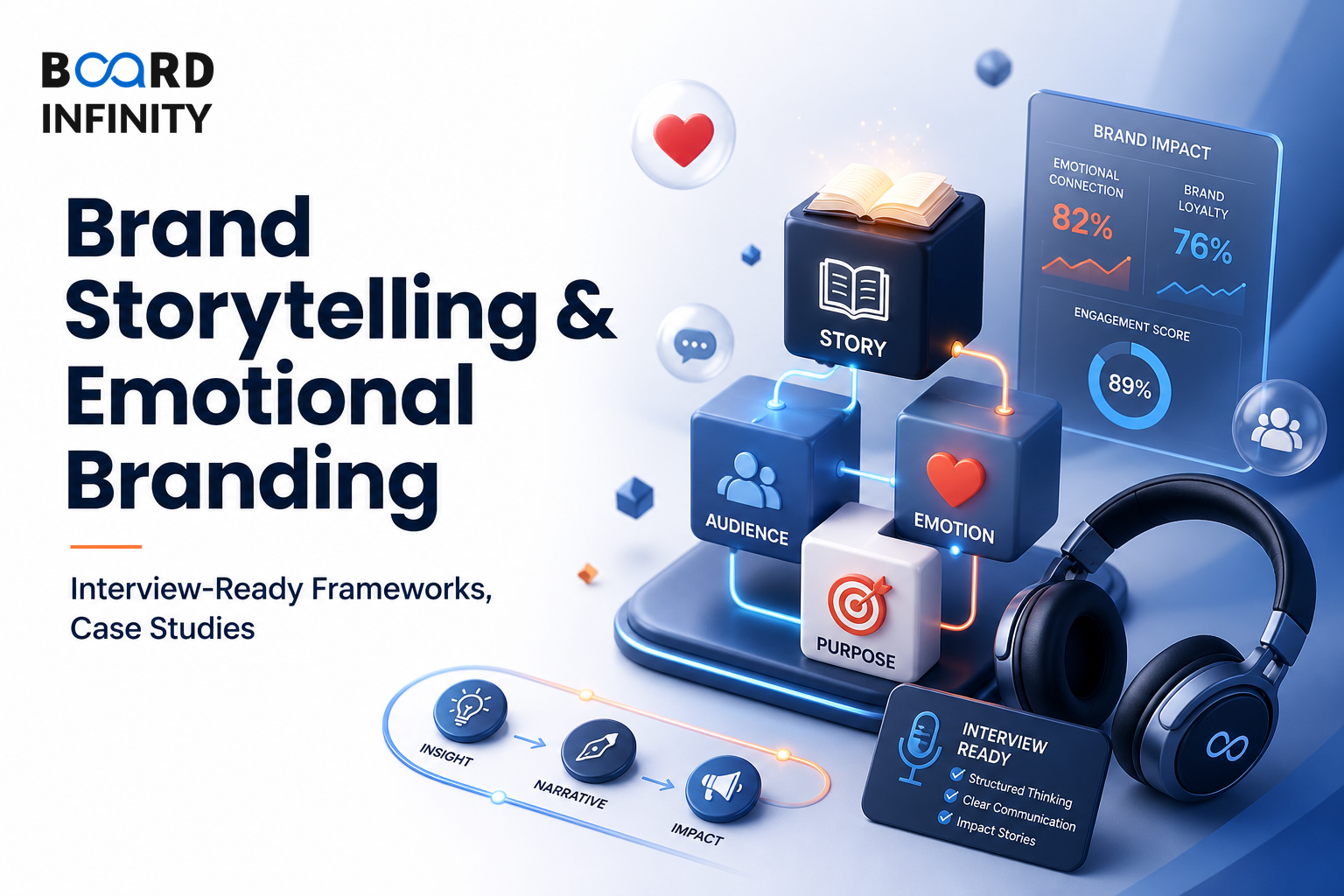
A customer is not choosing between two ads - she is choosing which version of herself she wants to believe in. That is why a jewellery film about a daughter’s wedding, a sports ad about grit, or a tea campaign about civic courage can sell more than a product feature ever could.
- Brand storytelling uses narrative - character, tension, choice and resolution - to make a brand meaning memorable.
- Emotional branding builds preference by linking the brand to felt needs such as belonging, pride, security, freedom or aspiration.
- The strongest stories start with brand truth, not a random emotional theme; emotion without proof feels manipulative.
- A good story has four parts: human tension, brand role, emotional payoff and repeatable brand assets.
- Use the ladder: product proof → values → human tension → emotional reward → shared identity.
- Measure storytelling through recall, emotion association, consideration lift, preference, advocacy and sales-linked brand lift.
- Interview-safe line: “Emotional branding works when the emotion is distinctive, credible for the brand, and connected to a business action.”
Brand storytelling is not “making an ad emotional.” It is the deliberate conversion of a brand’s truth into a human story that people remember, retell and use while choosing.
Core Explanation: How Story Becomes Brand Preference
The big idea: people remember brands through meaning structures, not isolated claims. A story gives the brain a sequence - problem, tension, choice, resolution - and emotion gives that sequence weight.
That is why a soap brand does not only say “moisturising.” It may tell a story about real beauty, self-acceptance and care. The product still matters, but the brand becomes easier to retrieve in a buying moment because it owns a feeling.
The Four Building Blocks of Brand Storytelling
A useful test: if the story could be used by any competitor tomorrow, it is not yet a brand story. It is only a category emotion.
Brand Storytelling vs Emotional Branding
They are related, but not identical. Storytelling is the method; emotional branding is the strategic outcome.
The Strategic Sweet Spot
A brand needs both rational credibility and emotional resonance. Too much proof without emotion becomes forgettable. Too much emotion without proof becomes hollow.
Dove’s long-running Real Beauty platform links the brand to self-esteem and more inclusive beauty representation. Its primary driver is a clear emotional territory - women questioning narrow beauty standards - supported by product fit in personal care, consistent campaign assets, PR, research-backed messaging and years of repetition. The strategic so what: emotional branding compounds when the same meaning is reinforced across touchpoints, not restarted every campaign.
Definitions You Can Say in One Breath
AMA: “A brand is a name, term, design, symbol or any other feature that identifies one seller’s goods or service as distinct from those of other sellers.”
- Brand storytelling: the structured use of narrative to make a brand’s meaning memorable, distinctive and worth retelling.
- Emotional branding: building brand preference by attaching the brand to a valued feeling, identity or relationship in the customer’s life.
- Brand truth: the credible reason a brand has permission to own a story or emotion.
- Emotional payoff: the feeling the customer receives after engaging with the brand - pride, reassurance, belonging, hope or control.
How to Measure Brand Storytelling and Emotional Branding
Do not measure emotion only by views or likes. A viral emotional film can still fail if people remember the plot but forget the brand.
Case Study: Tanishq and Relationship-Led Jewellery Storytelling
Tanishq built emotional distinctiveness by framing jewellery as a marker of progressive relationships, trust and life moments - not merely ornamentation.

Situation: Jewellery in India is a deeply emotional category, but it is also a high-trust purchase shaped by family, weddings, purity concerns, tradition and status. Many brands can show beautiful jewellery; fewer can own a progressive relationship narrative while still feeling credible in a trust-heavy category.
The move: Tanishq’s storytelling has repeatedly placed jewellery inside emotionally charged Indian life moments - weddings, family acceptance, self-expression, womanhood and changing social norms. The brand’s primary driver is its shift from “gold as possession” to “jewellery as a symbol of modern relationships.” Supporting drivers include the Tata trust halo, retail experience, design variety, category fit with rituals and consistent use of warm, cinematic storytelling.
The outcome or lesson: The lesson is not that “emotional ads work.” The lesson is that emotional branding works when the chosen emotion is believable for the category, distinctive for the brand and supported by product, trust and experience.
How AI Changes Brand Storytelling & Emotional Branding
AI does not replace brand judgment; it expands how fast marketers can find, test and adapt emotional meaning.
- Emotion and cultural listening: AI tools can cluster social comments, reviews and search queries to detect emerging anxieties, aspirations and language patterns in a segment. For example, a beauty brand can separate “confidence,” “skin safety” and “social comparison” conversations instead of treating all engagement as one bucket.
- Rapid story testing: Generative AI can create alternative story territories, scripts, moodboards and message variants for early testing. The marketer’s job is to reject generic emotion and keep only routes that fit brand truth.
- Personalised creative at scale: AI can adapt a core story into regional languages, creator briefs, short-form hooks, email subject lines and app notifications while preserving the same emotional platform.
Use Perplexity to gather recent campaigns of a brand, then use ChatGPT to classify each campaign by human tension, brand role, emotional payoff and proof. Finally, ask: “Which emotion is most ownable for this brand, and what evidence supports it?”
Interview Relevance
“Pick an Indian brand and explain how it uses storytelling or emotional branding. How would you judge whether it is working?”
Use this sentence to sound mature: “The story should not be judged only by how touching it is; it should be judged by whether it builds a distinctive memory structure for the brand.”
The biggest mistake is equating emotional branding with tear-jerker advertising. That costs candidates because it ignores brand fit, proof and business impact. One-line fix: always connect the emotion to a credible brand truth and a measurable customer action.
What to Revise Next
After this, revise Rebranding & Brand Revival - When and How to understand how brand meaning is changed or refreshed, then move to Measuring Brand Health & Brand Valuation to quantify whether the story is building equity.