
Branding in the AI Era: Distinctive Assets & Share of AI Answers
If ChatGPT names three EV scooters and your brand is not in the answer, does your brand exist for that customer? Branding used to fight for shelf space and memory space; now it also fights for answer space inside AI tools that compress the buyer's shortlist before the buyer even reaches Google.
- Branding in the AI era means building both mental availability in people and machine availability in AI-generated answers.
- Distinctive assets are recognisable brand cues - colour, sound, character, shape, tagline or style - that trigger the brand without needing the logo.
- Differentiation says why choose us; distinctiveness makes people notice, remember and find you quickly.
- Share of AI Answers is the percentage of relevant AI prompts where your brand is mentioned, recommended or cited.
- The best brands codify assets, repeat them consistently, and make their facts easy for answer engines to retrieve from credible sources.
- Measure both sides: asset fame, asset uniqueness, linkage, share of search, share of AI answers and answer accuracy.
- Interview answer shortcut: define the shift, explain human memory plus AI retrieval, give metrics, then use a real brand example.
The big picture is simple: a brand now has to be easy for a human brain to recognise and easy for an AI system to retrieve correctly. Distinctive assets do the first job; structured, credible, consistent brand information does the second.
The Core Idea: Mental Availability Plus Machine Availability
Mental availability is the chance that a buyer thinks of your brand in a buying situation. For example, when someone thinks of "quick snack on a road trip" and instantly recalls a familiar pack, colour or jingle, the brand has mental availability.
Machine availability is the chance that an AI tool, answer engine, marketplace algorithm or search system retrieves your brand correctly for a relevant question. For example, "best running shoes for beginners" or "reliable electric scooter in India" may produce a short AI-generated shortlist. If your brand is absent there, you may never enter the customer's consideration set.
The bridge between the two is distinctive assets: recognisable, repeatable brand cues that make the brand easier to notice, encode and recall. Think of Mastercard's sonic logo, McDonald's golden arches, Amul's topical illustration style, Nike's swoosh, Apple's minimalist product language or Cadbury's purple. These assets work because they are consistently attached to the brand over time.
Mastercard built a short sonic identity that plays across advertising, point-of-sale interactions and digital payment moments. The primary driver is repeated audio linkage at moments of transaction, supported by global consistency and use across digital channels. The strategic so what: in low-attention environments, a brand sound can perform the same memory job as a logo.
Distinctive Assets Are Not the Same as Differentiation
This is where many candidates get confused. Differentiation is about perceived meaningful difference - what makes the brand worth choosing. Distinctiveness is about recognisability - what makes the brand easy to identify.
A brand can be distinctive without being deeply differentiated. Many soft drinks, banks, food delivery apps and telecom brands sell broadly similar benefits, but the ones with stronger colours, mascots, sounds, icons, packaging and tone are easier to remember at the moment of choice.
The AI-Era Branding Playbook
A useful brand manager does not say, "Let us do AI branding." They translate the shift into operating actions. Use this five-step playbook.
Definitions You Can Say in an Interview
Kotler and Keller: "Branding is endowing products and services with the power of a brand."
Keller: "Brand equity is the differential effect that brand knowledge has on consumer response to the marketing of that brand."
Distinctive assets: Non-name brand cues that trigger brand recognition without needing the logo.
Share of AI Answers: The share of relevant AI-generated answers in which a brand is mentioned, recommended or cited.
Metrics: How to Measure Distinctiveness and AI Visibility
If you discuss AI-era branding without measures, the answer sounds like opinion. Use these six metrics to make it managerial.
Use one warning with these metrics: do not measure only owned prompts like "tell me about Brand X." The real battle is generic buyer prompts such as "best budget smartwatches for fitness", "safe SUV for family in India" or "CRM software for a small business".
Case Study: Ather Energy and the Two Fronts of Modern Branding
Ather Energy shows how a young Indian mobility brand can build recognisable cues while making complex product information easier for customers and answer systems to understand.
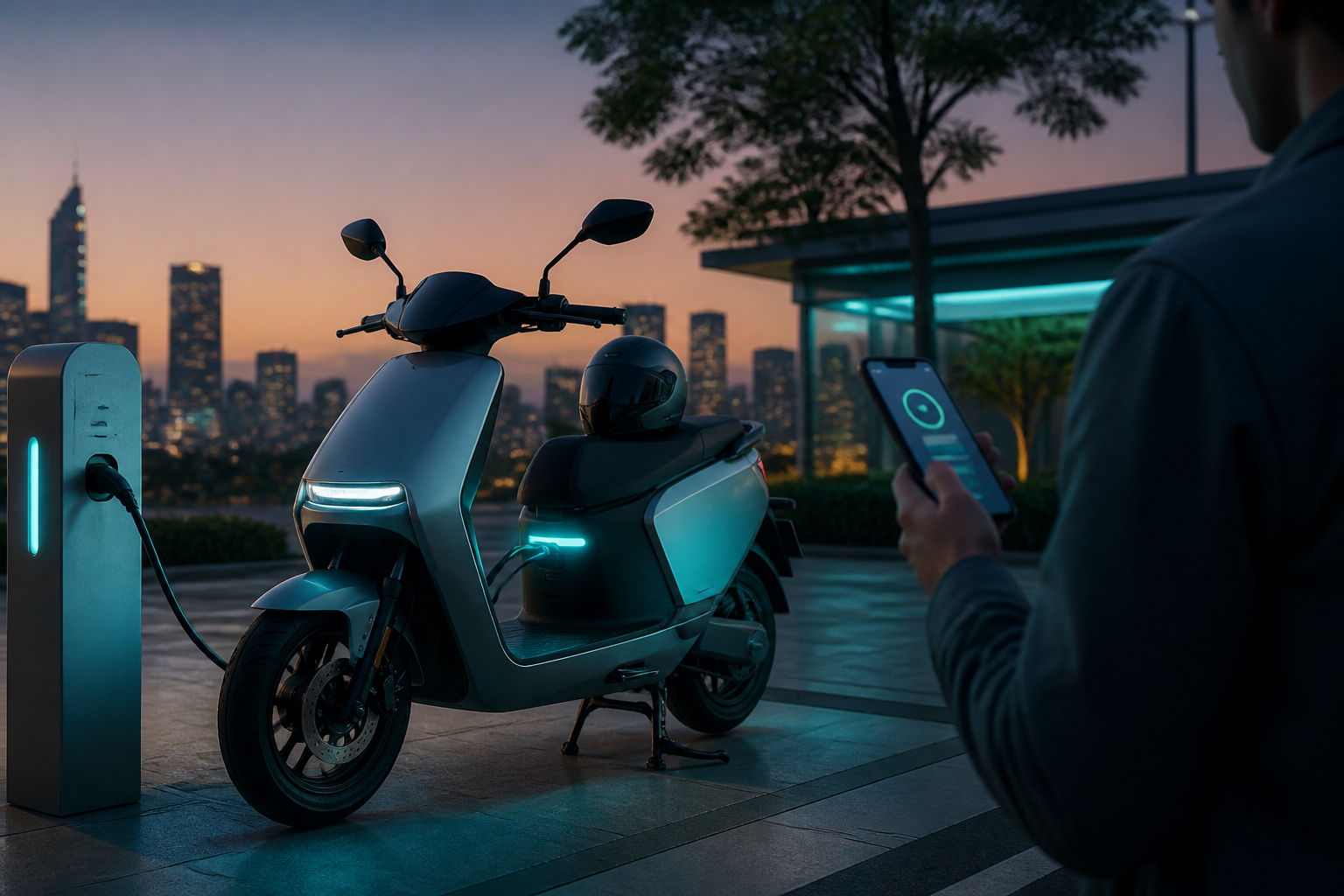
Situation: India's electric two-wheeler market became crowded with legacy players, start-ups and price-led alternatives. For many buyers, the category carried practical doubts: real-world range, charging access, battery life, service support and resale confidence.
The move: Ather did not rely only on advertising. It built a technology-led brand system around its scooter design, digital dashboard experience, Ather Grid charging ecosystem, experience-led retail and educational communication on EV ownership. The primary driver was product and ecosystem credibility; supporting drivers were coherent visual cues, owned experience centres, owner communities, comparison-led content and clear explanations of charging and performance.
The lesson: In AI-era branding, a considered-purchase brand must win both trust and retrievability. The brand should be distinctive enough for humans to recall and structured enough for AI systems, reviewers and comparison platforms to describe accurately.
The strategic so what: for complex categories like EVs, branding is not just emotional salience. It is also evidence architecture - the set of facts, sources and signals that help customers and AI systems explain why the brand belongs in the shortlist.
How AI Changes Branding in the AI Era
1. AI compresses the consideration set. Traditional search gave buyers ten blue links and many ads. AI answers often provide a short synthesis: three recommended brands, a comparison table or one "best for" answer. This raises the value of being mentioned early and accurately.
2. Brand facts must become machine-readable. AI tools pull from product pages, reviews, marketplaces, news, videos, forums, structured data and third-party explanations. A brand with inconsistent pricing, outdated specs, unclear FAQs or thin product content can be misrepresented or ignored.
3. AI creative can dilute distinctiveness. Generative AI makes it easy to produce polished but generic ads. The risk is sameness: the same neon gradients, smiling users, smooth copy and vague benefits. Strong brands will lock their codes - colour, typography, sonic cues, tone, characters and product angles - before scaling AI-generated creative.
Use Perplexity or ChatGPT to test 20 generic category prompts for a company you are preparing on, such as "best EV scooter for city commute in India" or "top premium coffee chains for work meetings". Then load the company website, annual report, product pages and 3-5 credible reviews into NotebookLM and ask: "Where is the brand absent, misdescribed or weakly evidenced in AI-style answers?"
Interview Relevance
"How is branding changing because of AI, and what should a brand manager do to protect or grow brand equity?"
The strongest answer uses this line: "AI does not replace brand building; it adds a new distribution layer for brand meaning." Then prove it with one human-memory metric and one AI-answer metric.
The biggest mistake is treating AI-era branding as only SEO or prompt engineering. That costs candidates because it ignores the real brand asset: long-term memory structures in buyers. The fix: always pair distinctive assets with answer visibility - people must recognise you and AI systems must retrieve you.
What to Revise Next
Now connect this concept to the actual brand manager job. Revise The Brand Manager Role: What the Job Is & How to Prep for It to understand ownership, KPIs and daily decisions. Then move to Case Study: Building Iconic Brands - Amul, Tata, Nike & Apple to see how distinctive assets become brand equity over decades.