
Building an Integrated Digital Marketing Plan: Interview-Ready Framework
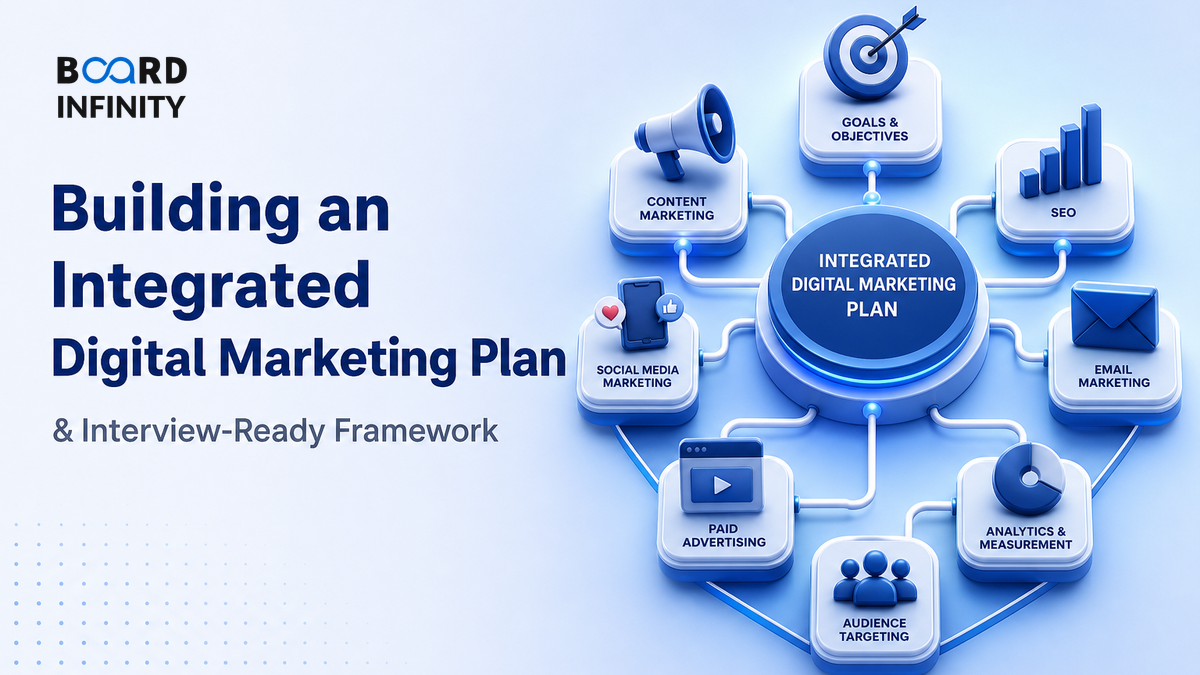
If your customer discovers a snack brand on Instagram, checks reviews on Amazon, gets a WhatsApp offer, and finally buys from the brand website - which channel “caused” the sale? That question is exactly why a digital marketing plan cannot be a list of platforms; it must be an integrated system where every touchpoint has a role.
- An integrated digital marketing plan connects business objective, target segment, proposition, channel roles, content, budget and measurement.
- Think in journeys, not channels: awareness, consideration, conversion, retention and advocacy need different messages and KPIs.
- The best plans separate demand creation from demand capture; social may create interest, search and marketplaces may harvest it.
- Use a full-funnel scorecard: CTR, CVR, CAC, ROAS, LTV:CAC and repeat purchase rate tell different parts of the truth.
- Integration means consistency of promise, sequencing of touchpoints and shared measurement - not posting the same creative everywhere.
- The most interview-ready structure is: objective - audience - insight - proposition - funnel strategy - channel mix - content calendar - metrics - optimization.
Big Picture: Build a System, Not a Channel Calendar
A strong digital plan starts with the business problem and ends with a learning loop. Channels sit in the middle - important, but never the starting point.
Core Explanation: The 8-Part Integrated Digital Plan
An integrated digital marketing plan is a coordinated blueprint for using digital touchpoints to achieve a business goal across the customer journey. The word integrated is the key: paid ads, SEO, influencers, website, CRM, marketplaces and analytics must reinforce one another instead of behaving like separate mini-campaigns.
The Channel Role Matrix: What Each Channel Is Really For
Most weak answers say, “We will use Instagram, SEO, influencers and email.” A stronger answer assigns each channel a strategic role based on two questions: does the customer already have intent, and does the brand own the relationship?
The Funnel View: Match Message, Channel and Metric
The funnel prevents a classic planning error: judging every channel by last-click sales. Awareness channels may look inefficient on immediate ROAS but create search demand later; retention channels may look small but drive profitability.
Use these measures as directional guardrails. Benchmarks vary sharply by category, price point, creative quality and season, so the strongest comparison is against your own historical baseline and unit economics.
Definitions You Can Say Cleanly
Kotler and Armstrong define IMC as carefully integrating and coordinating the company’s many communications channels to deliver a clear, consistent, compelling message.
Digital marketing plan: a structured plan to acquire, convert and retain customers through coordinated digital channels and measurable campaigns.
Customer journey: the sequence of touchpoints a customer experiences from problem recognition to purchase, usage and advocacy.
Performance marketing: paid digital marketing optimized against measurable actions such as clicks, leads, purchases, installs or subscriptions.
Owned media: digital assets the brand controls directly, such as website, app, blog, email list, WhatsApp list and community.
Case Study: The Whole Truth’s Integrated Digital Playbook
The Whole Truth built an Indian clean-label food brand by using education-led content, transparent product storytelling and D2C-first digital journeys to reduce trust friction.
Situation: Packaged snacks and protein products in India face a trust problem. Consumers want convenience and health, but many are skeptical of ingredient claims, hidden sugar, artificial additives and celebrity-led promises.
The move: The Whole Truth made “truth” the core proposition and carried it across touchpoints: founder-led explanations, ingredient transparency, educational content, product pages, email journeys, community-led trust and availability across D2C plus relevant commerce platforms. The primary driver was credibility through transparent positioning; supporting drivers included clean packaging cues, content that explains trade-offs, repeatable product formats and digital distribution that captures both discovery and purchase intent.
Outcome or lesson: The case shows why integration matters. If the same brand ran only discount ads, it would weaken its trust proposition; if it ran only educational content, it might not convert demand. The power comes from aligning proposition, content, channel roles and retention economics.
How AI Changes Building an Integrated Digital Marketing Plan
AI does not remove the need for strategy; it raises the quality bar for execution. In 2026, the advantage goes to marketers who combine human insight with faster experimentation.
Use NotebookLM or ChatGPT to upload a company website, recent ads, marketplace reviews and annual report extracts. Ask: “Map this brand’s digital funnel, identify channel roles, infer weak points, and suggest 5 interview questions on its digital plan.” Then verify every claim manually before using it.
Interview Relevance
“Suppose you are launching a new D2C healthy snack brand in India. Build an integrated digital marketing plan for the first 90 days.”
Say “channel role” before “channel name.” It instantly signals that you understand integration, not just platform tactics.
Common Mistake
The mistake that costs candidates is giving a platform checklist: “Instagram, SEO, influencers, email, Google Ads.” It fails because there is no objective, no customer journey, no channel role and no measurement logic. Fix it in one line: “I will first map the funnel, then assign each channel a job and KPI.”
What to Revise Next
Next, revise Case Study: A D2C Brand's End-to-End Digital Playbook. This will help you move from knowing the framework to applying it like a marketer - from proposition and content to acquisition, conversion, retention and unit economics.
Social Media Marketing Interview Guide: Meta, Instagram, LinkedIn & YouTube