
Content Marketing Strategy, Formats & Distribution - Interview-Ready Framework
At lunch, someone searches “how to start investing safely” and spends 20 minutes on an educational guide before ever opening a brokerage account. No salesman called, no banner ad interrupted them, and yet a brand quietly moved from invisible to trusted.
- Content marketing uses useful, relevant content to attract a defined audience and move them toward profitable action.
- The core strategy is not “post more” - it is audience problem → content promise → format → distribution → conversion → learning loop.
- Formats should match funnel stage: explainers for awareness, guides for consideration, case studies and demos for conversion, communities for retention.
- Distribution has three engines: owned channels, earned reach and paid amplification.
- Good content has a business job: reduce acquisition cost, improve trust, increase qualified leads, support sales, or improve retention.
- Measure content by both audience metrics and commercial metrics - traffic alone is not success.
- The biggest trap is confusing content creation with content strategy.
Big Picture: Content Marketing Is an Engine, Not a Calendar
Think of content marketing as a compounding trust engine. Every article, video, tool, guide or newsletter should solve a real audience problem, travel through the right channel, and create a measurable next action.
The Core Explanation: Strategy First, Formats Second, Distribution Always
The big idea is simple: content marketing earns attention by being useful before being promotional. A brand teaches, entertains, simplifies or helps the customer decide - then uses that trust to create demand.
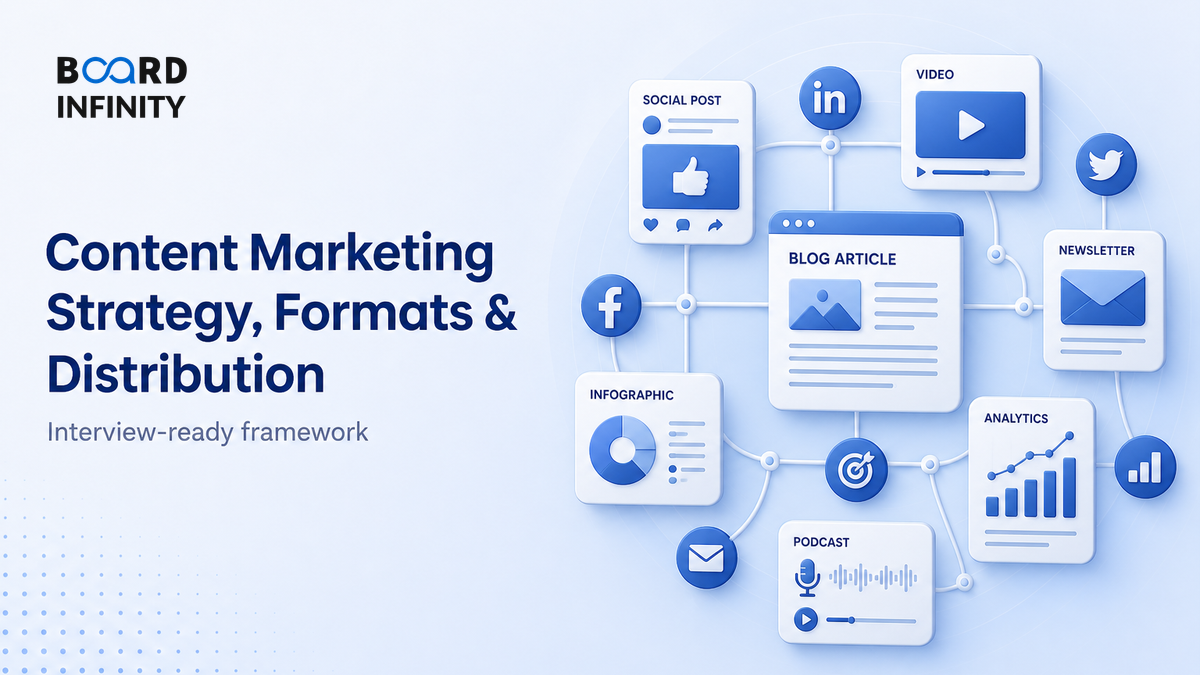
Content strategy is the plan for what to say, to whom, in which format, on which channel, and how success will be measured. Content formats are the vehicles - blogs, reels, webinars, tools, newsletters, case studies, podcasts. Distribution is how the content reaches the right audience.
The Content Marketing Funnel
Content should not do the same job at every stage. A beginner-friendly explainer builds awareness; a comparison guide supports evaluation; a case study or demo helps conversion; a community or newsletter supports loyalty.
Choosing the Right Content Format
Do not pick a format because it is trendy. Pick it because it matches the customer decision stage, the complexity of the message and the brand’s ability to produce it consistently.
Distribution: The Part Candidates Forget
A content asset that is not distributed is a well-written document sitting in a drawer. Strong marketers design distribution before production: search demand, platform behaviour, email or WhatsApp journeys, influencer amplification, sales enablement and paid retargeting.
Duolingo’s short-form social content became memorable because it adapted to platform culture rather than copying ad scripts. The primary driver was a distinctive brand character used consistently; supporting drivers included fast trend response, creator-style editing and a product category that naturally invites humour around learning. The strategic lesson: content can build salience when the format fits the platform’s native behaviour.
Definitions You Can Say Clearly
Content marketing: Creating, curating, distributing and amplifying useful content for a defined audience to create engagement and profitable action.
This follows the widely used content marketing framing popularised by Content Marketing Institute and Kotler, Kartajaya and Setiawan’s discussion of content in digital marketing.
Content Marketing Metrics: What to Track
Benchmarks vary by industry, funnel stage and channel, so use these as interview heuristics rather than universal laws. The sharper answer is always: compare against the brand’s own baseline and segment by funnel stage.
Mini Case Study: Zerodha Varsity and Trust Before Transaction
Zerodha built free investor education through Varsity to reduce fear, improve financial literacy and earn trust before users chose a brokerage platform.

Situation: Stock market investing can feel risky and technical for first-time Indian retail investors. A brokerage brand asking users to open an account faces a trust barrier: “Do I understand this enough to begin?”
The move: Zerodha created Varsity as a free, structured learning destination covering investing and trading concepts in simple language. The primary driver was education before selling. Supporting drivers included evergreen modules, product-adjacent relevance, plain explanations, mobile-friendly access, and a broader ecosystem that encouraged self-directed learning.
Outcome or lesson: Varsity does not behave like a one-off campaign. It behaves like a compounding owned media asset: it attracts search-led learners, builds category trust, supports customer readiness and strengthens Zerodha’s position as an investor-first brand.
Takeaway: The win was not “Zerodha wrote blogs.” The win was a strategic fit between a complex category, a high-trust customer need, and a durable owned content asset.
How AI Changes Content Marketing
AI changes content marketing most when it improves decision quality, distribution fit and speed - not when it floods the internet with generic posts.
- AI search and answer engines change discovery. Content now needs to be useful for Google search, featured snippets and AI answer engines. Brands must write with clear entities, credible sources, structured FAQs and quotable explanations so AI systems can understand and cite them.
- Personalisation becomes cheaper. Marketers can adapt one core idea into role-specific, industry-specific or funnel-stage-specific versions. For example, a fintech guide can be rewritten for first-time investors, salaried professionals and small business owners without losing the central message.
- Content operations become faster, but quality control becomes more important. AI can help with research summaries, outlines, repurposing, headline variants and content audits. Human judgment is still needed for positioning, customer insight, compliance, originality and brand voice.
Use NotebookLM for revision: upload a company website, annual report or campaign pages, then ask, “What content pillars does this brand use, which funnel stage does each serve, and what interview questions could be asked?” Cross-check all claims before using them in an answer.
Interview Relevance
“Suppose you are launching content marketing for a new Indian D2C skincare brand. What strategy, formats and distribution channels would you use?”
In interviews, always connect content to a funnel stage and a metric. “We will make reels” sounds tactical; “We will use dermatologist-led reels for awareness and measure qualified site visits” sounds managerial.
Common Mistake
The biggest mistake is saying content marketing means “creating engaging posts.” That answer ignores audience insight, distribution and business outcomes. The fix: explain it as a strategy engine - audience problem, content pillar, format, channel, conversion goal and metric.
What to Revise Next
Once content strategy is clear, revise the direct channels that turn attention into relationships. Move next to Email Marketing & Marketing Automation for lifecycle nurturing, then WhatsApp & Conversational Marketing: India's Direct Channel for high-intent, permission-led engagement in the Indian market.
Social Media Marketing Interview Guide: Meta, Instagram, LinkedIn & YouTube