
Centralised versus Decentralised Distribution
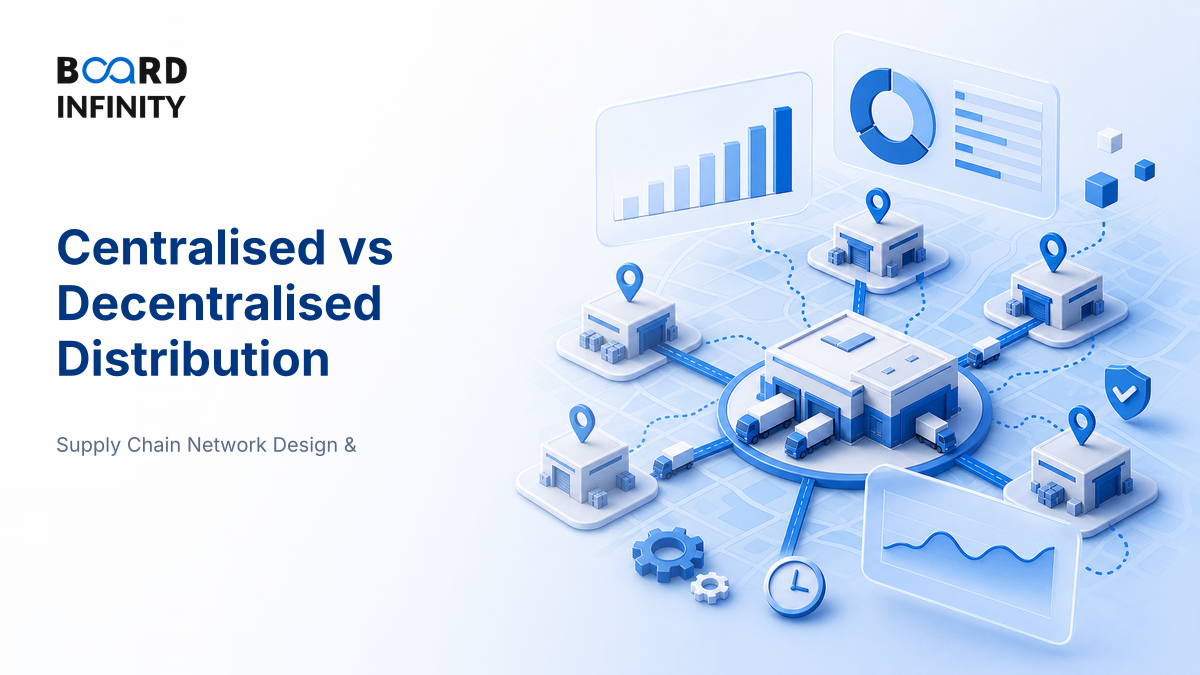
A shampoo bottle ordered from Jaipur may travel from one national warehouse, while a grocery basket in Gurgaon may be picked from a dark store two kilometres away. Same country, same customer expectation of speed - completely different distribution logic.
Centralised versus decentralised distribution is not a debate about “big warehouse good” or “local warehouse good”. It is a trade-off between inventory pooling, transportation cost, speed, control, resilience, and the customer promise.
- Centralised distribution means fewer, larger nodes serving many markets; it improves inventory pooling and control.
- Decentralised distribution means more local nodes closer to demand; it improves speed and responsiveness.
- The core trade-off is simple: centralisation lowers inventory duplication, while decentralisation lowers last-mile distance and lead time.
- Use centralised networks for high-value, slow-moving, uncertain-demand products; use decentralised networks for fast-moving, time-sensitive products.
- Never compare networks only on warehouse cost. Compare total landed cost at the same service level.
- The best real networks are often hybrid: central DCs for pooling, regional nodes for speed, and local fulfilment points for urgent demand.
Big Picture: The Network Choice Is a Service-Cost Trade-Off
Distribution design decides where inventory sits before it reaches the customer. Fewer nodes create scale and risk pooling; more nodes create proximity and faster response. The right answer depends on what the business has promised the customer.
Core Explanation: How to Choose Between Centralised and Decentralised Distribution
Think of the decision as a funnel. You start with customer requirements, filter through product economics and demand patterns, then choose a network configuration that delivers the promise profitably.
Centralised Distribution: Fewer Nodes, More Pooling
In a centralised network, inventory is stored in one or a few large facilities and shipped outward to customers, stores, or smaller fulfilment points. This works well when demand is uncertain, product variety is high, or inventory is expensive to duplicate.
The main advantage is risk pooling. If demand in one city is lower than expected and another city is higher, a central pool can absorb both fluctuations better than separate city-level stock pools.
Assume four regions each need 100 units of safety stock if served separately. A decentralised design holds 4 x 100 = 400 units. If demand is similar and independent, a centralised pool can often need roughly 100 x √4 = 200 units by the square-root logic. The saving is inventory, not magic - it comes from combining uncertain demand.
But centralisation is not free. It can increase outbound distance, delivery time, and dependency on a single facility. If a customer expects same-day service, a central warehouse 1,000 km away may be cheap on paper and weak in reality.
Decentralised Distribution: More Nodes, More Responsiveness
In a decentralised network, inventory is placed closer to customers through regional warehouses, city fulfilment centres, dark stores, dealer depots, or store-level stock. This improves delivery speed and local availability.
The cost is duplication. More nodes usually mean more safety stock, more replenishment complexity, more facility fixed cost, and a harder planning problem. Decentralisation makes sense only when speed, density, freshness, or local service advantage pays for that complexity.
The 2x2 Decision Matrix
The fastest interview-ready way to decide is to map products on two axes: demand density and service urgency. This avoids generic answers and forces a business-backed recommendation.
High urgency plus high density supports decentralisation because local nodes get enough orders to justify their cost. Low urgency plus low density usually favours centralisation because stocking everywhere would create idle inventory.
Key Metrics to Compare Both Networks
Do not evaluate centralised versus decentralised distribution on warehouse rent alone. Compare both designs at the same service promise using total cost and service metrics.
For a deeper next step on how inventory policy changes once the network is chosen, revise setting inventory policy for a multi-product business.
Definitions You Can Say in One Breath
- Centralised distribution: A network where inventory is pooled in a few large facilities serving many regions.
- Decentralised distribution: A network where inventory is held in many local facilities closer to customers.
- Risk pooling: Combining uncertain demand across locations to reduce safety stock needed for a target service level.
- Distribution node: Any facility that stores, sorts, fulfils, or transfers inventory in the network.
- Echelon: One stage of inventory holding or movement in a multi-level supply chain.
Case Study: Blinkit and the Logic of Decentralised Quick-Commerce Distribution
Blinkit shows why ultra-fast delivery needs inventory close to demand, even when that creates more local stock complexity.

Quick-commerce customers do not buy only a product; they buy immediacy. A central warehouse outside the city may be efficient for weekly grocery deliveries, but it cannot reliably support a near-immediate convenience promise across dense urban pockets.
Blinkit’s operating logic is therefore decentralised: stock frequently ordered items closer to customers in compact local fulfilment locations, replenish those nodes from upstream supply, and use routing and picking discipline to compress delivery time.
The primary driver is proximity to high-frequency urban demand. The supporting drivers are tight SKU selection, demand forecasting by locality, fast picking processes, replenishment discipline, and rider-route orchestration. Without those supporting systems, decentralisation becomes expensive chaos.
The lesson is not “decentralised is better”. The lesson is sharper: decentralisation is justified when the service promise creates enough demand density and customer value to pay for the extra nodes, stock, and coordination.
Hybrid Networks: The Most Common Real-World Answer
Many companies do not choose pure centralisation or pure decentralisation. They use a hybrid structure: central nodes for inventory pooling, regional nodes for availability, and local fulfilment points for speed.
For example, a consumer electronics brand may centralise slow-moving premium models, keep fast-moving accessories at regional hubs, and use stores for urgent replacement demand. The logic is not one network for all products; it is differentiated distribution by product and customer segment.
How AI Changes Centralised versus Decentralised Distribution
AI makes this decision more dynamic. Earlier, companies designed a network and reviewed it periodically. Now, demand signals, fulfilment costs, and service exceptions can be monitored continuously.
- AI demand sensing: Machine learning can detect locality-level demand shifts, helping decide which SKUs should move from central pools into regional or local nodes.
- Dynamic inventory placement: Algorithms can recommend where inventory should sit before demand arrives, especially for seasonal, promotional, or fast-moving products.
- Route and capacity optimisation: AI can simulate last-mile routes, node congestion, and replenishment frequency to test whether another local node improves service enough to justify cost.
A practical student workflow: load a company’s annual report, store footprint notes, and customer promise into NotebookLM or Claude, then ask: “Which products should be centralised, regionalised, or locally stocked, and what assumptions drive the answer?” For the inventory side of this, revise using AI for inventory optimisation and replenishment.
Interview Relevance
“A retail company wants to improve delivery speed in South India. Should it centralise inventory in one large warehouse or decentralise into multiple regional warehouses?”
Use the phrase “same service level comparison”. It signals that you understand network design is not about cheapest warehouse cost, but cheapest reliable fulfilment.
Common Mistake
The mistake is saying “centralised is cheaper” or “decentralised is faster” as a blanket rule. It costs candidates because it ignores product type, demand density, and service promise. Fix it in one line: “I would compare both networks on total cost to serve at the same customer SLA.”