
Applied: Choosing Warehouse Locations for National Coverage
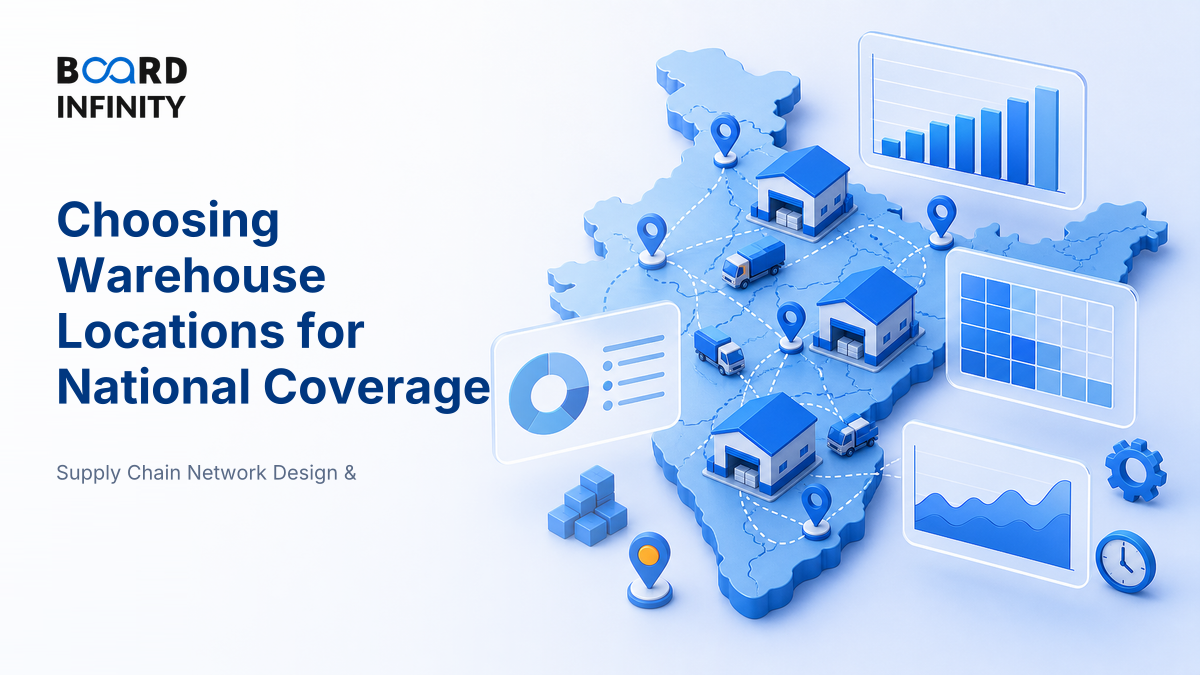
One warehouse in the middle of the country looks elegant on a map - until a customer in Guwahati waits five days, a Mumbai order ships past cheaper capacity, and your transport bill quietly eats the margin. Add two regional warehouses and delivery improves, but inventory, rent and coordination suddenly multiply.
- Warehouse location is a network decision, not a real-estate decision: pick nodes that meet service promises at the lowest total landed cost.
- The core trade-off is transport cost and delivery speed versus fixed cost and inventory duplication.
- Start with demand heatmaps by pin code or zone, then overlay transport lanes, customer SLAs, product constraints and risk.
- For national coverage, common designs are one central DC, zonal DCs, hub-and-spoke, city fulfilment nodes, or hybrid 3PL networks.
- Use total cost-to-serve, service coverage, average delivery lead time, OTIF, inventory turns and capacity utilisation to compare options.
- The best answer is rarely “put it in Nagpur because it is central”; the best answer explains why a location fits demand, service, cost and risk.
Big Picture: Warehouse Location Is a Four-Way Balance
A warehouse exists to place inventory closer to demand, but every extra node creates extra fixed cost, stock buffers and managerial complexity. The practical question is: which network gives enough national coverage without overbuilding the network?
Core Explanation: How to Choose Warehouse Locations for National Coverage
The simplest mental model is this: choose warehouse locations by minimising total network cost subject to a target service level. If the business promises two-day delivery to most metros, the network must be designed backwards from that promise. If the promise is low-cost bulk delivery, fewer nodes may be better.
The central trade-off: one big warehouse versus many regional warehouses
A single national distribution centre gives pooling benefits: lower safety stock, simpler control and better utilisation. Regional warehouses cut last-mile and line-haul distance, improve delivery speed, and reduce service failures in far markets. The right answer depends on product value, demand density, delivery promise and transport economics.
A five-step framework to locate warehouses
Do not separate warehouse location from inventory policy. A second warehouse improves reach only if stock is positioned intelligently; otherwise it becomes an expensive empty box. If you need a quick refresher, revise setting inventory policy for a multi-product business before solving a location case.
Product type changes the location logic
The same map can produce different answers for different products. A mobile phone, a sofa, fresh milk and spare parts do not need the same warehouse network.
Metrics to compare warehouse-location options
Use metrics that force the trade-off onto paper. A location plan is weak if it says “better coverage” without quantifying cost, speed and reliability.
Worked example: central warehouse or two regional warehouses?
Assume a company serves 100,000 orders per month across North and South India. It is comparing two hypothetical options.
In this simplified example, two regional DCs save ₹9 lakh per month and improve service. But the answer is not automatically “open two warehouses”. You would still test demand seasonality, stock duplication, vendor replenishment, management bandwidth and whether the second DC can maintain utilisation.
Definitions
- Warehouse location: the choice of storage and fulfilment nodes that serve demand at target service and minimum total cost.
- Service radius: the geography a warehouse can serve within a defined time, cost or reliability threshold.
- Total landed cost: the full cost of moving, storing, handling and financing inventory until it reaches the customer.
- Network design: the configuration of facilities, flows and capacities across a supply chain.
- Center of gravity: a location estimate based on weighted demand points, useful as a starting point, not a final answer.
Wakefit: Building Coverage for Bulky Products
Wakefit shows why bulky D2C categories need warehouse decisions that balance freight cost, delivery speed, installation experience and inventory discipline.

Wakefit began as a direct-to-consumer sleep and home-solutions brand, where the product itself creates a logistics problem. Mattresses and furniture are bulky, damage-prone and expensive to ship over long distances. A purely centralised warehouse might simplify inventory, but it can make delivery slower and freight-heavy as demand spreads across metros and tier-2 cities.
The strategic move is to think in clusters: place fulfilment capacity closer to large demand regions, use line-haul movement into regional nodes, and connect online demand with offline experience points. The primary driver is bulky-product transport economics: every kilometre and every handling touch matters. Supporting drivers include better delivery reliability, easier reverse logistics, improved installation coordination and faster customer experience in dense markets.
The lesson for interviews: a warehouse network is “good” only when it fits the category. Wakefit-type products justify more regional thinking than small, high-value electronics because the freight and damage economics are fundamentally different.
How AI Changes Warehouse Location
AI does not replace network design judgement, but it makes the analysis faster, more granular and more dynamic.
Student workflow: use ChatGPT or Claude to create a first-pass warehouse-location model. Give it a table of demand by city, current delivery time, freight cost per order, product constraints and SLA. Ask it to generate three network options, the assumptions behind each, and the interview risks in each recommendation. Then validate the logic yourself - AI can structure the problem, but it cannot know your company’s real constraints unless you provide them.
Interview Relevance
“Our e-commerce business wants national coverage from its current West India warehouse. Orders are growing in North and South India. How would you decide whether to open new warehouses, and where?”
Always separate where demand is from where inventory should sit. High demand in a city may justify faster transport lanes before it justifies a full warehouse.
Common Mistake
The costly mistake is choosing the “geographic centre” of India and calling it optimal. It ignores where customers are, what the product costs to move, what service promise the company has made, and how much inventory duplication the network can afford. Fix: recommend locations only after linking demand density, SLA, total cost-to-serve and risk.