
What Network Design Decides and Why It Is Strategic
A packet of milk reaching a Delhi home before breakfast is not just a logistics miracle. It is the outcome of years of network design - where collection centres sit, which dairies process, how cold-chain routes run, and how much inventory risk the system can tolerate.
- Supply chain network design decides the number, location, capacity, role and allocation of facilities and flows.
- It is strategic because it locks in cost, speed, resilience, working capital and customer experience for years.
- The core trade-off is cost efficiency versus responsiveness: centralisation lowers pooling cost, decentralisation improves proximity.
- Good network design starts from the customer promise, not from warehouse maps.
- Key decisions include facility location, capacity, inventory positioning, transport lanes, customer allocation and risk buffers.
- Measure it using total network cost, OTIF, order cycle time, inventory turns, capacity utilisation and transport cost per order.
- The best interview answer links network choices to business strategy - low cost, speed, freshness, omnichannel reach or resilience.
Big Picture - Network Design Is the Architecture of the Supply Chain
Think of network design as the blueprint of a supply chain. Procurement, production, inventory and transport all operate inside this blueprint. If the network is wrong, brilliant execution only makes the wrong system run faster.
Core Explanation - What Network Design Actually Decides
Supply chain network design is the decision set that determines where supply chain nodes are located, what role each node plays, how much capacity it has, and how products flow through the system.
The word “network” matters. A factory decision changes warehouse load. A warehouse decision changes transport cost. An inventory policy changes service level. Network design is strategic because these choices are interdependent and expensive to reverse.
The Six Decisions Network Design Owns
Inventory positioning is where network design meets working capital. If this part feels fuzzy, revise setting inventory policy for a multi-product business after this lesson.
Why It Is Strategic, Not Just Operational
Operational decisions answer: “How do we run today’s network better?” Network design answers: “What network should we be running in the first place?”
The Central Trade-Off - Efficiency versus Responsiveness
A centralised network pools inventory and capacity, which usually improves efficiency. A decentralised network places stock closer to customers, which usually improves responsiveness. The strategic question is not “Which is better?” It is “Which matches the customer promise and economics?”
Network Design KPIs - What to Measure
There is no universal “good” number for network KPIs because grocery, pharma, auto components and fashion have different economics. In interviews, compare the proposed network against the current baseline while holding the service promise constant.
Worked Example - When a Costlier Network May Still Be Better
Assume an e-commerce brand is comparing two hypothetical Indian distribution designs for 120,000 annual orders. Ignore taxes and land appreciation to keep the logic clean.
Option B costs ₹2 lakh more in this simplified model, but it may be strategically superior if faster delivery improves conversion, reduces cancellations or supports a premium customer promise. That is the interview-level insight: network design is not lowest cost alone - it is cost-to-serve for a chosen strategy.
Definitions You Should Be Able to Say Cleanly
- Network design: The choice of facility locations, capacities, roles and product flows that deliver a supply chain strategy.
- Facility: A supply chain node where products are made, stored, transferred, customised, returned or fulfilled.
- Lane: A defined origin-destination movement path for goods, usually with a mode, cost and service time.
- Customer allocation: The decision of which facility or node serves each demand zone or customer segment.
- Postponement: Delaying final customisation until demand is clearer, reducing mismatch and inventory risk.
Case Study - Amul: Designing a Network Around Freshness and Scale
Amul shows how network design can convert a highly perishable, fragmented supply base into a reliable national dairy system.
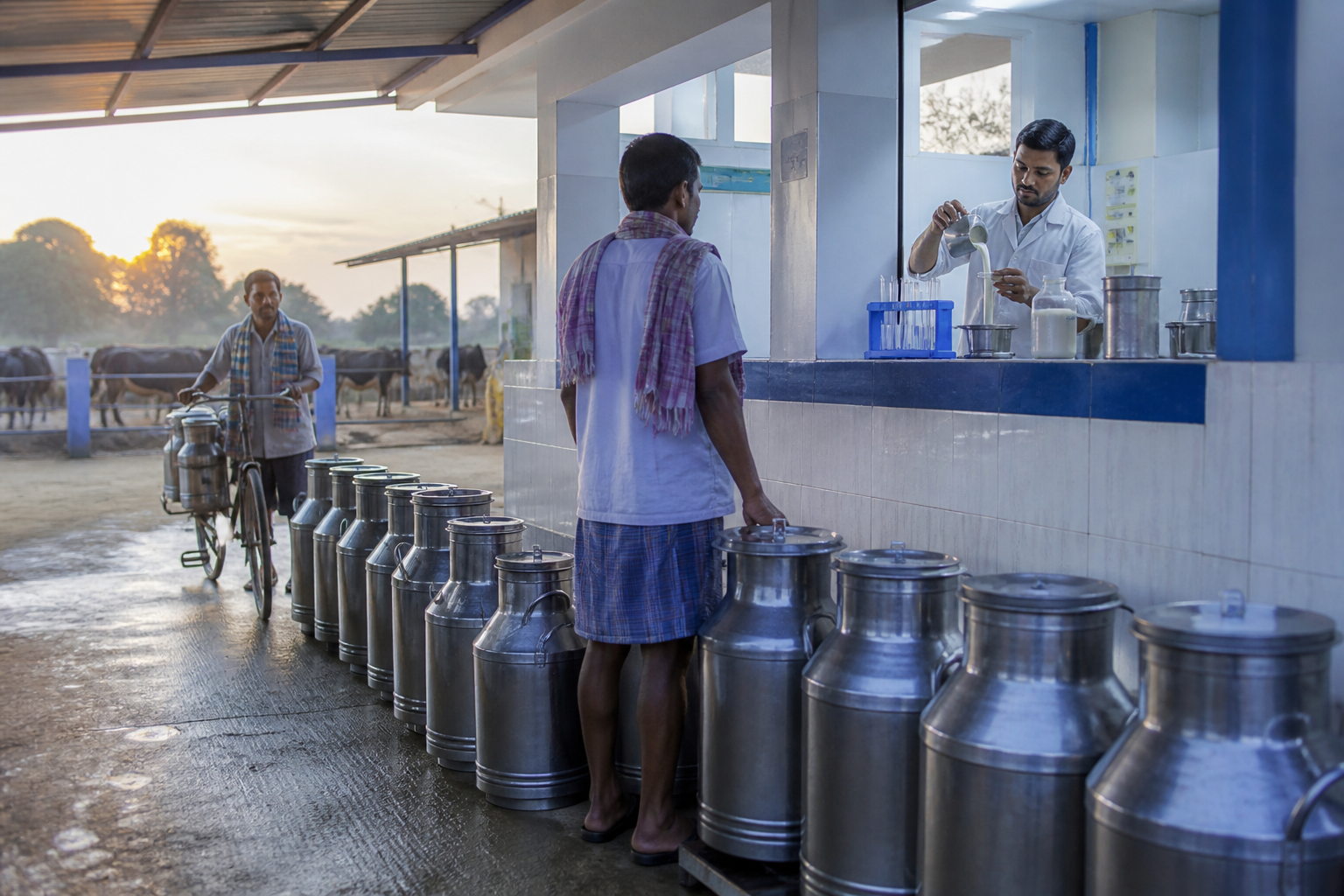
Milk is a brutal network design problem. Supply is dispersed across many small producers, demand is urban and daily, and the product is perishable. A purely centralised system would struggle with freshness; a purely local system would struggle with scale and brand consistency.
Amul describes its structure as a three-tier cooperative model of village dairy cooperative societies, district milk unions and a state-level federation (Amul organisation structure). Strategically, this creates a layered network: collection close to farmers, processing and chilling at district-level scale, and coordinated marketing and distribution at the federation level.
The primary driver of Amul’s network strength is its tiered architecture - local where freshness matters, aggregated where scale matters. Supporting drivers include cold-chain discipline, role clarity across nodes, pooled brand-building and demand coordination. The broader lesson: good network design does not centralise or decentralise blindly; it separates decisions by what the product and customer promise require.
How AI Changes Network Design
AI does not remove the strategic judgement from network design. It improves the quality and speed of scenarios that managers can test before committing assets.
The biggest change for 2026 interviews: network design is moving from periodic Excel redesigns to living digital models. For the inventory side of this shift, revise using AI for inventory optimisation and replenishment.
Use NotebookLM or ChatGPT like a supply chain analyst: upload a company annual report, investor presentation and this lesson, then ask, “What network design choices seem critical for this company, and what trade-offs should I mention in an interview?” Always verify any company-specific claim against the original document.
Interview Relevance
“A company wants to expand from North India to pan-India distribution. What network design decisions should it evaluate, and how would you decide between a centralised and decentralised model?”
Use the phrase “cost-to-serve by segment.” It instantly signals that you understand network design is not one average cost for all customers.
Common Mistake
The biggest mistake is treating network design as a warehouse-location problem only. That misses facility roles, inventory positioning, customer allocation, transport lanes and service strategy. One-line fix: start with the customer promise, then design the nodes and flows that deliver it at the best total cost-to-serve.