
Redesigning a Network After Demand Shifts
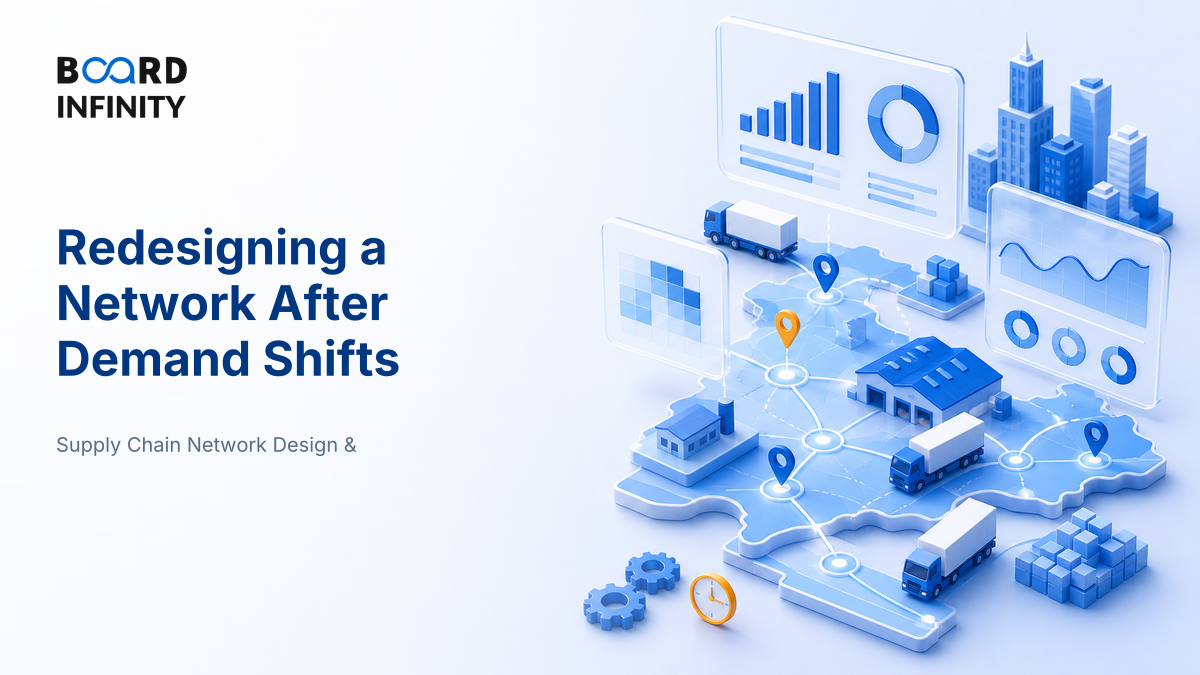
The biggest myth in network redesign is simple: “demand moved, so move the warehouse.” In reality, the smartest redesigns often change inventory rules, node roles, transport lanes and service promises before committing crores to a new facility.
- Network redesign means changing facility locations, capacities, roles and flows to match the new demand pattern.
- Start with the demand shift: what changed - geography, channel, SKU mix, order size, speed expectation or seasonality?
- Do not optimise cost alone. The real trade-off is cost to serve vs service level vs resilience.
- Redesign levers include reassigning demand to nodes, adding or closing facilities, changing transport mode, postponing inventory and using 3PL capacity.
- Use scenarios, not one forecast. Test base, upside, downside and disruption cases before recommending a network.
- The interview-safe answer: diagnose demand, map current network, identify constraints, model options, compare metrics, pilot and monitor.
Big Picture
A supply chain network is not just dots on a map. It is a living system of demand points, supply points, warehouses, plants, transport lanes, inventory buffers and service promises. When demand shifts, the network must be redesigned as a loop - sense the shift, model choices, execute, then keep learning.
The Core Idea: Redesign Flows Before You Redesign Buildings
After a demand shift, the first question is not “Where should we build?” It is “Which demand should be served from which node, at what service level, using which flow path?” A new facility is only one possible answer.
Common demand shifts include:
- Geographic shift: demand moves from metros to Tier 2 and Tier 3 markets, or from one region to another.
- Channel shift: demand moves from distributors to e-commerce, modern trade, marketplaces or quick commerce.
- SKU-mix shift: fast-moving SKUs change, long-tail SKUs increase, or premium/value segments behave differently.
- Service shift: customers expect same-day, next-day or appointment-based delivery instead of weekly replenishment.
- Volatility shift: demand becomes more seasonal, promotional or uncertain.
The redesign logic is simple: match the demand profile with the right network response.
The Network Redesign Toolkit
Think of redesign levers in increasing order of commitment. Good managers first test reversible levers before locking in fixed assets.
This is why network redesign connects closely with inventory policy. If the shift is mainly SKU-level volatility, a full warehouse move may be overkill; first revisit safety stock, reorder points and replenishment rules through multi-product inventory policy.
Metrics That Decide Whether the Redesign Works
In interviews, never say “we will optimise the network” without naming the metric. A redesign is good only if it improves the right mix of cost, service, capacity and risk.
Use the metrics together. A redesign that reduces cost but destroys OTIF is not a win. A redesign that improves speed but creates a single overloaded mega-node is fragile.
A Small Worked Example: Should We Add a North India Satellite DC?
Suppose a company currently serves North India from a central warehouse. Demand in North India has become stable enough to consider a satellite distribution centre.
Calculation: current annual transport cost = 100,000 × ₹70 = ₹70,00,000. New annual cost = 100,000 × ₹45 + ₹18,00,000 + ₹4,00,000 = ₹67,00,000.
The satellite DC saves ₹3,00,000 per year and improves delivery speed. But the recommendation is still conditional: test whether demand is stable, whether service improvement drives revenue or retention, and whether the new node creates inventory imbalance. The maths says “worth piloting,” not “blindly build.”
Definitions You Can Say in One Breath
- Demand shift: a sustained change in where, what, how much or how quickly customers buy.
- Network design: deciding the number, location, capacity and role of supply chain facilities and flows.
- Cost to serve: the total supply chain cost incurred to fulfil demand for a customer, channel, region or SKU.
- Service level: the degree to which the network meets promised availability, speed, completeness and reliability.
Case Study: BigBasket and the Two-Speed Grocery Network
BigBasket shows how a grocery network must change when demand shifts from planned weekly baskets to both scheduled orders and rapid top-up purchases.

Situation: Online grocery demand is not one pattern. A family stock-up order has many items, can tolerate a delivery slot and benefits from centralised picking. A “need milk, eggs and fruit now” order is smaller, more urgent and geographically sensitive. Serving both from the same large warehouse network creates either high cost or poor speed.
The move: BigBasket evolved toward a two-speed network: larger fulfilment capacity for planned baskets and neighbourhood-level fulfilment for urgent, high-frequency items. The primary driver is inventory segmentation - keeping fast-moving essentials close to dense demand pockets while retaining broader assortment in larger nodes. Supporting drivers include demand forecasting, SKU pruning for quick delivery, rider routing, freshness control and app-led order orchestration.
The lesson: The company did not need one “perfect” warehouse model. It needed different node roles for different demand missions. That is the heart of redesign after demand shifts: segment demand first, then design the network.
How AI Changes Redesigning a Network After Demand Shifts
AI does not remove the network-design problem. It makes the sensing, modelling and monitoring much faster.
- Demand-signal detection: machine learning can identify shifts by pin code, channel, SKU and daypart earlier than monthly planning reviews. This helps teams separate a real structural shift from a temporary promotion spike.
- Scenario generation: optimisation tools can test facility, lane and capacity combinations across base, surge and disruption scenarios. The manager still chooses the trade-off; AI expands the option set.
- Dynamic replenishment: once the redesigned network is live, AI can continuously tune reorder quantities and allocation rules. For the next layer, revise AI-driven inventory optimisation and replenishment.
Use ChatGPT or Claude to practise: paste a short company description, current network, shifted demand pattern and 5 constraints. Ask it to generate three redesign options, the metrics to compare, and the risks in each option. Then challenge its answer by asking, “What assumptions would break this recommendation?”
Interview Relevance
“Demand for an FMCG company has shifted from metro general trade to Tier 2 e-commerce and quick commerce. How would you redesign the distribution network?”
Say “I would not open a warehouse immediately.” That one line signals maturity. Then show the stepwise logic from demand diagnosis to network options.
Common Mistake
The biggest mistake is treating network redesign as a pure location problem. Candidates jump to “open a warehouse near demand” without checking cost to serve, inventory duplication, utilisation, channel service promise or volatility. Fix: always compare at least three levers - flow reallocation, inventory placement and footprint change - before recommending a new facility.