
How the Fintech & Payments Value Chain Works
A ₹49 QR payment at a kirana counter feels like one tap and one beep. Behind that beep, a customer app, merchant system, bank account, payment rail, risk engine and settlement process have all quietly done their job.
That is the central truth of payments: the customer sees a moment, but the industry runs a chain. If you can trace that chain clearly, fintech stops looking like a maze of apps and starts looking like a set of roles, risks and economics.
- The payments value chain is the sequence of players and processes that authenticate, authorize, clear, settle and reconcile a payment.
- Every payment moves two things: information first - approval, risk, identity - and money later - settlement between accounts.
- The core players are the customer, merchant, issuer, acquirer or aggregator, payment gateway, network or rail, settlement bank and regulator.
- Authorization is permission to pay; settlement is the actual movement of funds. Do not confuse them.
- UPI, cards, wallets and net banking use different rails, but the logic remains: initiate - authenticate - route - authorize - settle - reconcile.
- Profit pools often sit not only in transaction fees, but also in merchant software, risk management, credit, data, reconciliation and value-added services.
- The best interview answer follows one transaction end-to-end, then explains who captures value and who carries risk.
Big Picture: Payments Is a Chain, Not an App
The cleanest way to understand fintech payments is to ignore brand names for a minute and follow a single transaction. A payment begins with customer intent, passes through front-end interfaces and routing infrastructure, gets checked by banks and rails, and finally becomes merchant money after settlement and reconciliation. If you already know the idea of mapping a value chain and finding the profit pool, payments is one of the best sectors to practise it on.
Core Explanation: What Actually Happens in a Digital Payment
A digital payment has two layers running together:
- Message layer: Who is paying whom, through which instrument, for what amount, with what authentication?
- Money layer: Which account or wallet is debited, which merchant account is credited, and when is final settlement completed?
This is why a customer may see “payment successful” instantly, while the merchant may receive final funds later depending on the payment method, bank arrangement and settlement cycle.
The Six-Step Payment Flow
The most important interview distinction is this: authorization is a yes/no decision; settlement is the actual transfer of money. A strong candidate says both.
The Main Players in the Payments Value Chain
Different payment products use different names, but these roles appear again and again.
In India, UPI is operated by the National Payments Corporation of India, which describes UPI as a system that powers multiple bank accounts into a single mobile application (NPCI UPI product overview). Payment aggregators are also specifically regulated: the Reserve Bank of India issued its Guidelines on Regulation of Payment Aggregators and Payment Gateways, making compliance a central part of the payments value chain. If the regulatory map feels unclear, revise how to locate the regulator and what it controls.
How UPI, Cards and Wallets Differ in the Chain
The same payment logic appears across instruments, but the dominant control point changes. UPI is bank-account-led and rail-led. Cards are network-led with issuer and acquirer economics. Wallets are stored-value-led, with heavier emphasis on wallet loading, KYC and closed-loop or semi-closed-loop use cases.
Where the Value Is Captured
New candidates often assume “the payment company earns a fee on every transaction.” Sometimes yes, but that is not the full answer. Payment businesses may capture value through routing, merchant onboarding, software subscriptions, settlement services, risk tools, working-capital credit, reconciliation, fraud detection, checkout conversion and data-led value-added services. To connect this chain to economics, your natural next step is reading a business model as a set of economics.
Definitions You Should Be Able to Say in One Breath
- FinTech: The Financial Stability Board describes FinTech as technologically enabled financial innovation in financial services FSB FinTech workstream).
- Payment system: The BIS glossary describes it as instruments, procedures and interbank transfer systems that ensure money circulation BIS payments glossary).
- Payments value chain: The sequence of players and processes that authenticate, authorize, clear, settle and reconcile a payment.
- Payment gateway: A technology layer that captures payment details and routes transaction messages between merchant systems and payment processors.
- Payment aggregator: An entity that enables merchants to accept multiple payment instruments through one integration and settlement relationship.
Metrics That Tell You Whether the Chain Is Healthy
Payments is an operations-heavy sector. Strategy answers become sharper when you can name the metrics that each participant watches.
Notice the trade-off: pushing success rate up by approving everything can increase fraud; reducing fraud too aggressively can hurt conversion. Payments teams win by optimizing the chain, not one metric in isolation.
Case Study: Pine Labs and the Merchant-Side Payment Stack
Pine Labs shows how a payments company can move beyond transaction acceptance into a broader merchant operating layer.
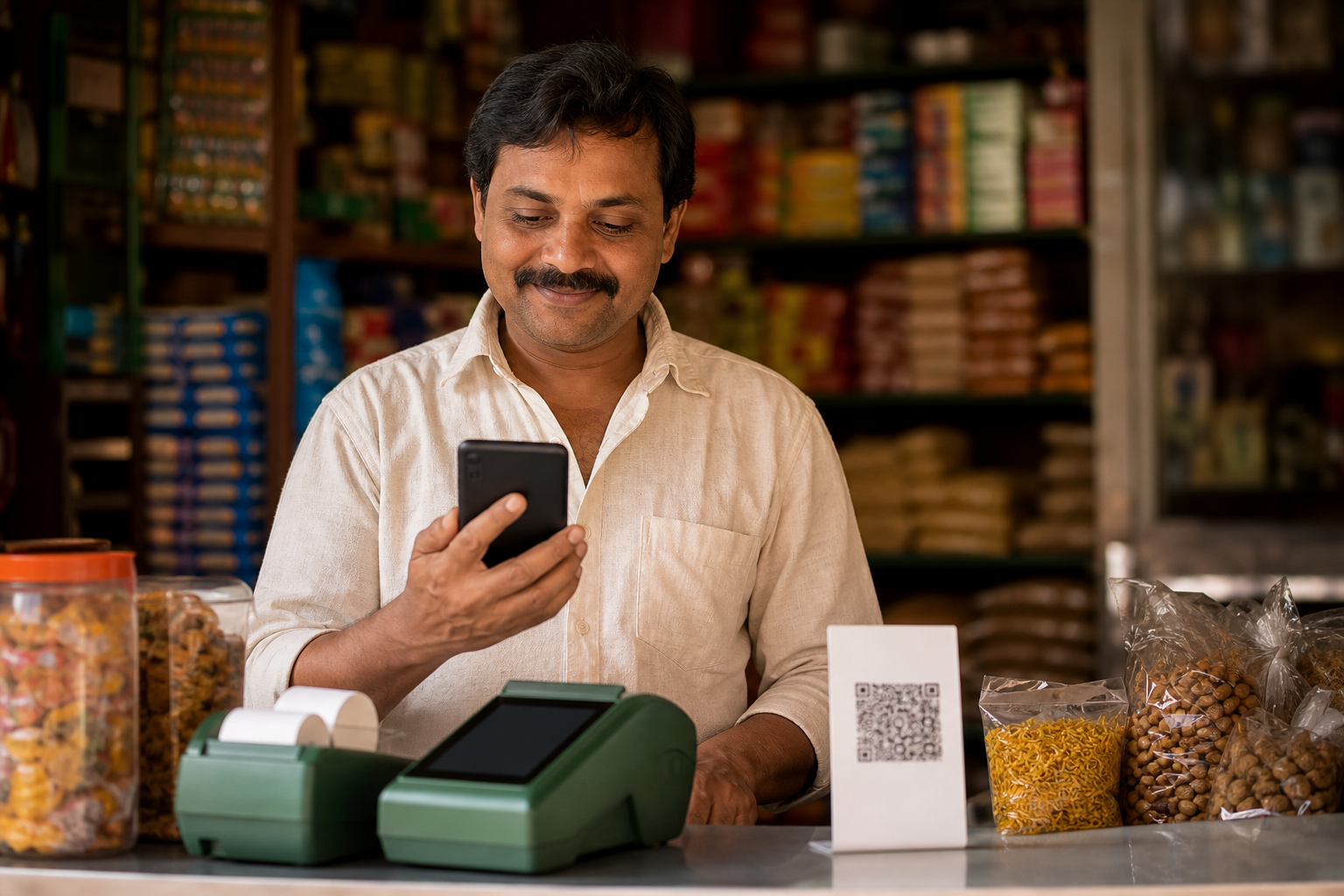
Pine Labs is a useful case because it is not just a consumer payment app story. Its world is the merchant counter - stores, checkout terminals, QR acceptance, card payments, affordability offers, reconciliation and merchant services. On its own website, Pine Labs presents itself around merchant commerce and payment solutions, which is exactly where much of the practical payments value chain becomes visible.
Situation: Indian merchants did not only need a way to accept one payment mode. They needed to accept cards, UPI, wallets and other instruments, manage settlement, reduce checkout friction, run affordability or EMI offers, and reconcile sales across stores and channels.
The move: Pine Labs built around the merchant side of the chain. The primary driver was merchant payment acceptance infrastructure - POS and digital acceptance that sat directly in the checkout flow. Supporting drivers included integrations with banks and networks, merchant software, reconciliation support, affordability solutions and value-added services that made the merchant relationship stickier than a simple transaction pipe.
The lesson: In payments, the visible transaction is only the starting point. The deeper value often comes from solving the merchant's operating pain: acceptance, settlement visibility, refunds, reconciliation, loyalty, EMI and credit-related use cases.
The strategic takeaway: Pine Labs demonstrates that fintech value is often captured by owning a painful workflow. The payment is the entry point; the merchant operating layer is the moat.
How AI Changes Fintech & Payments Value Chains
AI is changing payments less through flashy chatbots and more through invisible decisioning inside the chain.
- Smarter routing: Machine learning can predict which bank, rail or route is more likely to succeed for a given transaction pattern, improving success rate without changing the customer interface.
- Real-time fraud and mule detection: AI models can score device signals, velocity patterns, beneficiary history and abnormal transaction behaviour to flag risky payments before losses scale.
- Automated reconciliation and dispute handling: LLM-based systems can classify failed payments, summarize dispute trails, match transaction records and assist operations teams in resolving exceptions faster.
Use NotebookLM or Perplexity to study one payments company: load its annual report or official product pages, the RBI payment aggregator guidelines, and the NPCI UPI overview. Ask: “Map the payment value chain, identify who owns authorization, settlement, risk and merchant relationship, and list five interview questions. Then cross-check every generated claim using AI research without importing errors.
Interview Relevance
“Walk me through what happens when a customer pays a merchant digitally. Where do fintech companies fit in the payments value chain?”
If the interviewer asks for depth, choose one mode - UPI, card or wallet - and go one level deeper. Breadth gets you started; one clean transaction walkthrough gets you selected.
Common Mistake
Mistake: Stopping at the app name - “PhonePe processes it” or “Razorpay processes it” - and missing the issuer, acquirer, rail, settlement and regulator. Why it costs you: it shows you know the brand, not the sector. Fix: always answer payments by following the transaction end-to-end: initiate - authenticate - route - authorize - settle - reconcile.