
What Makes a Good Metric, and What Makes a Vanity Metric
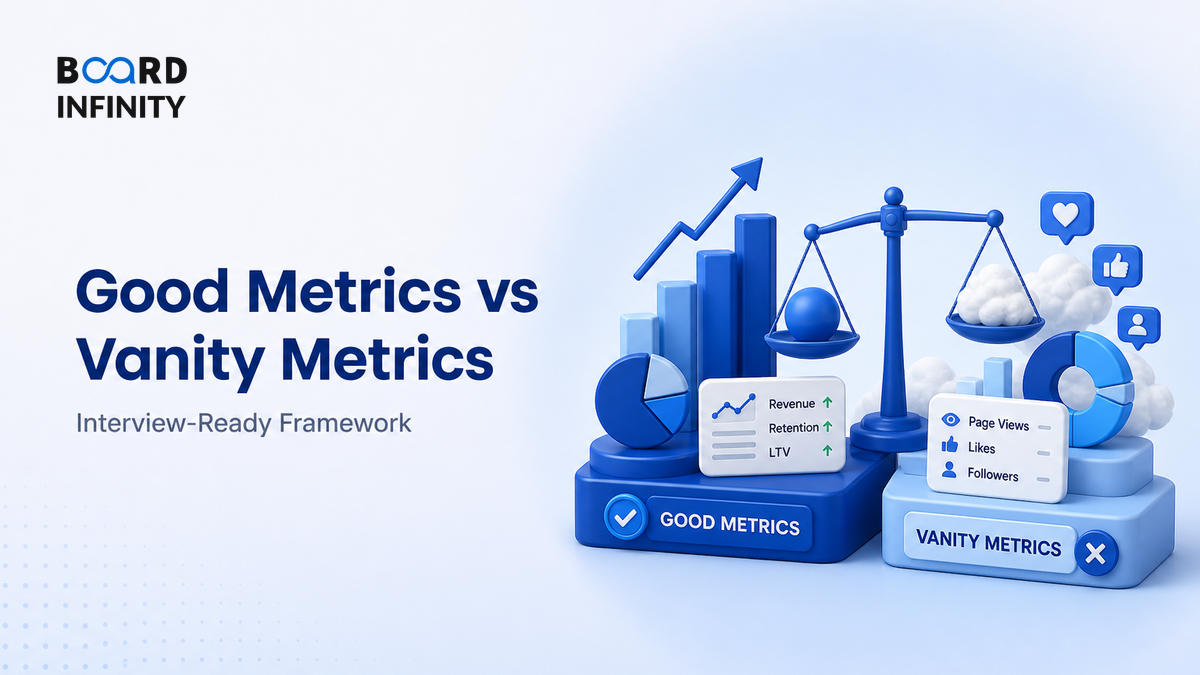
The dashboard looks brilliant: installs are up, impressions are exploding, followers are cheering. Then the CFO asks one quiet question - “Did customers buy again, and did we make money?” That is the moment vanity metrics collapse and good metrics earn their place.
- A good metric is a number that helps a team make a better decision. If no action changes when it moves, it is probably vanity.
- A vanity metric looks impressive but is weakly linked to value creation - examples: total downloads, total page views, registered users, raw followers.
- Test any metric on five filters: business linkage, actionability, sensitivity, comparability, and behaviour risk.
- Good metrics are usually ratios, rates, cohorts, or unit economics - not raw totals without context.
- Every primary metric needs counter-metrics, such as retention plus refund rate, growth plus contribution margin, speed plus quality.
- The best interview answer is: define, diagnose, replace vanity with better metrics, add guardrails, and show how the decision changes.
The Big Picture: A Metric Is Only Useful If It Climbs Toward a Decision
Think of measurement as a ladder. Raw numbers sit at the bottom; strategic decisions sit near the top. Vanity metrics usually stop at “looks good.” Good metrics climb all the way to “what should we do next?”
Core Explanation: What Separates a Good Metric from a Vanity Metric
A metric is a quantifiable measure used to track a condition, behaviour, process, or outcome. But not every number deserves management attention.
A good metric has three jobs: it explains what is happening, points to why it is happening, and suggests what action should follow. A vanity metric does the opposite: it creates confidence without improving judgment.
“1 million app downloads” may sound strong. But if only a small share complete onboarding, make a first purchase, and return next month, downloads are a weak signal. “Day-30 retained paying users by acquisition channel” is better because it links acquisition quality to future revenue and marketing allocation.
The Five Tests of a Good Metric
Use these five tests whenever you are given a dashboard, case prompt, product metric, marketing campaign result, or growth number.
Good Metric vs Vanity Metric: The Practical Comparison
The quickest way to upgrade a dashboard is to convert raw totals into rates, cohorts, unit economics, or quality-adjusted outcomes.
Metrics That Usually Beat Vanity Counts
Benchmarks vary by industry, price point, and channel. Use the ranges below as interview heuristics, not universal laws.
A Small Worked Example: Why “Downloads” Can Mislead
Suppose two campaigns each produce 10,000 app downloads. Campaign A looks cheaper, but the better metric is not downloads; it is retained paying users and contribution.
Campaign A wins on the vanity metric: cheaper downloads. Campaign B wins on the business metric: much lower cost per retained paying user. The decision changes from “scale A” to “scale B and study its audience, creative, and onboarding fit.”
Definitions You Can Say in One Breath
- Metric: A quantifiable measure used to track a business activity, process, behaviour, or result.
- Good metric: A metric that is linked to business value, actionable by a team, comparable over time, and hard to game.
- Vanity metric: A metric that looks impressive but does not reliably guide decisions or prove value creation.
- KPI: A priority metric used to evaluate progress against a specific strategic or operational objective.
- Goodhart's Law: “When a measure becomes a target, it ceases to be a good measure.”
Case Study: Zerodha and the Difference Between Sign-ups and Trust
Zerodha shows why a financial platform should not celebrate only app installs or account openings; the better metrics are active, funded, reliable, compliant customer relationships.

Indian broking became intensely competitive as digital onboarding, low-cost trading apps, and market participation grew. Many fintech dashboards could look attractive by highlighting downloads, demat account openings, or social media buzz. Those numbers matter at the top of the funnel, but they do not prove durable value.
Zerodha's stronger lesson is metric discipline. Its model has emphasised self-directed active customers, transparent pricing, product reliability, investor education through Varsity, and a low-cost digital operating structure. The primary driver is not one magic metric; it is the alignment between a simple revenue model and active, trust-based customer usage. Supporting drivers include educational content, word-of-mouth credibility, operational discipline, and a product experience built for repeat use.
For a brokerage, a vanity metric is “accounts opened this month” if many accounts remain unfunded or inactive. A better metric set would track active funded clients, order success rate, customer support resolution, compliant growth, and revenue or contribution per active client.
Lesson: Good metrics in regulated financial services must balance growth, trust, reliability, and compliance. The “so what” is simple: scale only the growth that produces active, satisfied, low-risk customers.
How AI Changes Good Metrics vs Vanity Metrics
AI makes measurement faster, but it also makes vanity easier. A dashboard can now generate beautiful summaries, anomaly alerts, and synthetic segments in seconds. The student's job is to ask: “Does this AI output improve the decision, and how do we know it is reliable?”
When AI touches a metric system, track the model itself with real measures, not vague confidence.
Use NotebookLM or ChatGPT: upload a company annual report, investor presentation, and campaign note. Ask: “List five metrics this company highlights. Classify each as good, diagnostic, or vanity. Suggest counter-metrics and the decision each metric should influence.” Then verify every factual claim against the original document.
Interview Relevance
“Our app downloads grew 80 percent after a campaign, but revenue barely moved. Is downloads a good metric? What would you track instead?”
Use this sentence: “I would not discard downloads completely; I would demote them from success metric to diagnostic metric and judge the campaign by retained profitable users.”
Common Mistake
The mistake: calling every large top-funnel number “bad.” That sounds simplistic. Downloads, impressions, reach, and sign-ups can be useful diagnostic metrics, but they are poor success metrics unless they predict business value. One-line fix: classify the metric by decision role - success metric, diagnostic metric, or guardrail - before judging it.
What to Revise Next
Now move from judging individual metrics to designing a metric system. Revise The North Star Metric and the Counter-Metrics That Protect It first, then learn Building a Metric Tree from Revenue Down to Drivers. That sequence will help you go from “Is this metric good?” to “How do I build the full dashboard?”