
Retention, Churn & Repeat Purchase Metrics
A brand can celebrate record app installs on Monday and still be quietly bleeding money by Friday. The common misconception is that growth means “more customers acquired”; the sharper question is whether those customers return without being bribed every time.
- Retention measures how many existing customers stay active; churn measures how many leave.
- Repeat purchase rate is the transaction-business cousin of retention - it asks how many customers buy again in a defined window.
- Always define the cohort, time window and activity rule: “90-day repeat purchase among January first-time buyers” is meaningful; “repeat is high” is not.
- Retention metrics must be read with unit economics: retained customers are valuable only if they return profitably, not only because of deep discounts.
- Churn is not always failure: some churn is natural in low-frequency, seasonal or one-time categories.
- The interview-safe answer links metrics to levers: onboarding, product value, replenishment, loyalty, service recovery and win-back.
- The biggest trap is using a blended repeat purchase number that hides weak new-customer cohorts.
Big Picture: Retention Is a Loop, Not a Score
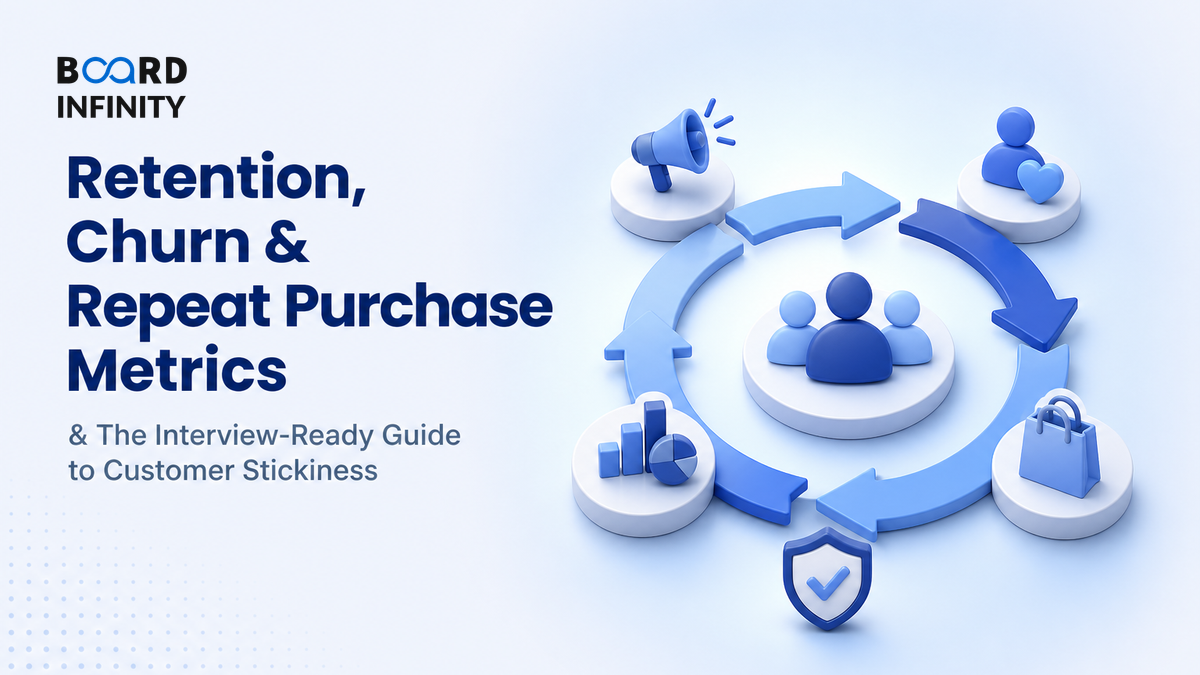
Acquisition fills the top of the business, but retention decides whether that customer base compounds or leaks. Think of retention as a loop: customers experience value, return, deepen usage, and either become cheaper to serve and grow - or silently churn.
Core Explanation: Retention, Churn and Repeat Purchase Are Related - Not Identical
Retention is usually used when a customer has an ongoing relationship - a subscription, account, app, bank product or SaaS contract. Churn is the opposite movement - customers who stop being active, cancel, lapse or fail to renew. Repeat purchase is used more often in transaction businesses such as D2C, retail, food delivery, beauty, grocery and fashion.
The concept is simple, but the measurement is dangerous unless you lock three things:
The Metrics You Must Know Cold
There is no universal “good” retention number because groceries, eyewear, SaaS, credit cards and furniture have different natural purchase cycles. The ranges below are interview-useful reference points, not category laws - always benchmark against the same business model and cohort age.
Worked Example: One Customer Base, Four Different Readings
Suppose a beauty commerce app starts April with 10,000 active customers. During April, it acquires 4,000 new customers and ends with 11,500 active customers.
The interview lesson: never stop at the percentage. Say what the numerator means, what the denominator excludes, and whether the customer returns profitably.
Why Cohorts Beat Blended Averages
A blended repeat purchase rate can improve even when new customers are getting worse, simply because old loyal customers dominate the denominator. Cohort analysis prevents this by comparing customers of the same age - for example, Day 30 retention for January, February and March acquisition cohorts.
How to Choose the Right Retention Action
Not every customer deserves the same retention spend. A high-value customer at high churn risk needs proactive service or a win-back offer. A low-value customer at low risk should not be over-incentivised. This is where retention becomes management judgment, not just analytics.
Definitions
- Retention rate: Percentage of starting customers who remain active after excluding newly acquired customers.
- Churn rate: Percentage of starting customers who stop being active during a defined period.
- Repeat purchase rate: Percentage of customers who make two or more purchases within a defined period.
- Cohort: A group of customers sharing the same start event, tracked across later periods.
- Customer lifetime value: Expected future contribution from a customer over the relationship, often discounted to present value.
Case Study: Purplle and the Retention Logic of Beauty Commerce
Purplle shows how a transaction-led Indian beauty platform can use category habit, personalisation and private labels to improve repeat purchase economics.

Situation: Beauty is a strong repeat-purchase category because products are replenished, routines evolve and customers experiment across skincare, haircare and makeup. But it is also crowded: marketplaces, D2C brands, offline stores and social commerce all compete for the same buyer.
The move: Purplle built retention around a category-specific loop rather than only coupons. The primary driver is relevance - helping users discover products suited to their needs and routines. Supporting drivers include broad beauty assortment, private-label offerings, app-led engagement, reviews and content that reduce uncertainty in a category where fit and trust matter.
Outcome or lesson: The strategic lesson is not “discounts create repeat.” Discounts may trigger a second order, but durable retention in beauty comes from making the next purchase easier, more relevant and less risky. In an interview, this is a strong example because it connects repeat purchase metrics to product experience, assortment strategy and margin discipline.
So what: Purplle’s retention story is multi-driver: category repeatability is the base, relevance is the primary engine, and assortment, content, private labels and CRM support the loop.
How AI Changes Retention, Churn & Repeat Purchase Metrics
1. Churn prediction is becoming earlier and more granular. Instead of waiting for cancellation or inactivity, companies can score risk from changes in browsing, order gaps, complaint history, payment failures, delivery delays and declining engagement. The useful output is not “this customer may churn”; it is “this high-value customer should receive service recovery before the next renewal window.”
2. Repeat purchase journeys are becoming personalised at the SKU and timing level. AI models can recommend the next product, estimate replenishment timing and choose the right channel - push notification, WhatsApp, email or in-app banner. In India, this must be done carefully with consent, data minimisation and privacy expectations under the DPDP Act framework.
3. Retention teams are moving from dashboards to next-best-action systems. AI can combine customer value, churn risk and likely response to decide whether to send a reminder, a service call, a bundle, a loyalty benefit or no incentive at all. The key is uplift: would the customer have returned anyway?
Use NotebookLM or ChatGPT like a retention analyst: upload the company's annual report, app reviews and recent news, then ask, “What are the likely churn drivers, repeat purchase levers and cohort metrics for this business?” Do not upload personal customer data; work only with public or anonymised information.
Interview Relevance
“A D2C brand says sales are growing but profitability is weak. Which retention, churn and repeat purchase metrics would you examine, and what actions would you recommend?”
Use one sentence that makes you sound mature: “I would not optimise repeat purchase rate alone; I would optimise profitable repeat purchase by cohort.”
Common Mistake
The mistake that costs candidates is quoting one blended retention or repeat purchase number without a cohort, time window or denominator. It costs you because the interviewer cannot tell whether you understand customer behaviour or are just reciting formulas. One-line fix: always say, “For which cohort, over what window, and what counts as retained?”
What to Revise Next
Next, connect retention to business economics. Revise Revenue & Unit Economics Metrics for New-Age Businesses to see how retention affects CAC payback, contribution margin and CLV. Then revise Funnel & Conversion Metrics, and Where They Mislead so you can explain why acquisition growth without cohort quality is fragile.