
HUL Project Shakti: Rural Marketing Case Study
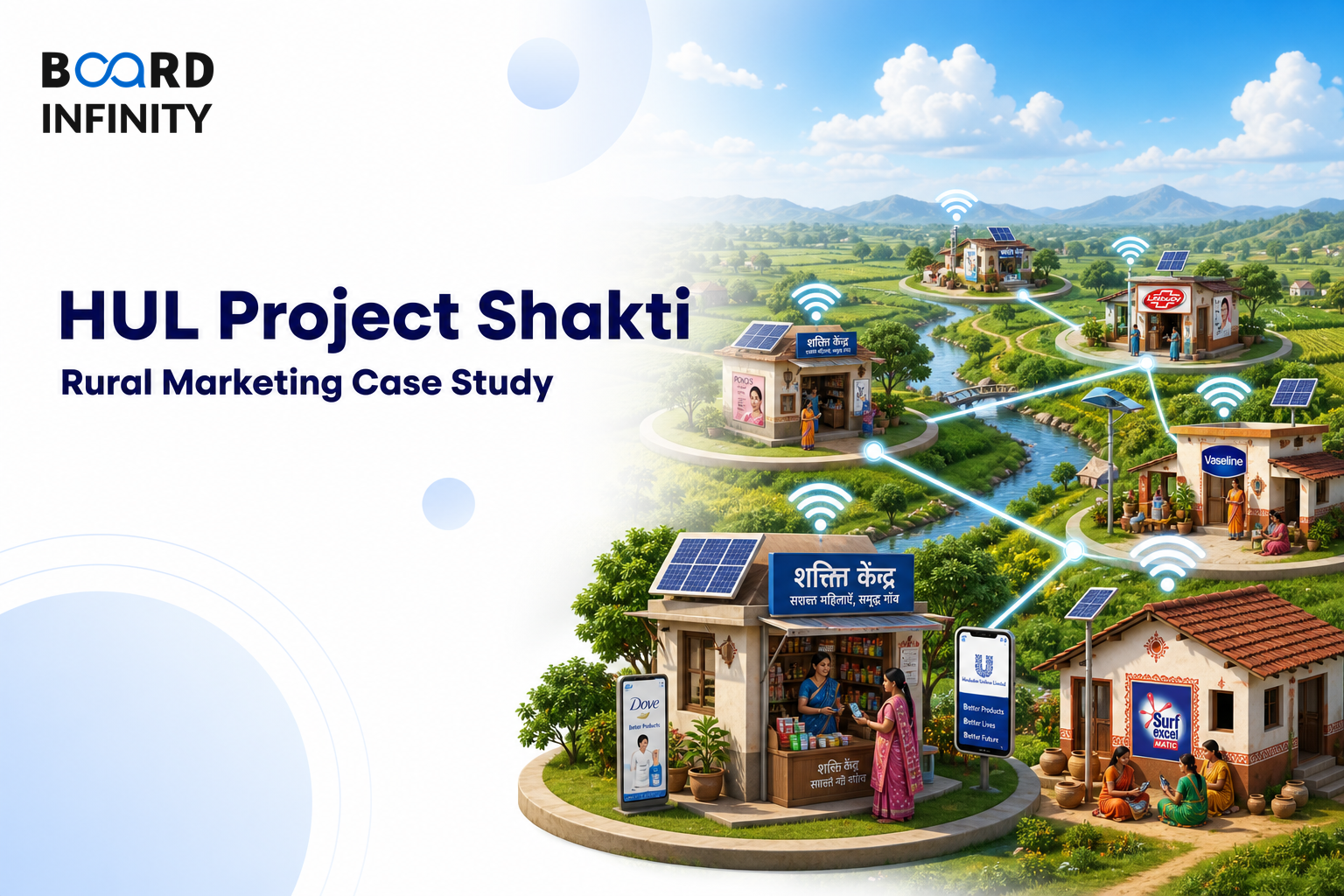
After studying Government Policies & Regulatory Framework for Marketing in India, the next interview question is practical: how does a company actually reach customers when infrastructure is weak, incomes are low, and trust is local? Hindustan Unilever's Project Shakti answers that question through one of India's most cited rural marketing cases. It matters in interviews because it combines strategy, distribution, women micro-entrepreneurship, revenue growth, and social impact in a single business model.
- Project Shakti was launched by Hindustan Unilever in 2001 to solve the rural last-mile problem across 600,000+ villages where 65% of Indians lived.
- HUL recruited women from Self-Help Groups, called Shakti Ammas, as micro-entrepreneurs who sold HUL products door-to-door in their villages.
- The model converted weak rural infrastructure into a human distribution network through credit, inventory, training, product knowledge, and later Shakti 2.0 digital ordering.
- The case is a classic example of Ansoff Matrix market development: existing HUL products taken into a new rural market.
- In the 4Ps of marketing, Project Shakti is primarily a Place innovation because HUL redesigned how products physically reached customers.
- The 4As framework is central: Availability through door-to-door selling, Affordability through sachets, Acceptability through trusted local women, and Awareness through in-person demos.
- The results were 50,000+ Shakti Ammas across 18 states, reach into 100,000+ villages, rural revenue at 40%+ of HUL's total revenue, and 80%+ rural penetration for Lifebuoy and Wheel.
Think of Project Shakti as a rural growth system, not just a distribution tactic. The whole model links market selection, channel design, local trust, affordability, and digital support.
The Context: Why Rural India Needed a Different Marketing Model
In 2001, HUL faced a fundamental rural marketing challenge: India had 600,000+ villages, and 65% of Indians lived in villages, but traditional distribution infrastructure was almost non-existent. Roads, warehouses, and retail outlets could not support the kind of reach that urban fast-moving consumer goods distribution required.
Fast-moving consumer goods, or FMCG, are frequently purchased consumer products such as soaps, detergents, and similar everyday categories. In this case, the source examples are HUL brands such as Lifebuoy and Wheel, which needed dependable rural reach.
The problem was not only that products were hard to deliver. Rural marketing also had to address affordability, trust, awareness, and the lack of organised retail. HUL's answer was to build a new route to market through local women micro-entrepreneurs.
Hindustan Unilever: The Full Framework in One Business
Project Shakti demonstrates the whole rural marketing framework because it connects business growth with social impact. HUL did not simply push more stock into rural India; it redesigned the distribution model around trusted village-level entrepreneurs.
A shallow answer says Project Shakti was rural distribution. A complete answer says it was market development through local trust, affordability, last-mile availability, entrepreneur enablement, and a scalable social impact model.
Project Shakti is a rural market development model in which Hindustan Unilever used women from Self-Help Groups as village-level micro-entrepreneurs to solve last-mile distribution, build trust, and expand FMCG access.
The Strategy: Turning Last-Mile Distribution into Local Entrepreneurship
The core design of Project Shakti was simple but powerful. HUL recruited women from Self-Help Groups, or SHGs, which are community-based groups that help members access support such as credit and livelihood opportunities. These women became Shakti Ammas, meaning village-level micro-entrepreneurs who carried HUL's products into households through door-to-door selling.
Each Shakti Amma received working capital loans and initial inventory on credit. This mattered because it reduced the entry barrier for women who could sell products without needing to finance inventory fully upfront. HUL also trained them on selling techniques and product knowledge, so the channel could create both access and awareness.
The later Shakti 2.0 layer added tablets for digital ordering and inventory management. This is important in an interview because it shows that Project Shakti was not frozen as a social programme; it evolved into a more operationally capable rural distribution model.
The Frameworks Applied in Project Shakti
The best way to explain Project Shakti in a case interview is to map it to standard marketing frameworks. This prevents the answer from becoming a story and turns it into a structured business analysis.
The nuance is that Project Shakti should not be reduced to one framework. In many interview answers, candidates mention only the 4Ps and stop at Place. A stronger answer explains that Place worked because it was supported by affordability, acceptability, awareness, and entrepreneur capability.
The 4As: Why the Model Worked in Rural India
The 4As framework is especially useful for rural and emerging markets because it asks whether customers can access the product, afford it, accept it, and understand it. Project Shakti is a strong example because the source explicitly states that it solved all four.
For Lifebuoy and Wheel, the result was 80%+ rural penetration. The important interview insight is that penetration in rural markets usually requires both physical reach and behaviour-building. Project Shakti addressed both through its village-level entrepreneurs.
Worked Example: Using Project Shakti to Expand an FMCG Brand in Rural India
This worked example is useful because it turns Project Shakti from a memorised case into a repeatable answer structure. It also shows why HUL's rural growth was tied to a sustainable business model rather than a one-time distribution push.
Why Project Shakti Is the Benchmark Rural Marketing Case
Project Shakti is considered the gold standard answer for "How would you expand an FMCG brand in rural India?" because it demonstrates several capabilities at once. It solves the last-mile problem, uses a human distribution network, creates income for women micro-entrepreneurs, and scales across states and villages.
The business result is also central. HUL's rural revenue grew to 40%+ of total revenue, which makes the case commercially significant rather than only socially meaningful. At the same time, the sustainable income of ₹3,000-5,000/month for Shakti Ammas shows why the model is also described as socially transformative in rural India.
The case also won multiple global awards for inclusive business innovation. In interview language, inclusive business innovation means a model that includes underserved participants in the value chain while still supporting business growth. Project Shakti did this by making rural women the distribution entrepreneurs.
Practical Lessons for Rural Marketing Strategy
- Do not treat rural India as only a media problem. In this case, distribution infrastructure was the biggest barrier to growth.
- Design for the 4As together. Availability without affordability or trust would not fully solve the rural adoption problem.
- Use local trust as a channel asset. Shakti Ammas were effective because they were local women selling within their own villages.
- Support the channel economically. Credit, inventory, training, and product knowledge made the entrepreneur model more viable.
- Scale requires systems. Shakti 2.0 added tablets for digital ordering and inventory management, showing the need for operational support as the network expands.
Structuring a Case Study Interview Answer
"How would you use HUL Project Shakti as a model to expand an FMCG brand in rural India?"
The strongest answers do not romanticise Project Shakti as only social impact. They show why it worked commercially: it solved last-mile distribution, built trust, improved affordability, created awareness, and generated a scalable rural revenue engine for HUL.
The most frequent error is saying "HUL used women to sell products in villages" and stopping there. That loses points because it misses the real case logic: Ansoff market development, Place innovation, 4As execution, Shakti 2.0 operational support, and measurable outcomes.
Conclusion
Project Shakti is the benchmark Indian rural marketing case because it turned a last-mile distribution barrier into a women-led micro-entrepreneurship model with clear business and social results. For interviews, remember the core lesson: rural marketing mastery comes from solving access, affordability, trust, and awareness together.