
Zomato's Brand Voice as a Strategic Moat
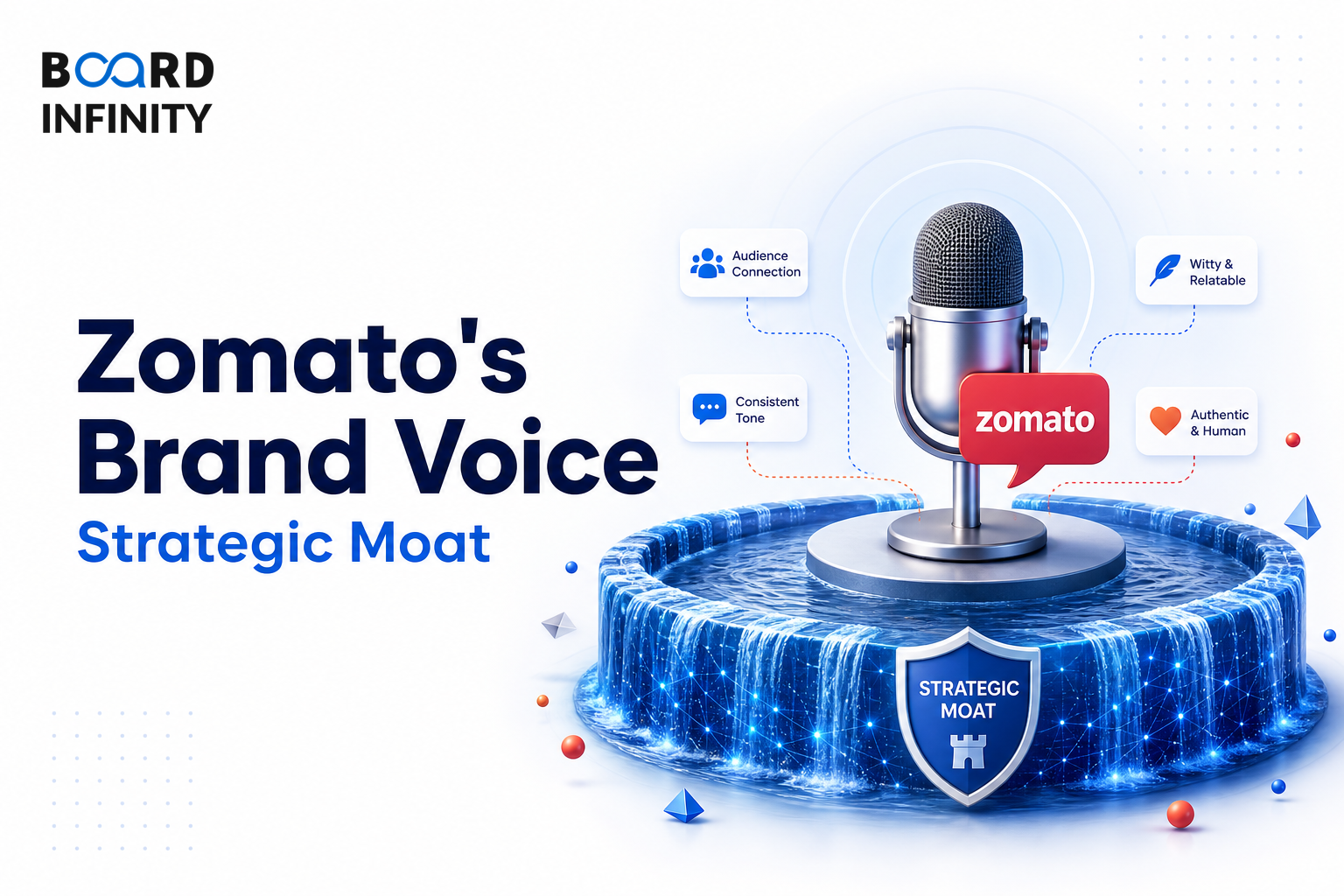
In the Nykaa content-led D2C growth case, content helped a brand educate customers and build trust before purchase. Zomato answers a sharper strategic question: when Zomato and Swiggy offer the same restaurants, similar delivery times, and comparable pricing, what can still create differentiation? This matters in interviews because it turns a familiar consumer app into a strong case on brand moat, earned media, platform strategy, and strategic evolution.
- Zomato operates in a commodity food delivery category where Zomato and Swiggy offer similar restaurant access, delivery times, and pricing.
- The core strategic insight is that in such a market, brand personality becomes the sustainable differentiator beyond discounts and delivery parity.
- Zomato treated Twitter as entertainment, not advertising, using witty, irreverent, culturally aware communication to create recall.
- The push notification "Bro, are you hungry?" achieved 3× better CTR than traditional promotional messages, showing that voice can affect performance, not just image.
- Zomato used real-time memes around IPL, elections, Budget Day, and Bollywood releases to generate 50K-500K organic impressions per meme with zero paid promotion.
- The Blinkit acquisition for ₹4,447 Cr shifted Zomato from a food delivery company toward a quick commerce platform, with Blinkit now contributing 30%+ of revenue.
- For interviews, use AIDA, STEPPS, and SOV greater than SOM to explain how brand voice creates awareness, shareability, and disproportionate media presence.
The Big Picture: From Commodity Parity to Brand Moat
Zomato's case is not just about funny tweets. It is a case of building differentiation when product features are hard to separate. The source frames food delivery as a commodity category: Zomato and Swiggy have the same restaurants, similar delivery times, and comparable pricing, so the brand has to compete on personality, cultural relevance, and strategic adjacency.
In a commodity market, a brand moat is created when functional parity is high, but customer recall, emotional preference, and earned media are meaningfully stronger than competitors.
Zomato: The Full Framework in One Business
Zomato demonstrates the whole framework because it combines commodity-market branding, meme-led earned media, measurable customer response, and a strategic pivot into quick commerce. Its FY25 revenue is ₹20,243 Cr, where Cr means crore, and its growth is 67% YoY, where YoY means year-on-year comparison.
A shallow answer says Zomato is good at memes. A complete answer explains why memes matter in a commodity market, how they reduce dependence on paid promotion, and how the Blinkit pivot adds strategic depth beyond brand communication.
Why Food Delivery Became a Brand Voice Battle
A commodity category is a market where customers see competing offerings as broadly similar. In this case, the source states that Zomato and Swiggy offer the same restaurants, similar delivery times, and comparable pricing. When the functional experience is this close, discounts can attract short-term orders, but they do not automatically create durable preference.
This is why Zomato's brand voice matters. A customer may not be able to sharply separate one delivery promise from another, but they can remember a brand that consistently sounds witty, culturally aware, and entertaining. In many organisations, this kind of brand personality is not treated as a performance lever, but Zomato's case shows that voice can influence attention, sharing, and click behaviour.
Brand Voice as a Performance Lever
Brand voice means the consistent personality, tone, and style through which a brand communicates. Zomato's voice is described as witty, irreverent, and culturally aware. The source uses the phrase "Twitter as stand-up comedian" to show that Zomato behaved less like a conventional advertiser and more like an entertainment account people wanted to follow.
The strongest proof point is the push notification "Bro, are you hungry?" It achieved 3× better CTR than traditional promotional messages. CTR means click-through rate, the share of people who click after seeing a message. In interview terms, this is important because it connects creativity to measurable behaviour.
The message worked because it sounded like a culturally familiar prompt rather than a standard offer-led ad. In a high-frequency category like food delivery, that tone can create attention before the customer evaluates price or delivery time.
The nuance is that brand voice is not random humour. If every message tries to be funny without fitting the customer moment, it can become noise. Zomato's examples work because the tone is linked to ordering behaviour, cultural context, and self-aware humour.
Meme Marketing and Earned Media at Scale
Earned media is unpaid reach generated when people voluntarily share, discuss, or react to brand content. The source says Zomato creates real-time memes for IPL, elections, Budget Day, and Bollywood releases. Each meme generates 50K-500K organic impressions, with zero paid promotion.
This is strategically powerful because it changes the economics of attention. Instead of buying every impression through paid ads, Zomato creates content that people share because it gives them social currency. Social currency means people share something because it makes them look informed, funny, or culturally tuned-in.
The interview nuance is that meme marketing is not the same as posting jokes. In Zomato's case, memes are linked to a repeatable attention engine: cultural timing, brand personality, organic reach, and low paid-media dependence.
The Frameworks: AIDA, STEPPS, and SOV Greater Than SOM
AIDA stands for Awareness, Interest, Desire, and Action. It is a marketing funnel that explains how a customer moves from noticing a brand to taking an action. In this case, the source specifically says Zomato's social media creates Awareness and Interest at zero cost.
STEPPS is a sharing framework used to understand why people pass along content. The source applies the Social Currency part: people share Zomato posts to look witty. SOV means Share of Voice, or how visible a brand is in conversations. SOM means Share of Market. The source says Zomato's earned media share of voice far exceeds its paid media spend.
These frameworks help you move from description to diagnosis. Instead of saying "Zomato is funny," you can say Zomato uses humour to create low-cost Awareness and Interest, makes users share content for Social Currency, and converts earned media into a larger Share of Voice than paid spend alone would create.
Worked Example: The "Bro, Are You Hungry?" Push Notification
This example is useful because it is compact, measurable, and directly tied to the brand voice thesis. It shows how a small copy decision can reflect a larger strategic posture in a commodity category.
The learning is not that every brand should use the word "bro." The learning is that communication should fit the category, customer context, and brand personality. Zomato's tone worked because it made a routine food prompt feel conversational and culturally familiar.
The Blinkit Pivot: From Food Delivery to Quick Commerce Platform
Zomato's moat is not only about social media. The source calls the Blinkit acquisition a strategic pivot and states that Zomato acquired Blinkit for ₹4,447 Cr. It also states that Blinkit now contributes 30%+ of Zomato's revenue and is the fastest-growing segment.
Quick commerce means rapid delivery of everyday products, typically positioned around speed and convenience. In this case, the strategic move is that Zomato recognised quick commerce as the future and moved from "food delivery" toward a broader "quick commerce platform." That is why the case works well in strategic management and platform business model discussions.
The nuance is that brand and strategy reinforce each other here. A distinctive brand voice builds recall and engagement, while Blinkit gives Zomato a larger platform narrative beyond restaurant delivery.
Structuring a Case Study Interview Answer
"How did Zomato build differentiation in a food delivery market where Swiggy offers similar restaurants, delivery times, and pricing?"
The best answers connect brand voice to business logic. Do not stop at "Zomato posts funny memes"; explain how humour creates awareness, interest, social sharing, organic impressions, and strategic differentiation in a parity market.
Conclusion
Zomato's case shows that when product features converge, personality can become strategy. Its witty voice, meme-led earned media, measurable CTR lift, and Blinkit-led platform pivot make it a strong example of how a commodity-market brand can build a moat beyond discounts and delivery parity.
The most common mistake is treating this as a social media case only. That costs points because it ignores the core strategic problem - commodity parity with Swiggy - and misses the Blinkit pivot that moved Zomato toward a quick commerce platform.